The Wellcome Collection, one of the UK’s leading museums exploring the human experience, on Friday announced a “landmark” commitment to return what is believed to be the largest collection of Jain manuscripts outside South Asia.
The return of more than 2,000 manuscripts held at its London collection for over a century follows dialogue and collaboration with the Institute of Jainology here.
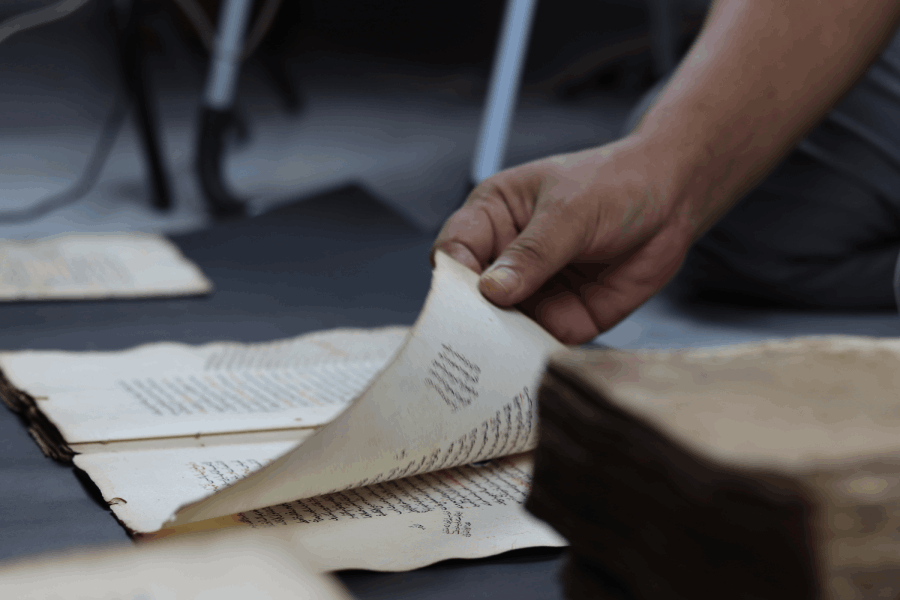
The collection spans 15th-century illustrated manuscripts to unique texts from the 19th century, covering religion, literature, medicine and culture, in Prakrit and Sanskrit, Gujarati, Rajasthani and early Hindi scripts.
Among them is a unique and powerful early example of the Indian independence movement’s ethical principles that Mahatma Gandhi drew on and made famous. The document heavily critiques the foundations of British colonial rule of India.
Other manuscripts include a “rare and magnificently illustrated,” early 16th-century copy of an important Jain scripture called the ‘Kalpasutra’; and a slim, fragile and battered paper manuscript dated 1688–possibly the earliest surviving copy of the first medical treatise in early Hindi, Nainsukh’s ‘Vaidyamanotsav’ (‘A Celebration of Physicians’), 1592.
Under the agreement, the collection will initially be moved to the Dharmanath Network in Jain Studies at the University of Birmingham, which will open it to researchers and faith communities best placed to read, interpret and translate the content for a global audience.
“Wellcome Collection’s brave decision to return these 2,000 sacred manuscripts is both pioneering and a model for other faith communities,” said Mehool Sanghrajka, Managing Trustee of the Institute of Jainology.
“We recognise that some of these manuscripts may not have survived the turmoil in India post-independence, and we are grateful to Wellcome for the care and respect they have shown these texts,” he said.
The institute said that rather than judging historical events with modern eyes, it is important to find ways through collaboration to “transform Jain scholarship and research and give the community access to its cultural heritage.” “We look forward to our collective efforts in ensuring these treasures are accessible to future generations,” he added.
A memorandum of understanding (MoU) was signed this week between the Wellcome Trust for Wellcome Collection, the Institute of Jainology and the University of Birmingham, with a full legal agreement to be subsequently drawn up.
“We thank the Jain community for our work together on this landmark restitution, through which we have formed a strong and lasting bond,” said Daniel Martin, Associate Director of Collections & Digital at the Wellcome Collection.
“We have set the bar high for a collaborative and compassionate approach to restitution that recognises the hurt caused by unethical acquisition and retention of material heritage.
“Wellcome Collection’s vision is a world where everyone’s experience of health matters. We share Jain principles of moral and spiritual health in realising that vision as we continue to interrogate the historical origins and ethical health of our collections,” he said.
According to the museum, more than half of the material at the Wellcome Collection was acquired during the colonial era for British entrepreneur Sir Henry Wellcome from a single Jain temple in Punjab, which no longer exists.
“They were bought at a low price and against the best interests of their original owners. The agreement demonstrates Wellcome Collection’s commitment to supporting a more equitable future through the inclusive, collaborative and ethical management of its collections,” the museum said.
As the first research institution in the UK to be wholly financed by Jain communities in the UK, US and India, the Dharmanath Network in Jain Studies was chosen as the most appropriate place to maximise community access, deepen research opportunities and safeguard the future of this significant collection.
Dr Marie-Helene Gorisse, the Dharmanath Network in Jain Studies Lead at the University of Birmingham, said: “By working together, we will make sure that the return of the manuscripts by Wellcome Collection to the Jain community has maximum impact for students, researchers, members of the community, and for the general public.” The collection was mainly catalogued in the early 2000s by Dr Kanhaiyalal Virji Sheth and Dr Kalpana Sheth, facilitated through the Institute of Jainology, and the museum said those notes will be made accessible on its website as part of the agreement.
“Research is often the first step in uncovering the histories of objects held in museum collections, so we’re proud that support from a Headley Fellowship helped make this important work possible,” said Jenny Waldman, Director of the Art Fund, which backed the initial research and scoping of the restitution programme.
Wellcome Collection is a free museum and library that explores the past, present and future of health through its historic collections, exhibitions and events.
Except for the headline, this story has not been edited by The Telegraph Online staff and has been published from a syndicated feed.