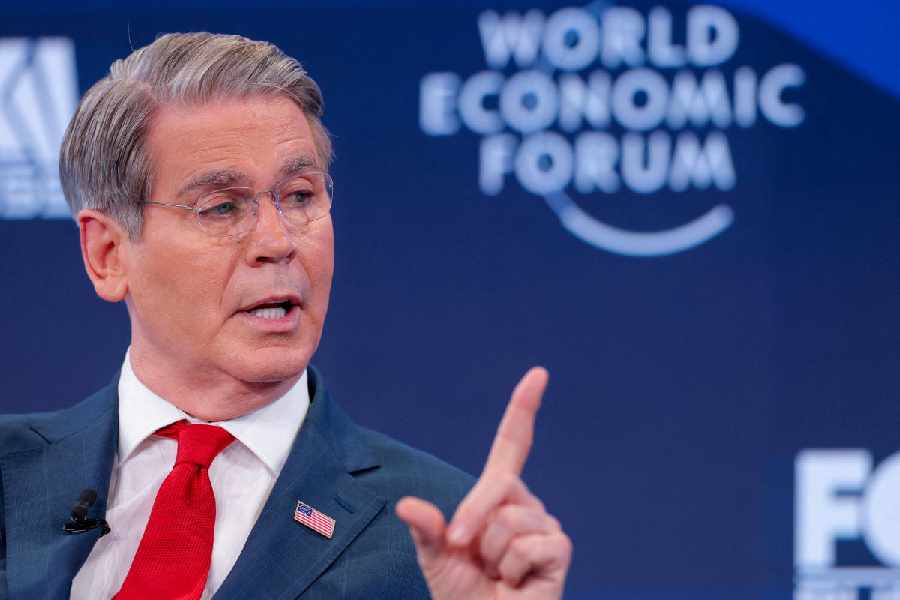
U.S. Treasury Secretary Scott Bessent on Tuesday urged Europe to “sit back” and avoid retaliation as tensions escalated over President Donald Trump’s ambition to take control of Greenland, a move almost unanimously rejected by Europe.
Speaking at the World Economic Forum in Davos, Bessent appealed for restraint, telling allies to keep “an open mind” as Trump prepares to outline his position.
“I tell everyone, sit back. Take a deep breath. Do not retaliate,” Bessent said. “The president will be here tomorrow, and he will get his message across.”
Bessent sought to project calm on the transatlantic relationship, insisting the Nato alliance “has never been more secure” and signalling Washington’s intent to proceed with a trade deal with Europe despite the political storm.
He also defended the strength of the US economy, saying growth was likely to accelerate, deregulation was beginning to boost output, and real income growth would be strong this year.
The administration, he added, was on track to cut the US deficit to 3 per cent of GDP by the end of Trump’s term, with little chance of the Supreme Court striking down the president’s signature economic policies.
Earlier, Trump had imposed 10 per cent tariffs on several European countries, including Denmark and France, from February 1, 2026, with a threat to raise them to 25 per cent by June if no agreement is reached over Greenland.
French President Emmanuel Macron struck a different tone at Davos as he warned against intimidation and unilateral pressure.
“We do prefer respect over bullies,” the French president said on Tuesday, underlining Europe’s commitment to the rule of law. “Europe may be slow, but it is predictable and has rule of law, which is an advantage these days.”
Without naming Trump, Macron cautioned that it “doesn’t make sense to threaten allies with tariffs” and warned that Europe could be pushed into deploying its Anti-Coercion Instrument, the bloc’s most powerful trade retaliation tool, against the United States.
“The crazy thing is that we can be put in a situation where we will have to use the anti-coercion instrument towards the US,” he said.
Macron also called for unity, saying Europe should not accept “a global order that will be decided by those that claim to have the bigger voice,” and pledged that the continent would work towards becoming a “stronger Europe” by 2026.
The Davos exchange comes against the backdrop of a sharp public spat between Washington and Europe over Greenland, a semi-autonomous Danish territory.
On Tuesday, Donald Trump posted a series of messages on Truth Social suggesting that Greenland and Canada were now part of the United States. In one post, Trump appeared with Vice President J.D. Vance and state secretary Marco Rubio, with the trio shown hoisting a US flag in Greenland. A sign placed nearby read: “Greenland, US territory, EST. 2026.”
Denmark Prime Minister Mette Frederiksen has said, “I will not abandon GreenIand. We are in dialogue with allies in Europe and other places 24/7. We are proposing a more permanent presence in the arctic in line Baltic sentry. The Americans have known about our increased presence in the arctic all along. I hope that we can avoid measures such as the bazooka.”
Frederiksen also said that a trade war among allies was a bad idea.
Earlier, Bessent defended Trump’s fixation on the Arctic island by citing future security threats from Russia, arguing that bringing Greenland under US control would ensure “peace through strength” and avoid conflict. He claimed the US projected strength while “Europeans project weakness”.
The official French foreign ministry response account compared Washington’s logic to burning a house to prevent a future fire or ramming a car to avoid a potential crash, drawing widespread attention online.
French finance minister Roland Lescure has since warned that any US move on Greenland would jeopardise EU-US trade ties, stressing that Greenland is “a sovereign part of a sovereign country that is part of the EU”.
He said the message had been conveyed directly to Bessent, even as he acknowledged Europe’s need to work with the US on shared priorities, including reducing dependence on China for rare earth minerals.
Trump has argued that the US has been “subsidising” Europe for centuries and that Denmark must “give back” in the interest of world peace.
Macron has already vowed that “no intimidation nor threat” will influence the European Union “nor in Ukraine, nor in Greenland, nor anywhere else in the world”.
Eight European nations have issued a joint statement expressing full solidarity with Denmark and the people of Greenland.