A hand stencil on a cave wall in Indonesia dating back at least 67,800 years is the world’s oldest known rock art and adds to evidence that modern humans had reached India and Southeast Asia about 65,000 years ago on their way to Australia.
Researchers announced on Wednesday that mineral layers over a hand stencil in a limestone cave on Muna island in southeastern Sulawesi suggest it is at least 67,800 years old — slightly older than a 66,700-year-old Neanderthal hand stencil
in Spain.
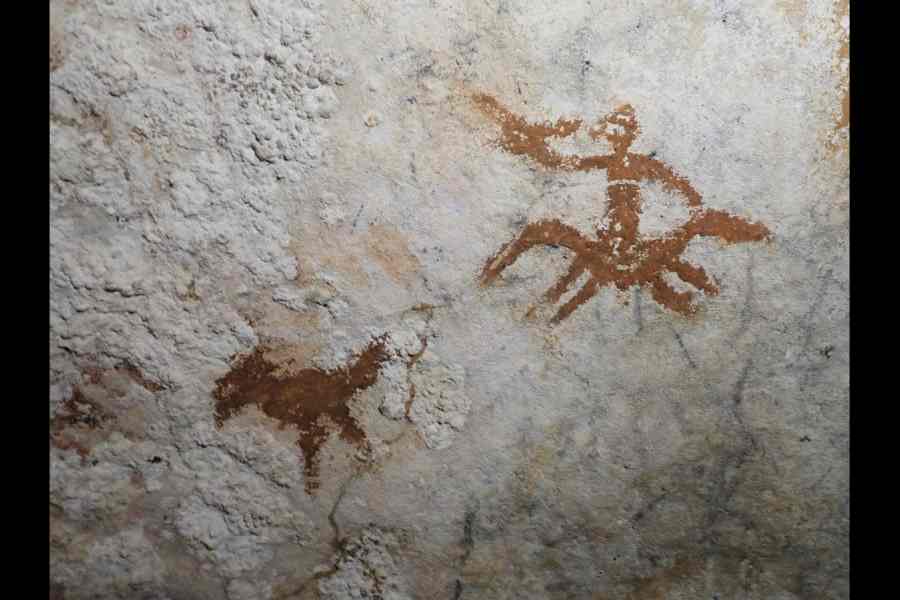
The Muna island hand stencil, distinguished by its antiquity, is among more recent painted cave art elsewhere in Sulawesi, including 13 more hand stencils, seven paintings of animals, and three paintings with human-like figures dated from 51,000 years to 4,000 years ago.
The collection of cave art suggests that Sulawesi hosted “a vibrant and long-standing artistic culture” during the late Stone Age, the researchers from Australia and Indonesia said, describing their findings in the journal Nature.
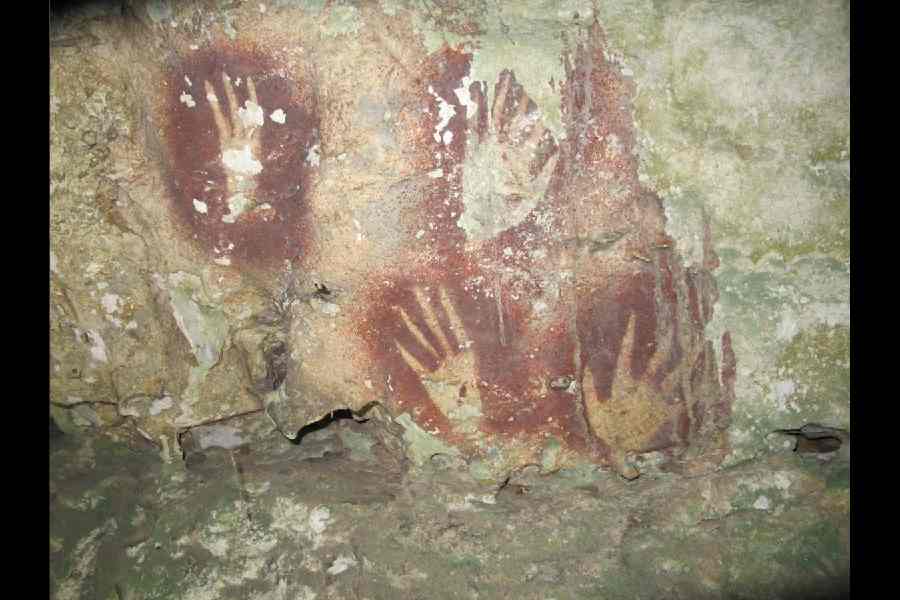
Narrowed finger hand stencils from another Sulawesi site. Credit: Ahdi Akus Oktaviana
“This was not a casual activity,” Maxime Aubert, an archaeologist and geochemist at Griffith University in Australia who led the study, told The Telegraph. “The fact that painting continued in the caves over tens of thousands of years suggests that this was a long-lasting tradition passed down generations.”
In the oldest hand stencil, the artists had reshaped the tips of the fingers to make them look pointed, creating the impression of a claw-like hand. Other images showed human figures with bird heads and other animal features.
Together, Aubert said, the artwork suggests that the artists were capable of representing complex symbolic ideas. “The cave paintings suggest they were marking places that mattered to them and expressing ideas about identity, belonging, or relationships with the natural world,” he said.
The Muna island hand stencil’s antiquity adds to evidence from earlier genetic studies that modern humans migrating out of Africa reached Australia by about 65,000 years ago, moving over generations through the Indian subcontinent and the islands of Southeast Asia.
The findings also have implications for a long-standing archaeological debate about the timing of the first human occupation of Australia.
Most archaeological evidence and genetic studies on Aboriginal Australians and Papuans had suggested that modern humans arrived in Australia only about 50,000 years ago. But stone tools found at a single site, Madjedbebe, in northern Australia had pointed to a human presence as early as 65,000 years ago.
“The new cave art date on Australia’s doorstep supports the earlier chronology,” Aubert said.
The discovery also sheds light on the route humans likely followed from mainland Asia to Australia, a passage that, together with the early settlement of the Andaman and Nicobar Islands, marks one of humanity’s earliest long-distance sea crossings.
Earlier researchers had proposed two candidate routes: the “northern” route from mainland Asia went through Borneo, Sulawesi and Papua to reach Australia, while the “southern” route passed through Java and Bali to reach Australia.
“We now have the oldest direct evidence for the presence of modern humans along this northern migration corridor,” said Rennaud Joannes-Boyau, a geoarchaeologist and study team member at the Southern Cross University in Australia.