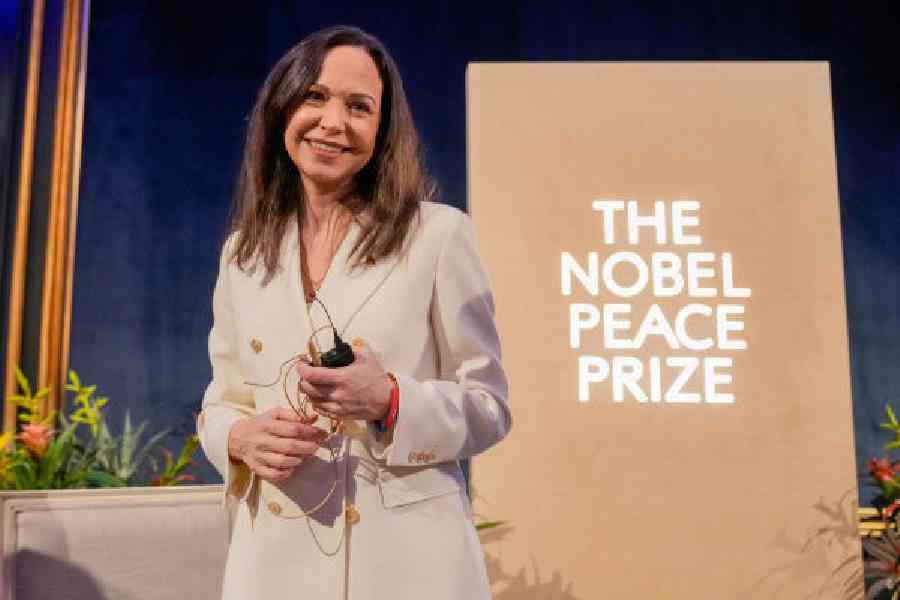
The Venezuelan Opposition leader María Corina Machado was determined to make it this week to Oslo, where she hoped to accept the Nobel Peace Prize in person.
Emerging from hiding and finding a safe route to Norway would require skirting military checkpoints, enduring hours of rough seas, and making a leap of faith that no US drone strike would obliterate the small vessels smuggling her to a Caribbean island where a private plane was waiting.
She arrived in Norway too late for the prize ceremony. But her perilous escape exhilarated her supporters and underscored how Machado — who spent the last year in hiding from the regime of President Nicolás Maduro — remains a key player in the intensifying standoff between Caracas and Washington.
The emerging details of her evacuation have also shed light on the usually secretive operations of a company run by US veterans with special operations and intelligence training, who orchestrated the effort to slip one of Venezuela’s most recognisable political figures out of the country without getting caught.
“We were not the first people to try this,” Bryan Stern, the combat veteran who leads the firm, Grey Bull Rescue, said in an interview. Machado’s rescue was the 800th for his Tampa-based group, which was organised in the wake of the chaotic US withdrawal from Afghanistan in 2021, he said. But it posed a unique challenge, even for operatives with long experience in being hired to evacuate clients from risky environments.
“All of our infrastructure is designed for nobodies, and Maria is a somebody,” said Stern. “The challenge with this operation was her.”
Venezuelan operatives had been trying for months to devise a way to spirit Machado, 58, a former lawmaker and election-monitoring activist who gained renown for uniting Venezuela’s fractious Opposition to challenge Maduro, out of the country so she could make it to Oslo. But it was not until last Friday that a personal contact introduced Machado’s team to Stern, he said.
Grey Bull Rescue had spent the last few months working from a base in Aruba to expand its Caribbean operations, anticipating that as the Trump administration escalated a pressure campaign on Venezuela, its extraction services would be in demand. The firm dubbed Machado’s rescue operation Golden Dynamite — gold, for the 18-karat medal Machado would be awarded, and dynamite, in homage to the most famous invention of Alfred Nobel, who established the prize.
Four days later, Machado, wearing a disguise, set off on her journey.
The first leg of her escape was by land. Machado and her handlers had to travel from the suburb of Caracas where she had been hiding out to a coastal fishing village. Along the way, they encountered 10 military checkpoints, Stern said.
Then came an even dicier part. On Tuesday evening, at about 5pm (local time), a fishing skiff carried her from the coast of Venezuela to another boat where Stern was waiting. Using a series of vessels, they spent more than 10 hours navigating choppy waters and high waves as they crossed the Caribbean Sea, heading to the island nation of Curaçao.
Whipping winds, turbulent waters and dark skies posed only one set of problems, however. The stretch of sea they traversed had been under heavy US military surveillance, as the Trump administration accelerated efforts to counter international drug trafficking by carrying out military strikes on the boats of people suspected of smuggling.
They reached Curaçao, disembarking in the wee hours of Wednesday morning. About three hours and a much-needed shower later, Machado was safely nestled in a private plane, wheels up and bound for Oslo.
New York Times News Service