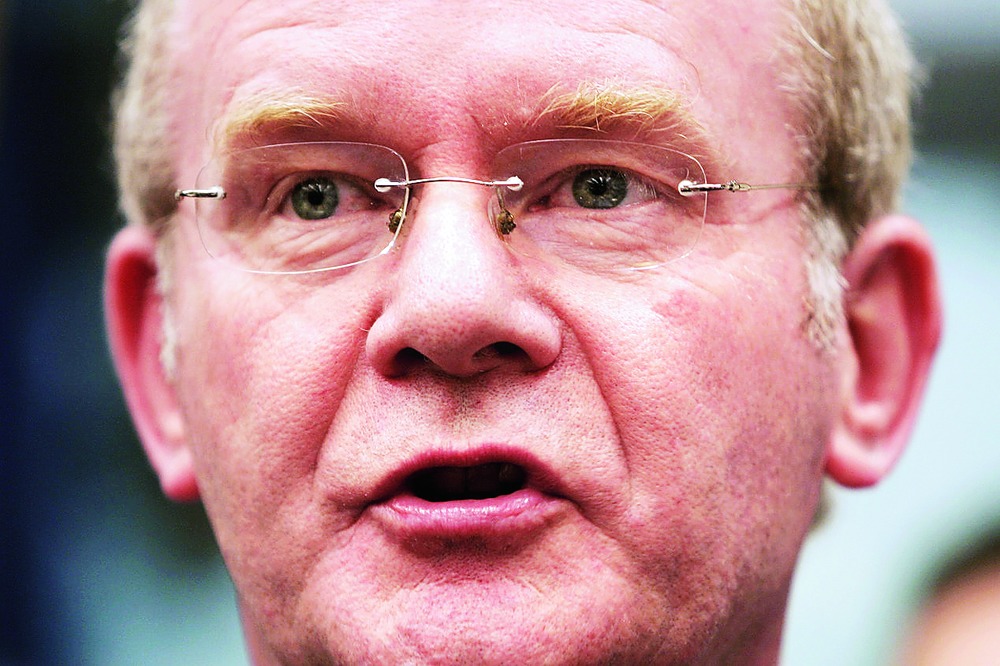

London, March 21: British politics witnessed an extraordinary development today as friend and foe united to pay tribute to former terrorist turned avowed peacemaker Martin McGuinness, who died last night, aged 66.
Those who know the history of Northern Ireland have no doubt that McGuinness, who was a commander with the Irish Republican Army, had blood on his hands.
Yet, politicians of all parties today recognised the "Good Friday Agreement" - signed in Belfast on Good Friday, April 1998 - could not have been achieved without active backing for the idea of a peaceful settlement from McGuinness.
This brought to an end over a century of a bloody civil war between Republicans and Unionists in Northern Ireland. The former had fought to unite Northern Ireland with the Republic of Ireland. The latter were determined that Northern Ireland, which had a Protestant majority, would forever remain part of the UK and never be swallowed up by the Republic with its Catholic majority. This was the time of the bomb and the bullet, despite the British army being deployed to Northern Ireland in 1969.
In the end there was a power sharing agreement under which two sworn enemies, the late Rev. Ian Paisley, of the Democratic Unionist Party, and McGuinness, of Sinn Féin, the political wing of the IRA, agreed to work together. The former became First Minister, the latter deputy First Minister in the Northern Ireland Assembly based in Stormont. They even became friends.
Paisley's son Kyle tweeted today: "Look back with pleasure on the remarkable year he and my father spent in office together and the great good they did together. Will never forget his ongoing care for my father in his ill health."
McGuiness, who was diagnosed with a rare heart condition at the end of last year, died in hospital overnight in his home city of Londonderry surrounded by family members. Sinn Fein president Gerry Adams paid tribute to his lifelong friend."He was a passionate republican who worked tirelessly for peace and reconciliation and for the reunification of his country," he said.
Prime Minister Theresa May commented: "While I can never condone the path he took in the earlier part of his life, Martin McGuinness ultimately played a defining role in leading the republican movement away from violence. In doing so, he made an essential and historic contribution to the extraordinary journey of Northern Ireland from conflict to peace."
Former Prime Minister Tony Blair confirmed that the peace process would not have been possible without the "leadership and courage" shown by McGuinness.
The Labour leader Jeremy Corbyn said: "Martin played an absolutely crucial role in bringing about the Good Friday Agreement and a peace process which, despite difficulties, remains an example throughout the world of what can be achieved when the will is there."
In June 2012 the unthinkable happened: the one time terrorist and the Queen met at a charity event in Belfast and shook hands.
A few years later McGuinness paid tribute to the Queen for meeting him.
"I liked her courage in agreeing to meet me, I liked the engagements that I've had with her. ... I like her," he told a BBC documentary.
Former US secretary of state Hillary Clinton described the handshake as "the most remarkable sign of change yet" in the Northern Ireland peace process.
In 1976, during the height of the Northern Ireland "troubles", McGuinness had a visit from an unusual supporter - Hollywood star Jane Fonda.
After her visit Fonda continued campaigning for elements of the Republican cause. In 1981 she lobbied Margaret Thatcher to end the Northern Ireland hunger strikes.
She also sent a telegram imploring the Prime Minister to reclassify all Irish republican inmates as political prisoners.
Not everyone was forgiving towards McGuiness today.
Former Tory Cabinet minister Norman Tebbit said he hoped McGuinness would be "parked in a particularly hot and unpleasant corner of hell for the rest of eternity".
The peer, whose wife Margaret was paralysed when the IRA bombed the Grand Hotel in Brighton on October 12, 1984, during the Conservative Party conference, said the world was a "sweeter and cleaner" place now the former IRA commander was dead.
McGuinness is survived by his wife Bernie and four children.