Europe's record June heatwave continued to exact a heavy toll on Thursday, with Dutch authorities estimating around 480 excess deaths linked to last week's extreme temperatures, while firefighters in southern France battled fresh wildfires after weeks of scorching heat and drought.
The Netherlands recorded around 480 excess deaths during the week of June 22-28, according to Dutch health authorities. Most were among people aged 80 years and older, with the highest mortality reported in the south and east of the country, where temperatures climbed to nearly 40 degrees Celsius during the hottest June on record.
The latest estimate adds to the mounting toll across Europe. France has already reported at least 1,000 excess deaths linked to the same heatwave and warned that the final figure is likely to be higher. Most of those who died were elderly, while French media reported that funeral homes in Paris and surrounding areas struggled to cope with the number of bodies.
Beyond the loss of life, the prolonged spell of extreme heat has strained healthcare systems, disrupted infrastructure and left vegetation across parts of southern Europe tinder dry. The same conditions have sharply increased the risk of wildfires, with drought and strong winds creating an ideal environment for flames to spread.
That was evident in southern France on Thursday, where the largest fire swept through the Aude and Hérault regions, burning more than 900 hectares (about 2,200 acres). Up to 800 firefighters and 150 emergency vehicles were deployed to tackle the blaze.
Separate fires also broke out near Marseille. Two blazes were brought under control during the day, although firefighting operations continued as crews worked to extinguish the remaining hotspots.
Aude prefect Alain Bucquet said two additional Canadair water-bomber aircraft had been deployed, taking the number operating at the site to four.
"The idea is to bring the fire under control quickly because temperatures are rising and the wind is growing stronger," Bucquet told France Info.
The Aude region is regularly hit by wildfires and was the site of France's largest wildfire in decades last year. Officials warned that the outlook remained worrying, with no rain forecast after an early heatwave in May and another at the end of June. Weeks of exceptionally hot and dry weather have left plants and vegetation under severe water stress, while strong Mediterranean winds continue to heighten the fire risk.
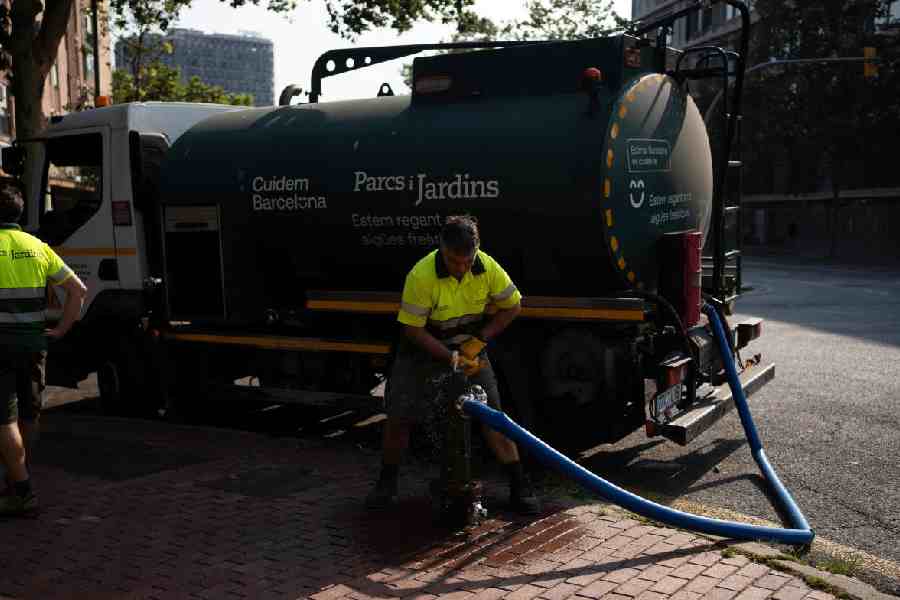
The extreme conditions are also prompting governments and local authorities to rethink how people work outdoors.
In Barcelona, city authorities have begun distributing around 1,400 heat-monitoring bracelets to employees who work outside, including street cleaners, park workers, lighting crews and waste management staff. The wearable devices monitor body temperature and emit a sound and vibration if they detect that the wearer may be at risk from the heat, requiring workers to stop immediately.
Pep Llimona, prevention coordinator for Barcelona's parks and gardens service, said the initiative formed part of the city's effort to adapt to "increasingly aggressive" climate change. Spain, which recorded more than 1,000 excess deaths in June amid successive heatwaves, is preparing for another spell of extreme temperatures this weekend.
The move follows several heat-related deaths among outdoor workers in Spain in recent years. In Barcelona, a 51-year-old street cleaner died last June after working in temperatures of 30.4 degrees Celsius. City officials said at the time they would investigate the death, although a spokesperson said on Thursday there had been no indication that heatstroke was the cause. Llimona said plans to introduce the bracelets predated the incident but acknowledged it had accelerated the rollout.
Any respite from the heat may also prove temporary. Meteorologists have warned that temperatures are expected to climb again from early next week across parts of France, Spain, Germany, Italy and Switzerland.
Scientists have described the heatwave, which began on June 20, as the most intense ever recorded in Europe. They have also said it would have been "virtually impossible" without human-caused climate change, estimating that the exceptionally high night-time temperatures during the heatwave were around 100 times more likely than they would have been just two decades ago.