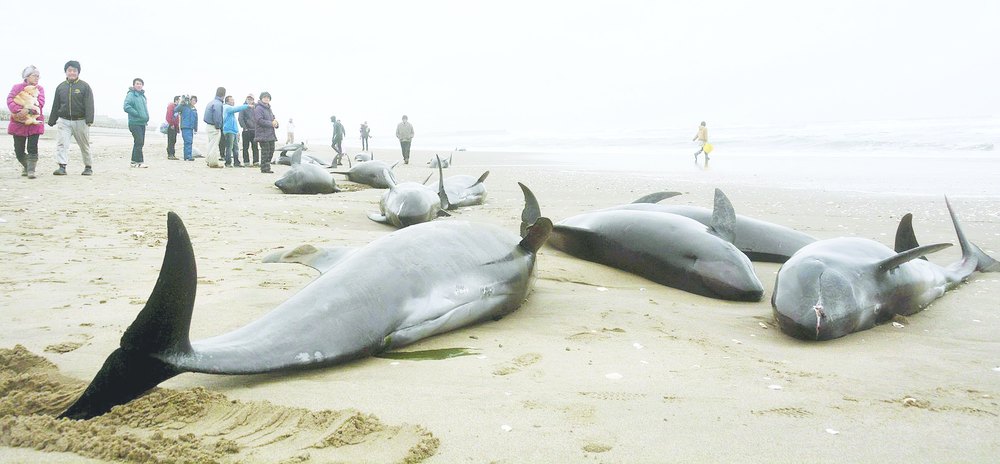

northeast of Tokyo. (Reuters)
May 1: Longer than a suburban front garden and twice the weight of a politician's battle bus, Steller’s sea cow was one of the most extraordinary sights in the remote waters of the north Pacific. The last of these gentle, lumpen creatures vanished in 1768.
Dozens of species of whales and dolphins may face a similar fate regardless of human persecution, scientists have claimed. An analysis of 23 million years' worth of fossils found that sea mammals are disproportionately likely to die out compared with other marine animals.
Researchers from the US, Canada and Australia said that the skeletal remains of mammals, sharks, molluscs and other animals were a strikingly consistent guide to which species were most inherently vulnerable to extinction.
Writing in Science, they said that even without hunting, pollution, climate change and other human interference, ocean mammal species were ten times more likely to die out than bivalves such as clams and mussels.
Like Steller’s sea cow, which lived off eastern Russia, animals whose habitats are confined to small patches of the sea are also particularly likely to disappear.
The biologists used the fossil records to determine that different groups of animals faced different risks of extinction, with mammals and sharks especially in peril and coral and mollusc species comparatively durable. They then superimposed a map of the dangers from human activities, such as whale hunting, to estimate the total risk to the various types of marine animal.
The researchers said the “intrinsic risk” was highest in the Tropics, but elsewhere it was more likely that humans had the heaviest hand in extinctions.
John Pandolfi, professor of marine studies at the University of Queensland, Australia, and one of the study’s authors, said: “We used these [fossil-based risk] estimates to map natural extinction risk in modern oceans, and compare it with recent human pressures on the ocean, such as fishing and climate change, to identify the areas most at risk.
“These regions are disproportionately in the Tropics, raising the possibility that these ecosystems may be particularly vulnerable to future extinctions.”