China got the world’s attention in January when it announced that its trade surplus for goods and services had hit almost $1 trillion, an excess of exports to imports that no country had ever reached.
Now China has surged through that milestone in just 11 months this year. China’s customs agency announced Monday that the country’s accumulated trade surplus reached $1.08 trillion through November.
Tariffs imposed by President Donald Trump on China have caused Chinese exports to the United States to drop by nearly a fifth. But China has throttled back its purchases of American soybeans and other products by almost the same rate, continuing to sell three times as much to the United States as it buys.
China’s $111.68 billion trade surplus in November was its third-largest in a single month. The overall surplus through the first 11 months of the year is up 21.7% from the same period last year.
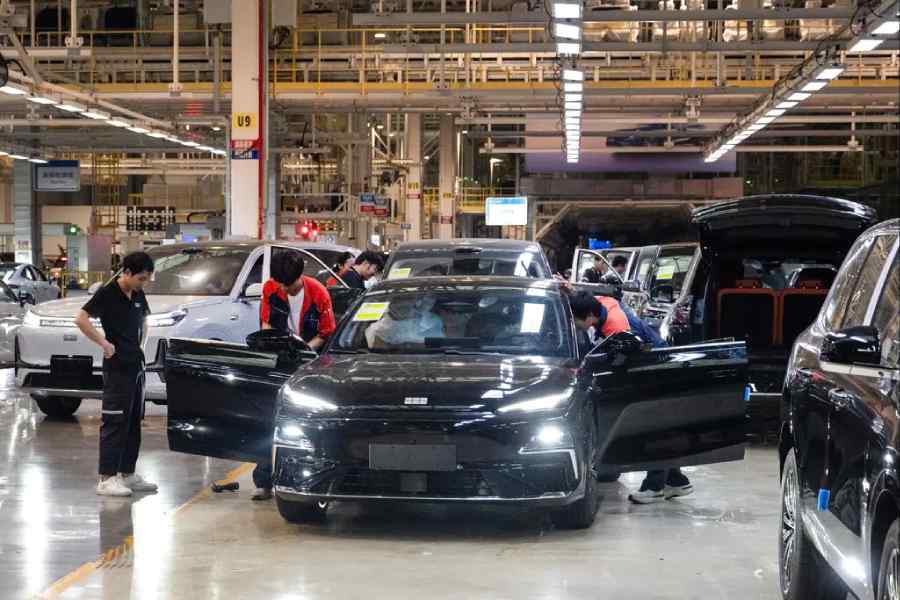
China has ramped up considerably its sales to other countries. From cars to solar panels to consumer electronics, a tsunami of Chinese exports is flooding Southeast Asia, Africa, Europe and Latin America. Carmakers and other exporters in traditional manufacturing powerhouses like Germany, Japan and South Korea are losing customers to Chinese rivals. Factories in developing countries like Indonesia and South Africa have had to curtail production or even close as they struggle to match China’s low prices.
Chinese companies have shifted final assembly of their goods to Southeast Asia, Mexico and Africa, which then ship finished products to the United States. This has allowed them to partly bypass Trump’s tariffs on goods coming straight from China.
China now sells more than twice as much to the European Union as it buys. China’s trade surplus with the region has widened considerably this year.
One major reason is that China’s currency has been weak over the past several years against many other currencies, particularly the euro. Another is that prices have been falling in China, while they have been rising in the United States and Europe.
The weakness of the Chinese currency, the yuan (also known as renminbi), has helped propel its exports. More than a tenth of the Chinese economy now consists of its trade surplus in manufactured goods. Europe has felt the sting sharply.
“With the renminbi undervalued by 30% against the euro, possibly more, it will be exceedingly difficult, if not impossible, to compete against Chinese manufacturers even if Europe does all the right things it needs to do in terms of deregulation, bringing down energy prices and establishing a true unified market,” said Jens Eskelund, the president of the European Union Chamber of Commerce in China.
China’s trade surplus in factory goods is even bigger as a share of its economy than the United States ran in the years immediately after World War II, when most other manufacturing nations were in ruins; or during the early years of World War I, when the United States was at peace and churning out civilian goods while Europe was embroiled in war.
Top leaders of the International Monetary Fund, which monitors economies with the aim of preventing crises, are making their annual visit to China this week to review its currency and financial policies and are expected to announce a preliminary summary of their findings Wednesday.
A growing number of economists and business leaders, including former senior officials at China’s own central bank, are calling on Beijing to let the yuan increase in value against the dollar and other currencies.
For China, a stronger yuan would make goods like gasoline, French wines or Japanese cosmetics cheaper to import. Savings on such purchases would leave China’s households with more money to spend on Chinese goods and services, like restaurant meals, concert tickets and electric cars.
Reviving consumer spending in China is one of the top goals of Beijing leaders. But doing so by allowing the yuan to strengthen would also carry costs for China.
A stronger yuan would hurt China’s exporters. The dollars they earn by selling goods in foreign markets would yield fewer yuan for them to pay workers and other expenses. Factories create millions of jobs in China, and a stronger yuan could slow the rate at which other countries transfer manufacturing to China.
China’s export success has also financed a boom in technological innovation and has given Beijing the resources to help other authoritarian countries when they encounter difficulties, notably Russia, North Korea and Iran.
China is trying to preserve its trade surplus by pressing other countries not to erect trade barriers. “Protectionism cannot solve the problems caused by global industrial restructuring, but will only worsen the international environment for trade,” Xi Jinping, China’s top leader, said Thursday, according to a Chinese government summary of his meeting with President Emmanuel Macron of France.
Some Chinese economists nonetheless say that China must someday accept a narrower trade surplus to help its long-suffering consumers.
“For China to expand domestic demand, it is necessary to minimize the trade surplus, and in the future it may even need to consider maintaining a trade deficit,” Zhang Jun, dean of the School of Economics at Fudan University in Shanghai, said in a speech last month.
The New York Times Services