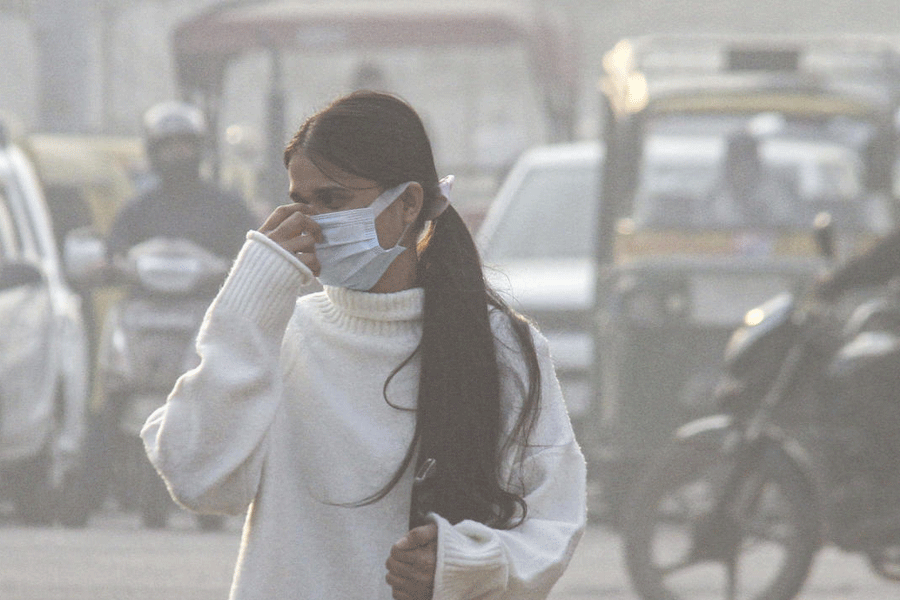
More than 13.5 million deaths due to air pollution could be avoided by 2050 under climate action that limits global warming to 2 degrees Celsius, mostly in low and middle-income countries, according to a new study.
Researchers, including those from The University of Texas at Austin, US, said that the amount of health benefits and how they are distributed across the countries would depend on how climate mitigation is shared globally.
The analysis, published in The Lancet Global Health journal, shows that under a least-cost approach, where emissions are cut wherever cheapest to do so, LMICs shoulder a significant share of the mitigation effort but also reap the largest air quality benefits.
However, wealthier nations bearing more of the climate mitigation effort under an 'equity-based approach' could result in LMICs paying less, but may avert nearly four million fewer premature deaths, because less fossil fuel reduction occurs where air pollution is the worst, the researchers said.
"We show that there is a difficult tension between international distributive climate justice and the goal of saving lives via air pollution co-benefits," said co-lead author Mark Budolfson, associate professor of philosophy and geography and the environment at The University of Texas at Austin, said.
"Within the current Paris Agreement climate regime involving Nationally Determined Contributions to global emissions reductions, shifting mitigation from poor countries to rich countries has the perverse effect of reducing the number of lives saved via air quality improvements in poor countries -- possibly by millions," Budolfson said.
The authors wrote, "Climate action to limit global warming to 2 degrees Celsius results in more than 13.5 million avoided premature deaths from air pollution between 2020 and 2050, mostly in middle-income countries."
The researchers modelled three scenarios - one through least cost, one that shifts mitigation burden towards higher-income countries (the "international equity scenario"), and a third one identical to international equity, but with LMICs also reduce air pollution to levels that occur in the least-cost scenario.
The third scenario was defined as an equity-based climate regime in which LMICs invest their mitigation cost savings into conventional air pollution controls, such as end-of-pipe technologies targeting soot, sulphur dioxide, and other pollutants, for example in the smokestacks of power plants.
The scenario emerged as the most favourable one, "delivering both the fairness benefits of shifting climate costs to wealthier nations and the full life-saving potential of cleaner air in the developing world", the researchers said.
The study found that for almost all LMICs, the savings from reduced climate mitigation costs more than cover the expense of these additional air quality measures, they said.
"There is an urgent need to design justice-centred climate mitigation regimes to ensure that developing countries do not miss an opportunity to realise transformative reductions in air pollution," co-lead author Noah Scovronick, associate professor at Emory University, said.
"We identify one attractive way of navigating this tension," Scovronick said.