 |
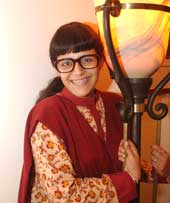
| Jasmeet “Jassi” Walia: Larger than screen life. Picture by Pradip Sanyal |
Who’s Mona Singh?” A 25-year-old stepped into a role on September 1, 2003, and we have to wonder whether she will ever step out of it. For, Jassi is proving that she is always Jassi.
And the earnest, sincere, hard-working employee of Gulmohar in Sony’s super-hit soap Jassi Jaissi Koi Nahin has seen one of her strongest audiences emerge in Calcutta. Huge amounts of fan mail and some of the top ratings have been recorded from here. The squealing girls who queued up to meet her on Wednesday and Thursday, were just the final proof.
Jasmeet Walia, the protagonist of Jassi Jaissi Koi Nahin believed to be model Mona Singh — mingled with fans across the city, from the Calcutta Book Fair to Funcity, where she met Jassi Pals, or those registered with her official fan club.
“I never thought Calcutta would be so rocking,” beams the girl in trademark glasses, salwar-kameez and braces (her own, which apparently was the role-clincher for the first-time actress). She was “mobbed” by groupies on Wednesday at Emami Landmark and at the book fair.
No wonder she was surprised: The daughter of an army man spent three years in the city as a child, and life couldn’t have been more different for her at the time. Adding fuel to the fan frenzy, she showed off her limited command over Bengali, winning every last one over.
It is easy to be impressed by this pretty girl behind the dowdy look, and her brand managers at Sony would have it no other way. Jassi off screen seems to embody everything Jassi stands for on screen, not in the least, complete dedication to her job. “I am happy to look like this,” insists the Pune-born girl who completed an MBA from Mumbai University before landing the role of a lifetime.
Her family is based in New Zealand and has not met her after the Jassi bomb exploded. “They still don’t know how big it is,” grins Jassi. Her friends, too, were shocked when they met her. “They didn’t know how to react. They said I had become a star.”
She is happy to be the new icon, bringing hope with her “simplicity and innocence” as opposed to the glamour, beauty and appearance young girls grow up with usually.
“Jassi symbolises success despite being beautifully challenged,” feels Albert Almeida, senior vice-president, marketing, Sony Entertainment Television. The decision to not show Jassi before the show launched was to “give people the opportunity to judge her not by looks alone”. Having created a loveable character, there is a concerted effort not to “drop the veil”, even now. But the “novelty value” of not knowing who Jassi really is will wear off, explains Almeida, and the incognito element will eventually cease to be relevant.
That is then. For now, the ploy has worked, as has the unconventional programme content. The bottomline as far as the beam battle goes: the TRPs have risen (Calcutta is known to have touched a peak of 9.2, over the Mumbai high of 8.7 and the 7.8 in Delhi) to be a real threat to the saas-bahu sagas on STAR and the rest.
Why are there no literary awards for Indian writing in English? That is a question being asked of the government by author and columnist Shobhaa Dé.
“The government does not recognise English as an Indian language. This is very discouraging. We have made English our own language, and writers writing in English should be given their due recognition,” states the lady who has hit the best-selling list more times than most writing in English.
According to Dé, this segment has really come up in the last decade. “Earlier, we didn’t have publishers ready to invest in these books. A market had to be carved out of nothing for these new and exciting voices, and pioneering publishers like Penguin deserve credit for that. They talk of the urban reality of India. Before that only R.K. Narayan wrote in English.”
But more and more writers are coming up who have chosen this medium. Dé has recently been roped in by Penguin India as a consultant editor for fiction. “My job will be to identify new voices. I have been doing that informally for years as I receive about 10 manuscripts every month, unsolicited. I take the trouble of reading them and pass the ones that I really like to the editors at Penguin. I will be doing that officially now,” she says.
The lack of interest of the urban middle class in fiction surprises Dé. “People do not mind forking out Rs 200 for a film annual or a ticket for a Hindi film in the black market. But they would not spend this money on a work of fiction in English,” the former editor of Stardust protests.
Even if non-fiction is topping the charts, she feels the two can coexist happily as they have a different audience. “Management, self-help, feel-good and cook books are the top grossers around the world, along with science fiction. Those of us who have chosen to tell our stories in our own ways need not despair. I can only see the market growing.” Neither is TV a threat and nor is the reading habit going down. “My royalty cheques from my backlist are just going up and I am talking of books over 10 years old. Obviously people are buying them,” she points out.
Dé complains that publishers do not invest enough in their writers. “In most houses, there is a low emphasis on marketing which is a vital part of the publishing programme. Without support, it is impossible to reach the audience.”
Though she missed visiting the Calcutta Book Fair on her packed two-day tour — launching a magazine one evening and a plantation programme the next morning before taking the flight back to Mumbai with industrialist husband Dilip — she describes a visit to the mela as the single-most exhilarating experience of her life. “It is very fulfilling for a writer to be at the Calcutta Book Fair. I have not felt such a high anywhere else in the world. It is the integrity of the readers here that makes the fair so special. Families save up the whole year through so that they have a budget to buy books. The respect they accord to writers can’t be found anywhere else.”
 |
| Indipop band Aasma performs at a programme at ITC Sonar Bangla on Tuesday evening to celebrate the addition of STAR News to the ABP Group. Picture by Aranya Sen |
Controversies have seldom cowed Mallika Sarabhai down. The dancer-activist retains enough energy to stay afloat, and tuned to her commitments, despite being dogged by the fraud charge. The long line-up of court hearings needs her attention, but so do choreography, dance recitals, rehearsals, TV production and a 13-year-old daughter.
Five days after the fraud case started against her, Mallika premiered Colours of the Heart in Ahmedabad, a multi-cultural dance piece featuring five women performers of Pakistani-British, Italian, French-Canadian, Tamilian and Gujarati origins. “I am raring to stage this show in Calcutta, where I just love to perform,” says Mallika.
The other show she has pinned much hope on is Inner Eye, improvised by French choreographer Karine Saporta. Along with the dancers of Darpana, her school for performing arts, Mallika is bound for France in April-May, before taking the piece to Turkey, Bulgaria and Hungary.
The frenetic pace of work is perhaps what keeps her so nimble even in her early forties. “While shooting for the Malayali feature film Danny, I was asked to slow down as a 75-year-old woman opposite Mammooty. But that’s me,” laughs the dancer. Three years after the Malayali hit, Mallika is eager to face the camera for Kaizad Gustad’s second project Mumbai Central in one of the lead roles. Six months from now, a feature film directed by Jayabrato Chatterjee should see her spending more time in Calcutta.
“But it’s the small screen which I enjoy the most. I think I am very good at it. There is a strong sense of immediacy in TV and I believe in making projects that blend entertainment with education,” she smiles confidently. And why not, after around 400 hard-hitting half-an-hour episodes on human rights issues amalgamating various genres, including music videos and chat shows, for Ahmedabad channels. Now, the dancer plans to go national with similar talk-based programmes and pack in even more punch.
• A face-to-face with executive director of Tata Sons Ltd. R. Gopalkrishnan, hosted by Millennium Mams on Saturday, at Saturday Club from 1.45 pm.
• Spring Fete organised by Nari Seva Sangha at its Jodhpur Park address, on Saturday and Sunday.
• The 8th annual intra-mural sports of Lakshmipat Singhania Academy at Fort William on Sunday.