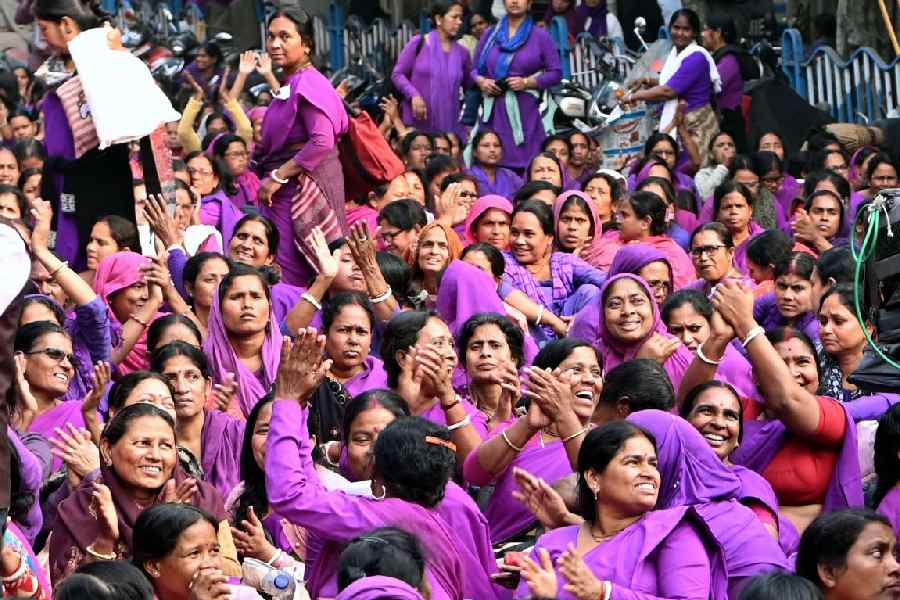
Bengal Police on Wednesday displayed unprecedented alacrity in preventing thousands of Accredited Social Health Activists (ASHA) from reaching Calcutta's Swasthya Bhavan, where they had planned to stage a demonstration for better pay.
ASHA workers are seeking a minimum salary of ₹15,000 a month, a three-fold hike from the current ₹5,250 that they get, recognition as government employees, insurance coverage, among other basic facilities.
ASHA workers heading to Calcutta from various districts alleged that they were stopped en route, yanked off buses and trains, detained at police stations and stranded on highways for hours to prevent any mass gathering against the state government.
Protesters said the police crackdown was especially undemocratic as senior health officials had earlier assured them of a meeting. ASHA workers had marched to Swasthya Bhawan on January 8 and again protested on January 12.
They said health secretary Narayan Swarup Nigam had assured them on January 8 that their grievances would be heard on Wednesday.
However, on Wednesday, at numerous places, cops allegedly seized the keys of many Calcutta-bound buses carrying ASHA workers and erected barricades around the vehicles.
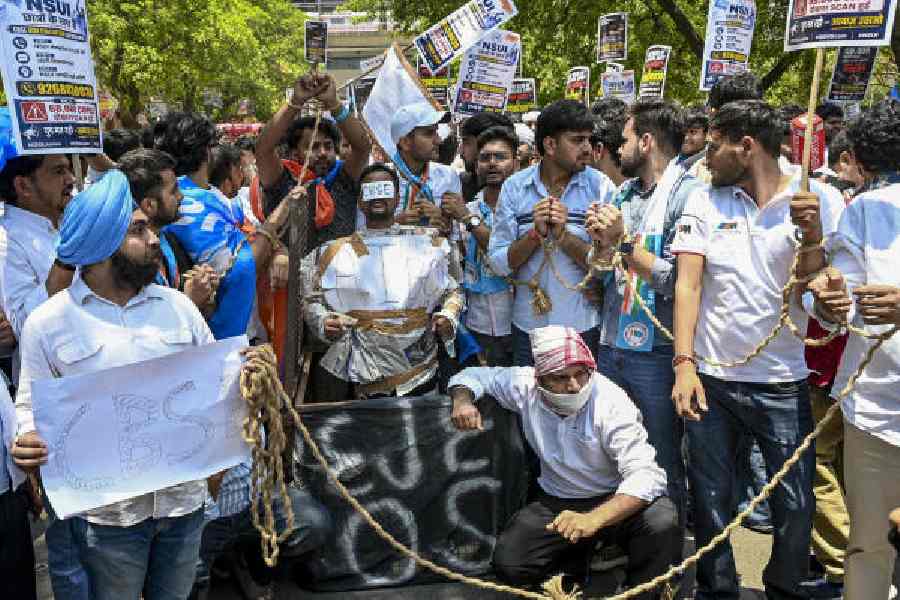
The grassroots health workers, who have been on "cease-work" since December 23, attempted to push past police barricades at multiple locations, leading to scuffles and chaotic scenes across the state.
The march to Swasthya Bhavan had been called by the West Bengal ASHA Karmi Union, affiliated to AITUC, the trade union wing of the CPI, to press an eight-point charter of demands, chief among them a fixed minimum honorarium of ₹15,000. The scale of participation, union leaders said, appeared to have unsettled the administration.
ASHA workers, mostly women aged between 25 and 45, serve as the backbone of grassroots public healthcare in rural Bengal as the primary link between communities and the health system. Their responsibilities include maternal and child healthcare, immunisation, disease surveillance, health awareness and the implementation of government-sponsored schemes. Yet, they receive ₹5,250 a month, which they say has remained unchanged for years.
The discontent over stagnant pay and lack of basic benefits led the West Bengal ASHA Karmi Union to announce the march to submit a memo to the state health administration’s headquarters in Calcutta.
But ASHA workers alleged they were blocked far from their destination to avoid "an embarrassing show of dissent".
“The police's role has been terrible,” said Nazma Khatun, 40, an ASHA worker from Kandi in Murshidabad, whose bus "was stopped by Ranaghat police at Ghatigacha on NH12 around 8.30am."
“We were dragged out and barricaded by police. There was a scuffle and two ASHA workers were injured,” she said, adding that cops "snatched the bus keys".
“I can't imagine that a movement for basic rights like wages can be throttled this way by a chief minister who claims to be women-friendly,” Nazma told The Telegraph.
Similar scenes played out across other districts and in Calcutta. Police erected barricades outside Sealdah and Howrah railway stations early in the morning to prevent ASHA workers from disembarking. Many ASHA workers were picked up by police vans.
Inside a police van in Calcutta, one ASHA worker said: “There are around 80,000 ASHA workers in the state like me. The police treated us like criminals. Mamata Banerjee will get a befitting reply to such an insult. Why, despite a promised meeting, did the state government go back on its word?"
Left outfits and the BJP slammed Mamata and her government.
CPM leader Sujan Chakraborty said: “Police atrocities have crossed all limits. The movement and demands of the ASHA workers are just. People of the state are with them. Is chief minister Mamata Banerjee trying to turn Bengal into a police state?”
Senior SUCI leader and Nadia South district secretary Anjan Mukherjee condemned the police action.
BJP leader Suvendu Adhikari accused Mamata of suppressing women’s voices. “The state has now reached the peak of oppression and lawlessness and raising one’s voice for genuine rights is considered treason here. Such oppression did not happen even during the British period,” he wrote on X, referring to ASHA workers as “Matrishakti”.
Trinamool leader and state deputy health minister Chandrima Bhattacharya alleged a political motive behind the protest. “There must be a political party behind this movement,” she said.