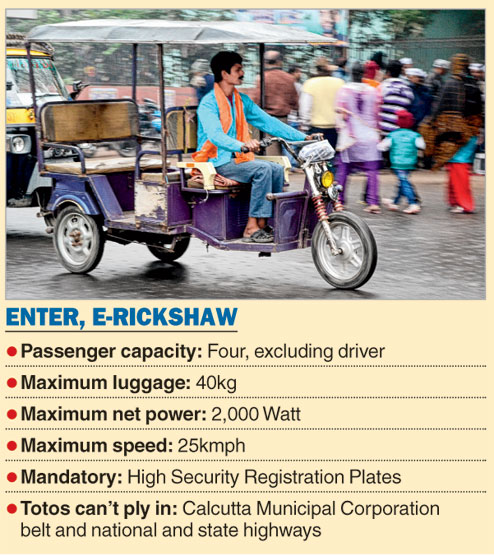

Bengal has decided to go the Bangkok way by legalising totos, a battery-operated version of the tuk-tuk that is already a common sight in Howrah and the northern and southern fringes of the city.
The decision to accord legitimacy to totos is in line with Mamata Banerjee's twin objectives as she trains her eyes on Assembly polls - tapping an easy source of mass employment and engaging the beneficiaries as foot soldiers of the party.
A notification to legalise e-rickshaws, the official name given to totos, is being sent to the district magistrates.
"Totos have been plying across the state without legal sanction. We have issued the notification to streamline their operation by registering these e-rickshaws, creating routes and making insurance mandatory," said an official of the transport department.
For those worried that a toto invasion would add to Calcutta's traffic chaos, the good news is that e-rickshaws and e-carts - the battery-operated alternative to small goods carriers - won't be allowed to ply within the Calcutta Municipal Corporation area and on national and state highways. But there will be no escape from anarchy on narrow roads, lanes and bylanes elsewhere as the newly legalised totos fight for road space from Salt Lake to Santiniketan.
"Totos are environment-friendly and they will increase options for passengers in urban centres across the state," the transport official said.
But what is being pitched as a transport solution by the government gives a feeling of déjà vu to experts in transport economics. They see the Mamata government's move as a repeat of what the Left Front had done in the Eighties by doling out autorickshaw permits.
The similarities are hard to miss as some of the more important decisions regarding e-rickshaws - routes, fares and the concentration of such vehicles in an area - would be taken by an association of these vehicles.
When the Left was battling the flight of capital and large-scale unemployment in the late Seventies and early Eighties, everything related to autorickshaws would be decided by Citu.
The Mamata regime has gone a step further as the government has authorised the toto operators' association to issue certificates, besides keeping them outside the purview of mandatory taxes till 2016.
"The Left had used its grip on the auto unions to build an army of foot soldiers. Trinamul will do the same.... The rules of the game are such that to become eligible to drive an e-vehicle, one has to be a Trinamul loyalist," said an expert on transport economics in a B-school in the city.
The attempt to politicise the process of legalising e-rickshaws is not the only concern. There are other factors that could have serious repercussions.
"There are proper mathematical models in place to study demand and supply. The decision to get the toto association involved in fixing routes, fares and the number of vehicles in an area seems to be flawed. We know how the auto unions made a mess of it," said Bhargab Maitra, an expert on transportation and research at IIT Kharagpur.
Questions are also being raised about whether the government would be able to enforce checks and balances such as wattage and vehicle speed after giving the toto association a say in almost everything.
Transport department officials said the move to legalise totos was the outcome of a central government decision to promote pollution-free vehicles in a regulated manner.
But the entry of totos might not be as smooth as many party leaders would like to believe.
"We need pollution-free vehicles but not at the cost of autorickshaws," said Ajit Chaudhury, a leader of the Citu-affiliated autorickshaw operators' union in north Calcutta. "We have already seen clashes between auto and toto operators in Bally and Barasat," he warned.