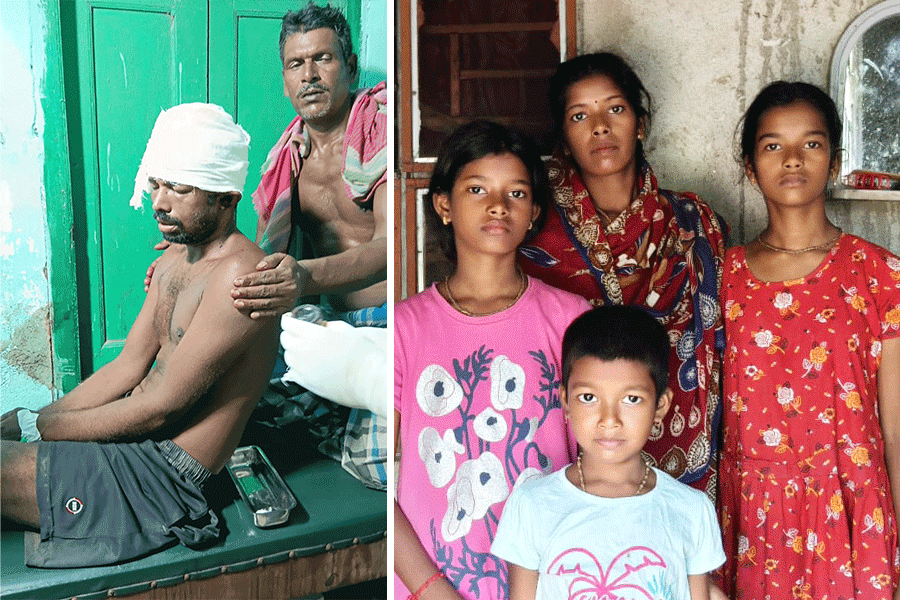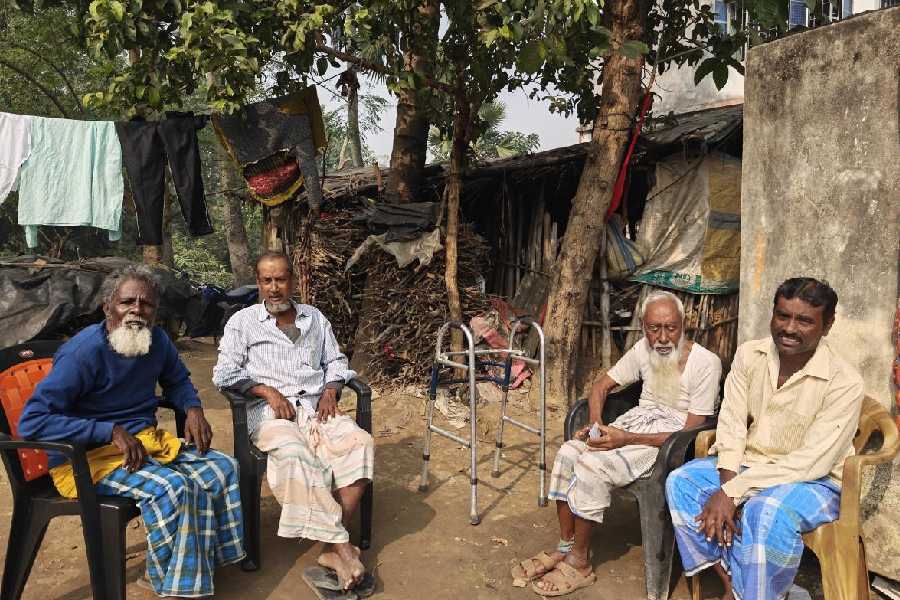
Sheikh Joynal Abedin, 85, was horrified when one of his grandsons showed him a video featuring his son.
It showed Sheikh Riyazul, 50, being assaulted in Calcutta, a city where Abedin had spent over 45 years selling chicken and vegetable puffs on the streets like his son, and where his father hawked cakes and bread since the 1930s.
“I was shocked because this wasn’t the same Calcutta where I had spent years,” the Arambagh resident, who now walks with support because of an injury to his right leg, said.
“I joined my father in selling bakery products on Calcutta’s streets when I was a 10-year-old. I never witnessed any such thing.”
Riyazul, the second of Abedin’s five sons, was forced to do squats and thrashed at a mass Gita recital on the Brigade Parade Grounds on December 7. His assaulters accused him of selling chicken puffs in the guise of vegetable puffs at the venue of the religious event.
Riyazul says he was attacked after he told his tormentors what he was selling and what his name was — he never sold them anything.
Multiple attacks were reported from the venue on several vendors, mostly Muslims, some for allegedly putting sliced onions in jhal muri. Three men, seen in assault videos, were arrested on Thursday but were granted bail shortly afterwards.
“My father told me that Calcutta was a city of love. When I grew up and took charge of my father’s profession, I realised how true his words were,” Abedin said, sitting in a chair at his home in Purba Keshabpur village on the banks of the Mundeshwari, 13.5km from Arambagh town in Hooghly.
“But for the first time in my life, I felt afraid when I saw the video of Riyazul’s assault.”
He said his father, Sheikh Shamser, had moved to Calcutta in search of a better income about 90 years ago.
“He owned a small bakery in Phears Lane whose products he sold on the streets. He later had to sell it off but never left Calcutta as long as he was able to work. I, too, spent my entire working life in the city, which helped me raise my five sons and five daughters.”
When this correspondent reached Rohina Para in Purba Keshabpur, traversing a dusty, 5km rural road from the Harinkhola bus stand, Abedin and two other elderly men were chatting in the small courtyard of Riyazul’s home.
Sheikh Lutfar, 65, and Sheikh Khairul Islam, 61, too sold cakes and other bakery products, including chicken puffs, in Calcutta before poor health forced them to return home. All three recalled vending their goods at popular sites such as the Brigade Parade Grounds, Eden Gardens, Babughat, Outram Ghat and the Salt Lake Stadium, among others.
“I used to sell at Bankshal Court, too — many Hindu advocates and barristers regularly bought from me. A few would place their order in bulk and ask me to deliver to their doorstep,” Abedin said.
Lutfar cut in: “Don’t forget the Hindu pilgrims who bought cakes and puffs from us at Babughat and Outram Ghat?”
Abedin nodded: “Durga Puja was the best time for us; we put up our boxes in front of popular pandals. No one ever asked me whether I was a Muslim.”
The neighbourhood where Riyazul’s family lives is locally known as Hawkers’ Para.
“We have 210 families in Rohina Para, and at least 150 are hawkers,” said Khairul, who sold his stuff across the Maidan — in front of the Victoria Memorial and, of course, on the Brigade Parade Grounds during political or apolitical rallies.
Khairul added: “You won’t find too many young people here -- most of them are away. Of the 150 vendors’ families, at least 100 sell bakery products like cakes, puffs and biscuits in Calcutta or nearby in Howrah or Hooghly.”
The attack on Riyazul has left many in Rohini Para worried about their safety, and not just those who ply their trade in Calcutta.
Sheikh Masoor, 54, who sells chicken and vegetable puffs in Konnagar, Hooghly, said he had returned home immediately after hearing about Riyazul’s ordeal.
“I came home to meet him and understand what actually happened. What I learnt was horrible,” he said.
“Earlier, we would never think twice before going to any gathering to sell. Now, I feel afraid. Who will protect us if someone attacks us at night? Who will look after my family if I become unable to work after such an attack?”
However, Masoor added, he must keep working as he has no other source of income.
Riyazul returned home on Wednesday, three days after the attack, mainly because his family — especially his younger son, Sheikh Safiulla — insisted. The boy had refused to eat until his father came home.
“I told them that staying here would only cause financial loss. But my wife and son wanted to see me. They want me to stay with them for a few days; then I will return to Calcutta,” Riyazul said.
His fears have, however, deepened after learning that the alleged attackers have lodged a counter-complaint against him.
“They are claiming that I sold them chicken patties (puffs) while claiming they contained only vegetable stuffing,” Riyazul said.
“Why would I do that? I earn the same profit from both. I don’t know why I have been falsely accused. Now I’m worried whether I shall have to fight a legal case. I haven’t got the money to hire a lawyer.”
Riyazul said he planned to return to Calcutta next week and would feel safer if the police gave an assurance about the security of people like him.
As this correspondent was about to leave the village, Abedin said softly: “I want all vendors like my son to be able to sell their goods without fear. Calcutta is not a place of hatred, and what my son went through should never happen again.”