 |
Good morning Calcutta. Another Sunday, another new column. Is anything new left to tell? This city, a young city as far as cities go, has borne a crushing burden of history upon its back, and aged rapidly. But it is also one of nature’s great survivors, like a shuffling amphibian which is equally at home in land or water. A creature of strange beatitudes, and stranger histories.
Of all those who call this creature their home, many have become part of its official history. But there are those who the angel of history leaves well alone. These people are the true riders of the beast — they have spent so much time on its back that it is hard to imagine that they might have their own stories.
Unlike the figures of official history who rise and shine, their stories are still buried in the mud. Brief Lives is an attempt to recover such stories.
Today we will begin with a maker of dictionaries, but the following await their fortnightly turn: ring-master, hack writer, sexologist, baker, palm-candy maker, almanac writer, poetaster, serial killer, pehlwan, graffitist, stationer, hotelier, rocket launcher. The list goes on. These are people who make up our collective memory of the city. Without them there would be no Calcutta.
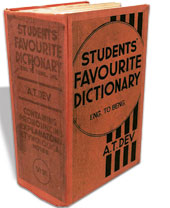
We start with the man who gave many of us our words. Breathes there the man who has not been given a diglot dictionary bearing the imprimatur of A.T. Deb at some stage? My childhood copy, bound in red cloth and thick as a brick, gave yeoman service till recently when it went the way of all pulp. The dictionary itself I did not use much, but the appendix was full of riches. As a child, I learnt the Greek alphabet from it, as well as cricket field-placing.
Who, then, was A.T Deb? He was born Ashutosh Deb Majumdar in 1867, to Barada Prasad, bookseller and publisher. Having raffled away his zamindari after a drunken night’s carouse, Barada Prasad started a new life literally ferrying books on his head. He may well have been the man referred to by the Church of England Magazine in 1860: “One man in Calcutta realises more than 100 rupees monthly by this employment”.
By the time Ashutosh was born, Barada Prasad had begun a press called BPM’s Press. It published books such as Ramani ratna (A slight novel representing a curious couple) and Ritumala. But its cheap staple was the academic cram or note-book, a field in which it has been a leader ever since. The first-ever note-book it published was in 1867, and was titled Subodhini. It was in two parts, and purported to be key to the Sanskrit Rijupath. The book was priced at seven annas.
Having inherited this business from his father, Ashutosh paid special attention to production values and the press soon began to make a name for itself. This was when he was bitten by the dictionary bug. There was no dearth of good dictionaries in Bengal, but Ashutosh’s dictionary bearing his own name proved to be a remarkably durable product, holding its own well into the 20th century.
In 1924, Ashutosh bought the rights of a large number of Ishwarchandra Vidyasagar’s textbooks, and shortly afterwards set up the Deb Sahitya Kutir. This was soon to become the leading publisher of children’s books in Bengali, a distinction it holds to this day.
When Ashutosh died in 1943, he left behind him not just the Deb Sahitya Kutir, but such ancillaries as the Barada Type Foundry, the Deb Library and so on.
Ashutosh was not the only A.T. Deb in 19th century Bengal. One must not confuse him (as does Wikipedia) with the Ashutosh Deb better known as Chhatu-babu and the brother of the equally famous Latoo-babu. The two brothers were involved in a range of judicial, philanthropic and cultural activities, but by a strange twist of fate history remembers this Ashutosh in the name of a market, Chatu-babur Bajaar, off Beadon Street.
This column will feature the lives and times of Calcuttans, real and imaginary, who are part of the city’s collective consciousness. The writer teaches English at Jadavpur University.