
The tree cover of Raj Bhavan or Government House, as it was known during British rule, did not exist till 1870.
In 1799, Lord Wellesley, then Governor General of India, took it upon himself to build the sprawling pile, and without the greenery that embraces it today, it was visible from the surrounding streets, although the six gateways were already in place.
Now, anybody who has walked past it cannot help noticing the wide variety of trees and creepers growing within its balustrated confines. It is said that the ululation of jackals can occasionally be heard from within the huge compound.
While that may be a pure canard, koyals do sing tirelessly inside Raj Bhavan. And that is not surprising, given the density of the tree cover there. The total area occupied by Raj Bhavan is 27 acres.
While the leafy borders of this magnificent building are for anyone to see, did you know about the "300 species of floral and faunal wealth" of the Governor's residence in Calcutta, as Keshari Nath Tripathi, the current resident, writes in his foreword to the recently-published book, Biodiversity of Raj Bhavan?
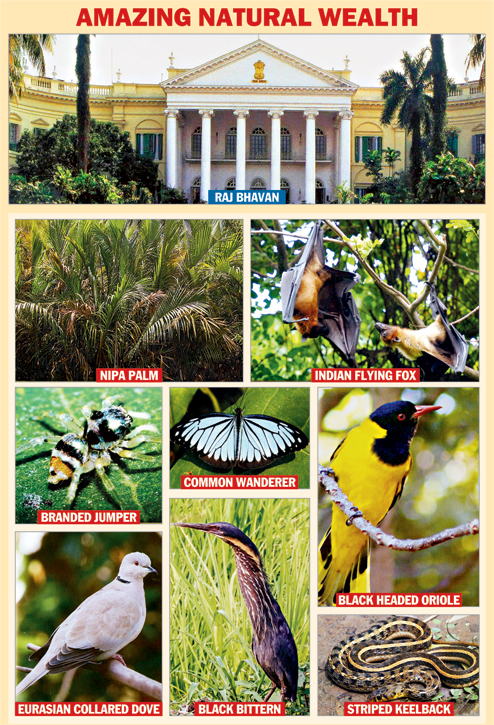
This is mainly a book of photographs of the vegetation and animal life within the compound with short notes on each plant, tree, animal, bird or insect featured. The dust jacket notes: This book encompasses 190 number of species of flora including macrofungi and 210 number of species of fauna of Raj Bhavan campus..."
The various heads under which the various species are itemised give us some idea of the astonishing bounty of nature: trees 76, shrubs 25, climbers and lianas 9, palms and bamboos 9, herbs 21, ornamentals 5, bryophytes 5, macrofungi 40, mammals 12, birds 59, lizards and snakes 11, toads and frogs 4, fishes 20, dragonflies and damselflies 15, grasshoppers and cricket 4, true bugs 6, beetles 4, flies and mosquitoes 11, butterflies and moths 32, ants and bees 12, spiders 6, earthworms 4, snails and slug 10.
The introduction says: "The Raj Bhavan Botanical Garden is marvellous in its layout, design, aesthetic beauty and above all, in its diverse plant wealth...The various seasonal flowers, varieties of roses offer a magnificent beauty, particularly in winter. However, the existing plants in the botanical garden represent a miniature natural vegetation giving rise to a unique ecosytem of its own inside the campus of Raj Bhavan. This naturalness of undisturbed plant communities of Raj Bhavan attracts a large number of butterflies, other insects, birds, and faunal members. The presence of some water bodies inside the garden are the reservoirs of a good number of fishes and other aquatic fauna..."
"The mangrove palm, Nypa fruticans, once widespread in some parts of the city... survives still today in the Raj Bhavan Garden."The contributors, going by their antecedents, are experts in their field. The editor-in-chief is Asok Kanti Sanyal, chairman, West Bengal Biodiversity Board, and the photo editor is Koushik.
Although the book is quite informative, particularly because of the images illustrating each entry, the design and editing are of a very poor standard, and the text is marred by typographical and grammatical errors. The printing quality is equally bad. But this is routine with all government productions. If only they had taken a little more care, this could have been a collector's item.