
Picture by Anup Bhattacharya
During World War II, when the Germans created the Warsaw Ghetto in Poland in 1940, a certain orphanage was forced to relocate from its building to a new building inside the ghetto. Janusz Korczak, a Polish-Jewish educator, paediatrician and a popular writer of children’s stories in Poland, had started the orphanage in Warsaw in 1912. It had its own small parliament, court and even a newspaper which was circulated as weekly supplement with a Polish-Jewish newspaper. After the orphanage shifted to a new address inside the ghetto in 1940, Korczak decided to stage Rabindranath Tagore’s Dakghar with the children of the orphanage. The play, relevant in those times, related to the confinement of the children within the ghetto.
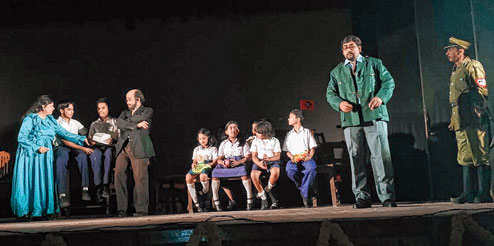
About 75 years later, in the lanes of Bally, a play, Shikarer Dana, based on Korczak’s life, his orphanage and how he trained the children to stage Dakghar, was staged at Bally Rabindra Bhavan on April 2. Members of Bally Sadharan Granthagar Karmisangha put up this play as part of 75th anniversary celebrations.
The script was written by Bally residents Amrita Mukhopadhyay and Pradipta Mukhopadhyay and the play was directed by Amrita. It was a period play and the members ensured that it had all the elements related to the time it was depicting. The coats and costumes belonged to the period of World War II as did the make-up. Lights, done by Barun Das and background music by Dilip Bhattacharya, heightened the effects of the plot. A number of Tagore’s songs were used in the play.
Apart from telling the story of Korczak and his orphanage in the ghetto, the play tried to highlight the suffering of children in present times. It referred to the mass killing of children across the world, in Pakistan or the US. “It was a very touching play. The way the children’s sufferings were highlighted brought tears to everyone’s eyes,” said Sarmistha Ghosh, a resident of Bally. The play was one of the many activities of the karmisangha organised through the platinum jubilee year.