 |
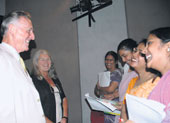
| Participants with Tony Murray and Lorna Hillman at the Ladybird workshop. Picture by Sanjoy Chattopadhyaya |
 |
What impressed us most here, is the keenness of the teachers. We met teachers who had travelled overnight to attend the workshop. Obviously it is because this is a society that still values education and values its teachers,? said Tony Murray in Calcutta on Thursday.
Tony and his sister Lorna Hillman (both educationists themselves) were here to conduct a workshop for teachers on the Ladybird Key Words reading and learning method developed by their father William Murray.
The two sessions, organised by Penguin Books India, were held at the Shripati Singhania Hall of Rotary Sadan, on November 10 and 11. A total of 230 teachers from 45-50 schools attended.
Forty years after the Key Words scheme was developed by educationist William Murray and educational psychologist J. McNally, it is still considered relevant and is finding an eager market in many countries.
In 1964, the first books of the Ladybird Key Words scheme entered the market. Beside the shoddy, badly illustrated books that had so far occupied the racks, the Ladybird books were a revolution. Murray had found that just 12 words ? a, and, he, I, in, is, it, of, that, the, to, was ? make up one quarter of all the English words we read and write. A hundred words make up half of those we use each day. So, he argued that if these key words are taught first, it is easier for children to learn to read.
?The books carried forward father?s own optimistic approach to education, his philosophy that children enjoyed learning things that interested them and were always willing to please teachers and parents,? explained Lorna, who had ?learnt English sitting on father?s lap?.
Till date over 90 million children have learned to read with Key Words, according to Camilla Hills, international marketing manager, Ladybird. Yet, there is a constant effort to upgrade and improve the scheme. ?Some teachers at the workshop have suggested that we change the illustrations and names of characters a bit so that Indian students can identify with them more easily,? explained Tony.
Ladybird has in 2005 added to the Read It Yourself series based on Key Words scheme, a collection of non-fiction books on subjects like Mummies, Inventors and The Body. ?By 2006 we hope to include titles which deal with specifically Indian subjects like festivals, food, rivers, etc,? said Lorna.
The Key Words series, today a total of 36 titles and counting, does not enjoy the same attention it once did in UK. ?Today schools in England are using other schemes, but we have an expanding readership in mainland Europe, Malaysia, Singapore, India, Sri Lanka and China. The system offers a secure step-by-step method which is very useful for those handling large classes of 45-50 students,? said Tony.
An unlikely wordsmith
Ever since his first book has been a fixture on the top ten list for more than a year, Chetan Bhagat has stuck to a simple formula as far as writing a best-seller is concerned.
?Plan a good story, test it on a few people, look at their faces and body language and if they are gripped by it, go ahead with your book.?
The best-selling author of Five-Point Someone ? What Not to Do at IIT was recently in town to promote his second book, One Night@the Call Center, where he stresses that ?big emotions don?t come from big words?.
That, more or less, sums up the philosophy of the IIT-bred, Hong Kong-based banker.
He can hardly be blamed for being steeped in literary history ? Joseph Heller?s Catch-22 is one of his favourite reads (with Amitav Ghosh and Samit Basu his Indian picks).
And he can hardly be accused of being reverential towards literary technique ? ?I don?t care much about language and style. The plot and characters are what people like to read about,? declares Bhagat, who is still not ready to call himself a writer.
 |
| Say this for Manisha Koirala, she has nothing to do with debut ? or comeback ? nerves. Rituparno Ghosh?s Khela may have been her first foray into Bengali films, and that too after a long lay-off, but she was ?completely relaxed? during her five-day shooting stint in town. The Bangali bou wrapped up her schedule with a trip to Kalighat temple on Saturday afternoon. Picture by Aranya Sen |
He will become a full-time novelist some years later, he says. As of now, he?s happy planning the plot through the week, writing over the weekend and taking long sabbaticals to meet the publishing deadlines.
If his alma mater had triggered off his debut, what has been the inspiration behind the second? ?Nothing significant,? shrugs Bhagat. ?The character of Shyam is much like me and the bad boss is someone I have come across in life.?
For One Night@the Call Center, Bhagat called up a string of ?cousins and their friends? employed at call centres in India. The 300-page book is built around a one-night incident when six employees of a call centre get a call from God.
?It (the book) is darker and has a little more suffering for the characters. It?s about ordinary lives. And it?s a complete U-turn from my first book,? says Bhagat.
Whether the U-turn has really gone down well with the readers is still not showing on the top ten list, but Bhagat feels it will touch a chord for the broader canvas it offers.
And also for his sense of humour which Bhagat feels is his ?competitive edge?.