 |
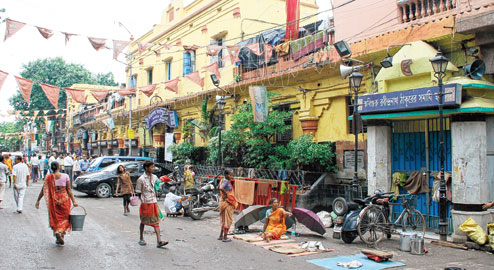
| The facade of the Nimtala burning ghat. Picture by Bhubaneswarananda Halder |
An intervention has come from unusual quarters to give the Nimtala Ghat, painted bright yellow and blue and fitted with bathroom tiles in the corridor, a muted look.
Union expenditure secretary Sumit Bose, who was shocked by the bright colour scheme during a recent visit to the ghat to cremate his father-in-law, worked informal channels to make it “aesthetically pleasing”.
The colours of the ghat are in stark contrast to the aesthetic sensibilities of Rabindranath Tagore, who was cremated there in 1941.
Bose, a 1976 batch officer of the Madhya Pradesh cadre now posted in Delhi and believed to be in line for the finance secretary’s post, got in touch with a fellow Bengali, the director-general of the Archaeological Survey of India, Gautam Sengupta.
“I was at the Nimtala Ghat for my father-in-law’s cremation. Since the culture ministry was celebrating Tagore’s 150th anniversary, I asked them to look at the place. It looked like it needed a bit of help,” Bose told Metro.
The Calcutta Municipal Corporation had in fact painted the ghat in bright colours as part of Tagore’s 150th anniversary celebrations. Now, after the end of the year-long celebrations, the civic body is looking for central help to repaint the ghat in more appropriate colours.
The Nimtala Ghat has attracted this kind of attention before. In 2010, the then shipping minister, Mukul Roy, wanted it to be renamed Rabindra Ghat after Tagore. The proposal fell through after opposition.
Among the other luminaries cremated at the Nimtala Ghat were Ishwarchandra Vidyasagar, Bankimchandra Chattopadhyay, Kaliprasanna Singha, Debendranath Tagore, Pyarichand Mitra, Dwijendralal Roy, Sukumar Ray, Manik Bandyopadhyay and Tarashankar Bandyopadhyay.