
 |  |
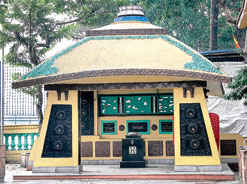
| The Tagore memorial now and (right) during the Left regime. Picture by Bhubaneswarananda Halder | |
After his death on August 7, 1941, Rabindranath Tagore’s last rites were held at the Nimtala burning ghat. On his first death anniversary, thousands of people gathered there to pay homage to him. But his memorial, Rabindrasmarak Bedi, was built 16 years later.
Its foundation was laid on August 7, 1956, and Suniti Chattopadhyay had presided over the ceremony. It was designed by Nandalal Bose and sculptor Sunil Pal and was inaugurated a year later by Tarashankar Bandyopadhyay. It was a simple ceremony and Bandyopadhyay lit a lamp to declare it open.
The Calcutta Football Committee had contributed Rs 6,000 to construct this aatchala-like structure. Its construction was delayed because this northern end of the Nimtala Ghat juts into the Hooghly and is buffeted by its currents. Cracks had developed at this end and although it is patched up from time to time, the problem persists.
The Calcutta Municipal Corporation is responsible for its upkeep, and after its inauguration it suffered neglect for years and had fallen into disrepute as well. Drunks used to hang out there, and those wanted to pay tribute to the poet had to brave the dirty lane leading to it. The structure was in a shambles, and in the late-1990s the public works department (PWD) started work on renovating it. Earlier, it used to be stark white, but under PWD care it bloomed as the body was painted cream and the floral motifs a garish red.
It was then that the courtyard was paved with marble slabs, and the compound of the memorial was fenced off. Terracotta tiles with floral motifs were used to embellish the memorial. Of late, it has been repainted a loud yellow and the floral motifs are sea green. The colour schemes change according to the dictates of the party in power. And that is not surprising as Milan Kundera had come to the realisation that “Kitsch is the aesthetic ideal of all politicians and all political parties and movements.”
On the eve of Tagore’s 150th birth anniversary in 2010, the Centre had announced a Rs 14-crore upgrade scheme for the Nimtala ghat, and the project included a scheme to beautify the memorial. Nothing seems to have come of it yet.
Ganesh Pyne feels that the structure should be declared a memorial of national importance, and after consultations with architects, it should be given a position of greater prominence and visibility.
Pyne has two suggestions on what its structure should be like: “It should be well-planned and remind us of an Indian temple like the memorials at the Keoratala burning ghat. Tagore’s memorial should have elements of ancient Indian temples. But Tagore did not belong to India alone. His vision embraced the whole world. We cannot forget that while designing the memorial.”