 |
The outer casing of the cables that hold Vidyasagar Setu together is crying out for maintenance after around two decades of bearing the load of heavy traffic, a report has highlighted.
A team comprising specialists in different fields such as cables, bearings and bridge structure recently submitted its report to the Hooghly River Bridge Commissioners (HRBC), an autonomous body responsible for the showpiece structure’s upkeep.
“It’s been almost 20 years and the cables play a crucial role in holding the load of this bridge. So, they need proper maintenance,” said professor Saibal Kumar Ghosh of the civil engineering department of Bengal Engineering and Science University, a member of the team.
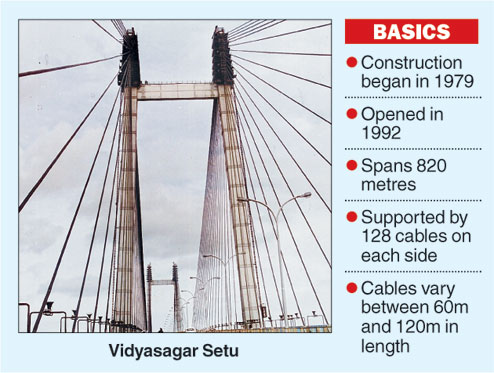
Vidyasagar Setu, also called the second Hooghly bridge, was commissioned in 1992 and is one of the longest cable-held bridges in Asia.
It has 256 cables holding the structure from both sides and meeting in a triangle, turning it into an architectural spectacle against the city’s skyline.
HRBC had commissioned the report after an internal review revealed that maintenance could be better. “We have had some problems in the absence of a detailed, long-term maintenance manual. So a team was formed to look into properly maintaining the bridge,” an official said.
Besides representatives of Besu, the team had officials of Consulting Engineering Services, the firm that designed the VIP Road flyover, and a bearing manufacturing company.
HRBC has fallen back on Schlaich Bergermann & Partner, the German company that designed Vidyasagar Setu, to suggest a maintenance plan based on the technical report sent to its Stuttgart headquarters. “Once the company sends us its report on the state of the cables, we will draw up a detailed maintenance plan,” the vice-chairman of HRBC, S.R. Banerjee, told Metro.
Experts said the condition of the outer casing of the cables was crucial to maintaining the stability of the bridge. “These are all specially made steel cables and each lies embedded in anti-corrosive material. An outer casing of high-density polyethylene pipes ensures the cables are not exposed to the elements.”
Sources said some of the cables’ outer casing had developed cracks because of natural wear and tear and exposure to sun and rain. There have also been incidents of trucks hitting the base of the cable anchorage. One such incident occurred six months ago.
“So far it has been mostly patchwork repairs such as welding the parts of the pier close to the base of the deck slab, where they remain anchored. The top section has largely remained unattended,” a senior official said.
The inspection report delves into the maintenance of specific parts of the bridge, including the girders, pier caps, expansion joints, decks, crash barriers and drainage.
“We have mentioned that some of the bearings need to be replaced. The underbelly of some of the deck slabs on the approach to the bridge need repairs too,” professor Ghosh of Besu said.