 |
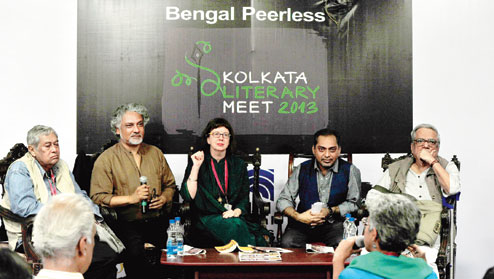
| Has the Coffee House lost its charm? Where are the argumentative Indians who kept it abuzz? (From left) Writers Belal Chowdhury, Kunal Basu and Deborah Baker, Chandrabindoo’s Anindya Chattopadhyay and poet Utpal Kumar Basu grappled with these questions and relived their memories at a session titled Coffee Houser Shei Adda Ta at the College Street landmark on the last day of the Kolkata Literary Meet. “I used to come here to eat. Ekhane ekta tomato omelette pawa jeto, osadharon (the tomato omelette that used to be served here was exceptional)! It is like a temple which you must visit to be tagged an antel,” said Chattopadhyay. The session ended with him singing the Pulak Bandhopadhyay-written song that gave the session its name |
Leading lights
Gandhi called him the “prince among patriots”, Tagore anointed him “deshnayak”. One hundred and sixteen years after his birth, Netaji remains the most revered hero of the Bengalis. This and more were discussed by historian Sugata Bose and his mother, academician Krishna Bose, with translator Semanti Ghosh at the Kolkata Literary Meet on Saturday evening in the session “Boroniyo kara?” on the Bengali icons of the past 100 years.
Sugata Bose, who is Netaji’s grandnephew and the author of His Majesty’s Opponent: Subhas Chandra Bose and India’s Struggle Against Empire, spoke about how Rabindranath Tagore found in Subhas the national leader he had been searching for.
Chittaranjan Das, whom Tagore had christened “deshbandhu”, had a profound influence on Netaji, according to the historian.
Krishna Bose said despite hardships and Gandhi’s opposition to Netaji, the members of the INA never lost faith in their leader. “He had an electrifying effect. His call for duty to the motherland came from within. They truly believed that Netaji could bring them freedom,” she said, adding that even today she was moved by the devotion of the descendants of INA officers in Lahore or Rawalpindi to Subhas.
“What would have happened had Netaji managed to march to India via Burma? What if Netaji had become Gandhi’s deputy and not Nehru?” Semanti wanted to know from Sugata, her former teacher. “It’s evident I haven’t been able to teach my former student anything against speculation,” he laughed and went on to say that while it was futile to dwell in the realm of “what if”, he was pretty certain that had Netaji been at the helm of national affairs with Gandhi, India wouldn’t have been partitioned.
 |
| Sugata Bose, Semanti Ghosh and Krishna Bose at the session on Saturday evening |
Rooted in language
A New Link Language served up food for thought with Sampurna Chattarji and Sreemoyee Piu Kundu in conversation with Bangladeshi author Farah Ghuznavi about being uprooted from their mother tongue and going back to their roots, and more, on Saturday.
“I grew up in Darjeeling where my parents were teaching at St. Paul’s and they were reasonably bilingual. And there I was a teenage rebel, who rejected Bengali language,” said Sampurna, known for her 2004 translation of Sukumar Ray’s Abol Tabol, titled Wordygurdyboom!
 |
| Sremoyee Piu Kundu at her session on Saturday |
“I want my next work to be a collection of Bengali poetry. Though when I had expressed that interest aloud, they said ‘why destroy a good career?” said Sreemoyee, whose four English fiction works deal with nostalgia, lad lits and erotica.
It was short-story writer Farah, the family’s “sacrificial lamb”, who bowled over the audience. “My first experience was to read and write in English. But then when my parents moved to Bangladesh they threw me into a Bangla-medium school as if to make up for everyone else,” laughed the development professional who shared how she later managed to have considerable command of both the languages.
Writer denied
Syed Mustafa Siraj (1930-2012) is yet to get his due recognition as a novelist and short story writer and many still know him solely as the creator of the fictional detective Colonel Niladri Sarkar, feel Sahitya Akademi award winning novelist Amar Mitra and writer Rabisankar Bal. They were in conversation with Subhamay Mandal at a KLM session on Friday titled Aleek Jibon after an award-winning Siraj novel.
 |  |
| The last session of Kolkata Literary Meet 2013 was a celebration of Pancham’s life and works as his biographers Balaji Vittal and (right) Anirudha Bhattacharjee made an audio-visual presentation on the music maker on Sunday | |
Bal described how Siraj’s philosophy on nature and man was shaped by the violent struggle to stay alive he saw around him as a child in Khosbaspur and his erudite family. Wide reading and varied experiences, such as being a part of folk group Aalkaap, helped him hone his craft.
Mitra said Siraj kept alive the Tarashankar tradition. He was one of the first writers to focus on the lives of the rural poor and the marginalised. His Trinabhumi, for instance, focuses on the rural folk of Murshidabad and Maya Mridanga on folk theatre and music.
Siraj could also take his narrative beyond the realistic and the familiar. And whether it was through literary quotations or associations, he always made readers aware of his universal perspective, added Mitra. In the novel Jaanmari, for example, a half-mad, old man is caught by the Jaanmaris or murderers for trying to save a young woman and is crucified like Christ.