 |
 |
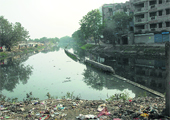
| The Upper Bagjola canal, bordering Dum Dum Road, which emits a foul smell. Pictures by Bishwarup Dutta |
Waterlogging and mosquitoes apart, there is something more that the Dum Dum Road neighbourhood, near Hanuman Mandir, has accepted as a part of its life — a stink that can raise the dead.
The source is the Upper Bagjola canal, which criss-crosses Dum Dum Road carrying sewage water from Dunlop Bridge to Kestopur. But the neighbourhood is as much to blame for the squalor and the stench as the irrigation department.
Canal corridor: The Upper Bagjola canal runs along a 9.24km stretch, flushing out waste from the Dum Dum, North Dum Dum, South Dum Dum, Kamarhati and a part of Panihati municipalities.
Present condition: Things didn’t improve even after the irrigation department dredged the canal in March 2008, after a gap of five years. The channel remains choked by muck, with weeds, plastic and decaying vegetables forming a thick layer on the water. Sometimes, residents find carcasses of dogs and cats floating in the channel.
“The water doesn’t flow freely as the canal is never properly dredged. As a result, it has become a breeding ground of mosquitoes. But the residents are also responsible for this mess as they throw litter into the canal, though municipality workers come to pick up household trash,” said Matilal Maitra, the Forward Bloc councillor of ward 18, South Dum Dum municipality.
Resident peeve: “We cannot open our windows because of the stench and mosquitoes. We have to use repellents round-the-clock,” rued Sheila Bose of Kakali Apartment, whose Jawpur Road house overlooks the canal.
“During monsoon, the canal water rises up to knee-level and floods our houses,” said Nirmalendu Das, who lives at 372 Jawpur Road.
Lack of civic awareness: Habituated to the stink over the years, several residents add to the problem by dumping polythene bags, cooked food and even mats and pillows along the banks. The local shopkeepers throw flower, vegetable and chicken waste, while a nearby khatal (cow shed) empties cow dung into the water.
“Yes, residents are also to blame. They throw garbage in polythene bags, which clog the canal. As a result, water cannot flow and since it’s a low-lying area there’s waterlogging even after a moderate shower,” said Shiv Shankar Mallick of Barnona Apartment, I/J Shahid Hemanta Kumar Basu Sarani.
Rekha Ghosh of 4/37/A Mordecai Lane agreed: “It is true that residents throw all kinds of waste but that is because the place is already so dirty and it’s seldom cleaned. Things will be better if there are vats on the banks.”
A section of the residents feels the irrigation department didn’t scoop out the entire muck during its clean-up operation early this year.
Desilt drive: The five-year gap may have taken a toll on the canal but the irrigation department has its own reasons. “We wait for the silt to reach a thickness of 3.5 to 4 ft, or else a dredging drive is not cost-effective. On an average, a channel like the Upper Bagjola canal gathers up to 10 inches of silt every year,” said an irrigation department official.
Dredging work was carried out from December 2007 to March 2008, a period when the canal bed wasn’t dry. “As the canal flows out a huge amount of waste, we cannot always dry it before dredging. Besides, we use an excavator mounted on a floating vessel to scoop out the silt, which needs a minimum water level,” explained Subhas Naskar, the minister-in-charge of irrigation and waterways department.