Seven of the 12 air quality monitoring stations in Calcutta and Howrah recorded “poor” air quality on Sunday morning and afternoon, exposing thousands of people outdoors on the last weekend of the year to unhealthy air.
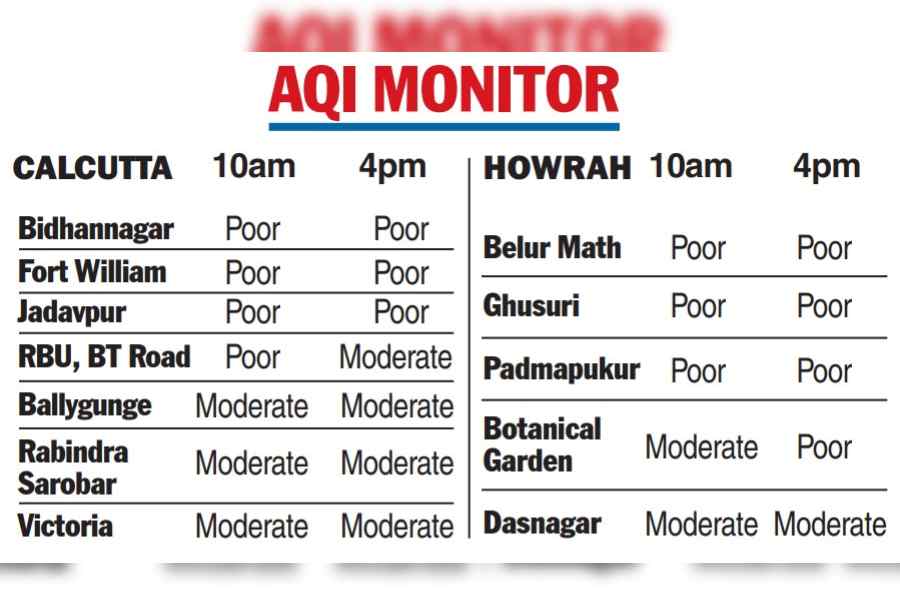
At 10am on Sunday, air quality was categorised as “poor” at Bidhannagar, Fort William, Jadavpur and Rabindra Bharati University (BT Road campus) in Calcutta, and at Belur Math, Ghusuri and Padmapukur in Howrah.
Five other stations reported “moderate” air quality: Ballygunge, Rabindra Sarobar and Victoria in Calcutta, and Botanical Garden and Dasnagar in Howrah.
By 4pm, conditions showed mixed trends. Air quality at RBU improved from “poor” to “moderate”. However, at the Botanical Garden — a popular winter afternoon destination — air quality deteriorated from “moderate” to “poor”.
According to the National Air Quality Index (AQI), “poor” air quality can cause breathing discomfort to most people after prolonged exposure.
Even “moderate” air quality poses health risks, particularly for those with existing respiratory or cardiac conditions. The AQI notes that “moderate” air can trigger breathing discomfort among people suffering from lung disease, asthma and heart ailments.
“Moderate” air quality, which was the best reading recorded on Sunday morning at only two stations in the city, is still two levels below the ideal. Under the AQI framework prepared by the Central Pollution Control Board, air quality is ranked from
“good” and “satisfactory” at the top, followed by “moderate”, and then “poor” and “very poor”.
Although the minimum temperature on Sunday rose slightly to 14° Celsius from 12.8° on Saturday, there was no improvement in air quality. The maximum temperature remained unchanged at 22.9° Celsius on both days.
Scientists said such marginal temperature changes are insufficient to disperse accumulated pollutants.
Every winter, Calcutta’s air quality deteriorates as cooler, heavier air and lower wind speeds trap pollutants close to the ground — the air we breathe.
Environmental scientists attribute the current dip to an accumulated pollutant load that has built up over several days.
A scientist with the state pollution control board (PCB) said air quality is unlikely
to improve without a substantial change in weather conditions.
“Temperature is only one of several factors that influence air quality. A marginal rise in minimum temperature is not enough,” the scientist said.
Wind speed and precipitation play a crucial role in clearing the air. “Strong winds can disperse pollutants. Rain can also wash them out of the atmosphere, but that is rare during winter. A substantial rise in temperature is the other possibility,” the scientist added.
A study commissioned by the state PCB and reported by this newspaper on Sunday identified dust, coal and biomass-fired cooking, vehicular emissions, industrial pollution and refuse burning as the major sources of air pollution in Calcutta.
Refuse burning, particularly in the open, poses a serious health hazard. Environmental scientists warn that burning solid waste containing plastic releases highly toxic and carcinogenic substances.
Most of the pollutants — including toxic gases and fine particulate matter measuring 2.5 micrometres or less — are anthropogenic, underscoring the role of human activity in worsening winter air quality.