The Railway Board is planning to involve local stakeholders and representatives from state government departments in its efforts to conserve railway heritage across the country, a senior official of the board said on Sunday.
“We have started a joint consultative mechanism, which means we will involve local stakeholders — local communities, journalists, and representatives from relevant government departments such as culture, tourism, and meteorology. Whichever departments are important to us, we bring them on board so that whenever there is any damage or any plan for conservation, we can consider their opinions and make informed decisions,” said Aashima Mehrotra, executive director (heritage), Railway Board.
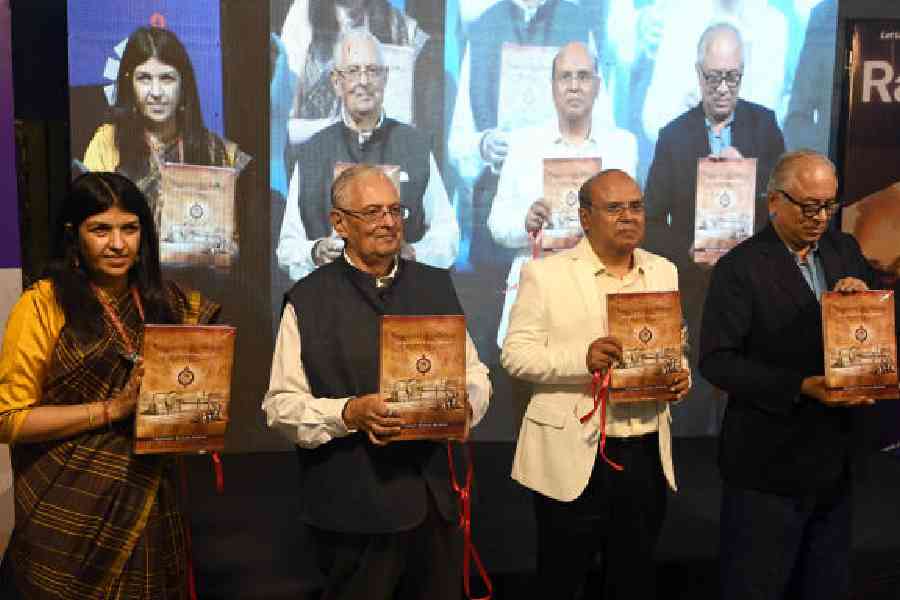
She was a speaker at the Rail Utsav, organised by the Rail Enthusiasts’ Society, at Calcutta University Institute Hall on Sunday.
The day-long event saw presentations and talks on railway heritage, rail literature, railway philately and railway cinema. Documentaries were also screened.
“We need to involve people who can engage with us about these heritage sites. We already have a comprehensive inventory of heritage sites and will continue to add more to it. We aim to reach more people through zonal vending and ensure greater participation in preserving railway heritage,” she said.
A pilot project in this connection is already underway in the Darjeeling Himalayan Railway, said railway officials. It will gradually be expanded to other areas, they said.
Calcutta is dotted with majestic colonial edifices that still serve as railway offices.
“We want the Howrah station building to become a Unesco World Heritage Site. It is a long road ahead. But we have appealed to the Railway Board to take it up,” said Sanjoy Mookerjee, retired financial commissioner of railways, author of multiple books on railway heritage and head of the eastern chapter of the Rail Enthusiasts’ Society.
East Indian Railway, which later became the Eastern Railway, had started functioning from a building on Theatre Road and shifted to its present headquarters at Fairlie Place in 1879. The road got its name from a merchant, William Fairlie, who supplied food for the elephants and camels of the British army. The building had been much smaller and was expanded after the East Indian Railway took over.
The BNR (Bengal Nagpur Railway) House, the white edifice overlooking the Hooghly in Garden Reach, which serves as the residence of the general manager of the South Eastern Railway, was built by the British in 1846, the architecture inspired by the Tower of the Winds in Athens.
Vinoo. N. Mathur, president of the Rail Enthusiasts’ Society, spoke on these majestic buildings.
“The Fairlie Place office was designed by an architect known as Richard Roskell Bayne. The architect designed it in the style of an Italian palace. He borrowed ideas from Italian buildings. If we look at the top, we can see its very fine cornice” he said.
Bayne had also designed the New Market in Calcutta.
P. K. Mishra, general manager of Modern Coach Factory (MCF), Rae Bareli, and a railway historian, spoke about the early years of the Eastern Indian Railway.
He noted that the early railway administration functioned under strict rules regarding the flow of information.
“There was also a ban on communication with the press following a series of leaks,” he said.