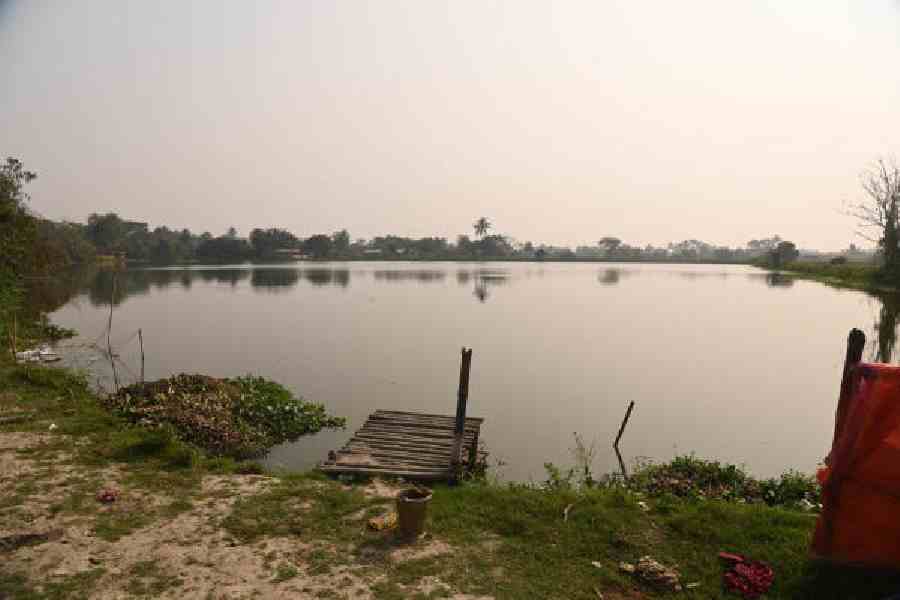
The East Kolkata Wetlands being gobbled up for small businesses and real estate is well known. But in parts of the Wetlands, land is also being converted into water bodies, driven by higher returns from pisciculture.
“Agricultural land in these parts does not yield more than one crop a year, while in a fishery three to four cycles can be completed annually,” said residents.
Just as portions of water bodies are often filled up to create land, the reverse process is also unfolding, local cooperatives and government officials said. Over the past two decades, vast tracts of farmland have quietly been turned into fisheries, leaving hardly any land under paddy cultivation, said a member of fishers’ cooperative.
Proximity to Calcutta has provided a ready market for the fish cultivated in these water bodies.
According to the website of the East Kolkata Wetlands Management Authority, there are 254 sewage-fed fisheries in the notified Wetlands area. However, conversations with residents, fishers’ cooperatives and officials suggest the actual number is significantly higher.
“We run a cooperative with about 25 members. Our bheri is around 30 bighas in size. The income from fish farming is more than three times what one would earn by cultivating paddy,” said a member of the Taruni Kanta Bag Fish Production Group, a cooperative in the Kheyadaha II gram panchayat area.
“About two decades ago, paddy was cultivated on many plots here. Now, I hardly see anyone growing paddy. With paddy, you get one crop a year here. Fish farming allows three or four cycles annually, even after accounting for time needed to clean the ponds at the end of the year,” he said.
Most of these conversions were carried out without permission from the state government.
A former senior official of the South 24-Parganas district administration said a few years back, the government allowed the conversion of land classified as baastu (homestead and non-agricultural land) into water bodies after realising that large-scale changes were taking place on the ground.
“The state thought it could earn some revenue by regularising these conversions, but the earnings have been negligible,” the official said.
The most commonly cultivated fish varieties in the East Kolkata Wetlands include rohu, catla, tilapia and silver carp. The produce is supplied to markets such as Gariahat, New Market, the bazar outside Ballygunge railway station and Kalighat.
Wholesale markets located close to the Wetlands help ensure easy access to retail hubs. “There are wholesale fish markets at Chowbhaga, Bantala, Gangajoar and near Garia railway station,” said a cooperative member.
A member of the Wetlands authority said surveys indicate that the area under
freshwater fisheries in the notified Wetlands has nearly doubled over the years.
“Of the 12,500 hectares notified as the East Kolkata Wetlands, water bodies initially covered around 3,500 hectares when the Wetlands were declared a protected area in 2006. That figure has now increased to about 6,000 hectares,” said the member.
Besides water bodies, the notified Wetlands also include arable land, barren land, and rural and urban settlements. Although close to Calcutta, Salt Lake and New Town, the Wetlands span several wards of the Kolkata Municipal Corporation as well as panchayat areas in South and North 24-Parganas districts.
“The notified Wetlands include Kheyadaha I and II, and Pratapnagar gram panchayats in South 24-Parganas,” said Balai Chandra Barik, sabhapati of the Sonarpur panchayat samiti.
Some experts said the conversions may have environmental benefits. “An increase in water bodies could help manage intense, short-duration rainfall, which is likely to become more frequent due to climate change. These water bodies can also act as carbon sinks,” an environmental scientist said.