Years before Satyajit Ray cast a teenage Sharmila Tagore in Apur Sansar, she had played a letterbox in a children’s play. She was then part of Children’s Little Theatre (CLT), where she had been enrolled at the age of six by her aunt, Karabi Tagore.
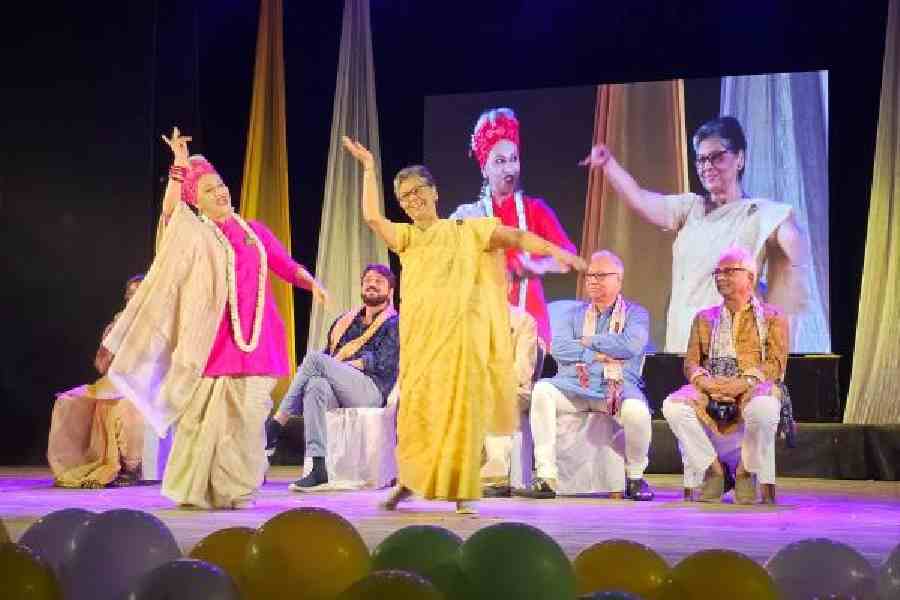
As the veteran actress shared “vivid and happy memories” of her years at CLT in a video message played during the institution’s 75th anniversary celebrations, generations of students and alumni gathered at its Dhakuria auditorium seemed to echo the sentiment.
Housed in Aban Mahal, named after Abanindranath Tagore, CLT was founded in 1951 as a space for the holistic development of children — inclusive in spirit long before the term became fashionable.
“CLT, then called Rhythms and Rhymes, began in a room at founder Samar Chatterjee’s Cornfield Road home,” said general secretary Sankar Mukherjee.
The idea for a children’s theatre group had first taken root in Chatterjee’s mind in 1949 after historian and parliamentarian Kalidas Nag inspired him during a Scouts rally
performance at Chetla High School featuring rhymes written by him.
Struggling for space, Chatterjee eventually reached the office of Prime Minister Jawaharlal Nehru, through whom he was introduced to then chief minister Bidhan Chandra Roy
“The rest was history,” Mukherjee said after garlanding the founder’s photograph.
CLT staged its first public performance at New Empire on May 11, 1952. The response drew support from several leading schools.
Around the same time, Satyajit Ray attended a rehearsal at St John’s Diocesan School and created a sketch that served as CLT’s emblem for several years. On July 7, 1952, the organisation adopted its present name, formally registering it that October.
“I belong to the earliest generation of CLT students,” recalled dancer Alakananda Roy, who joined in 1955 at the age of three-and-a-half. “This is where I learnt to use the stage and take the light over the next nine years.” She fondly remembered productions such as Song of India and The Wizard of Oz, lit by celebrated designer Tapas Sen. Nostalgia swept through the hall as she invited an old classmate on stage to match steps with her to the CLT favourite Chai Tupi.
Students like her and Tagore would travel across the country, sometimes having a train compartment to themselves, staging dance drama like Mithua and Aban Pantua and adaptations of folklore like Saat Bhai Champa. In 1964, CLT even performed across Europe as part of the Children’s Commonwealth Programme, arranged by Nehru.
Actor Chiranjeet recalled attending rehearsals of productions that his father, artist Saila Chakraborty, was associated with. “I watched several performances at Nizam Palace and one at a Deshapriya Park pandal. Once Indira Gandhi, then information minister, and Governor Padmaja Naidu were in the audience,” he said. He also recounted how his father had been offered a chance to train in puppetry in Yugoslavia, which he had to turn down, and was replaced by CLT choreographer Suresh Dutta, who returned to found Calcutta Puppet Theatre.
CLT’s activities extended beyond theatre, with classes in philately, skating, table tennis and puppetry. Jaba Talukdar, 82, remembered training under Dutta using rod and glove puppets and performing Gulabo Sitabo with him.
Among the other veteran teachers present was singer Sumitra Ghosh, who taught at CLT for 21 years. “I had to learn all the CLT songs when I joined. Samarda wrote plays for us,” she recalled. Dance legends such as Balakrishna Menon, Muralidhar Majhi and Kalavati Devi were associated with the institution, while Pandit Ravi Shankar and Timir Baran composed background scores for landmark productions like Chheleta and Ramayana. “We plan to revive some of our iconic productions,” said president Jayanta Mitra.