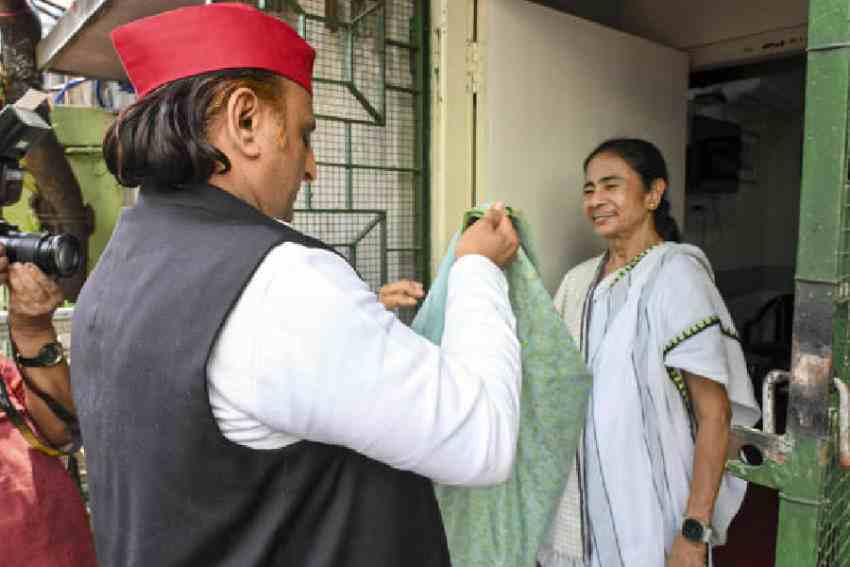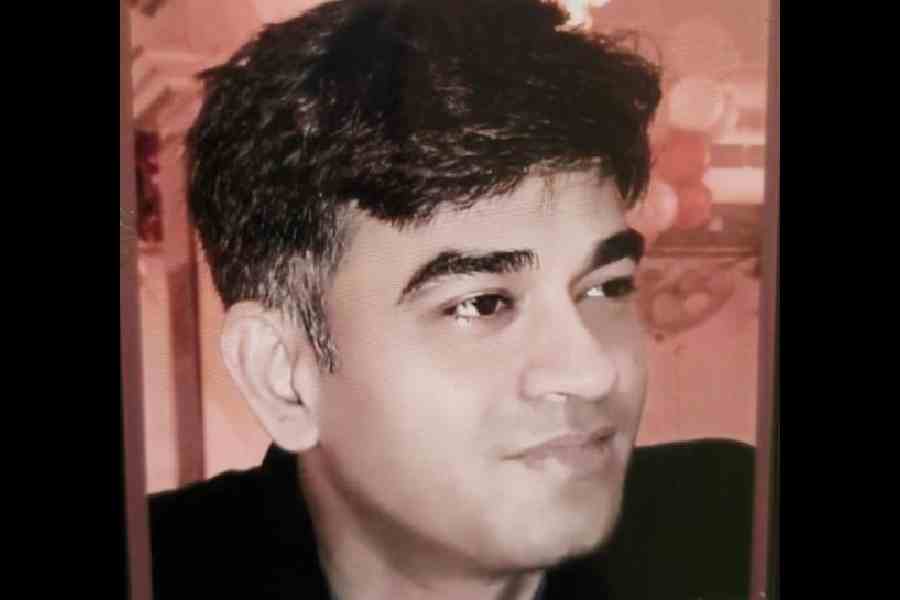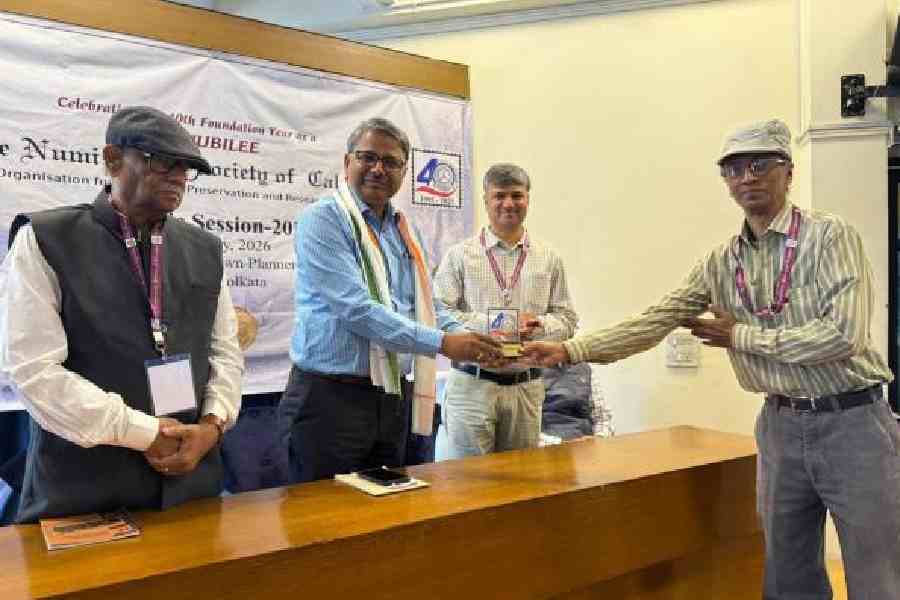
We started with paperless currency. Now that we have smartphones, we are back to being paperless, with digital currency,” remarked Rajendra Yadav, superintending archaeologist, Calcutta circle, of the Archaeological Survey of India (ASI). He was addressing members of the Numismatic Society of Calcutta (NSC), the apex body of the city’s numismatics and coin enthusiasts, who had gathered at the Institute of Town Planners auditorium in IB Block recently.
“The Harappans had a barter system. But society was changing and people found another way to purchase things, which led to coins coming to use. From punch marks to die-based ones, coins have had a rich history,” he said, delivering the chief guest’s address.
Coin collection, he pointed out, is a service to the nation. “Coins are a reflection of our ancestors’ society. Every region has its own kind of coinage and history. We started writing our history using numismatics only after the Europeans came,” he said, admitting that he relied on excavations to learn about history as his training was as an archaeologist, and not as a numismatist.
He highlighted the importance of the role of local people in archaeological discoveries. “Often, a farmer while ploughing the field would find pieces of sculpture or a few old coins and we would be alerted to undertake a search at the spot. We don’t have enough manpower. We also depend on faculties of college departments to join hands with us to save the country’s treasures.”
He warned against fake coins flooding the market. “Do not make a purchase without ensuring the genuineness of the coin.” On the other hand, priceless antiquities have got sold off to foreigners, he lamented.
Yadav recalled being called to inspect cargo seized by the customs department during his posting in Mumbai. “It was a casket of coins, which was filled at the top with fakes but there were genuine ones mixed with the fake underneath,” he said, marvelling at the ingenuity of the smugglers.
Another route through which lot of ancient coins have been lost is the practice in earlier years of smelting coins for their metallic value. “Earlier families used to preserve coins as deposits of gold or silver, whichever metal it was made of. I have heard of George I guineas being smelted to make a payel before a wedding. But now, thankfully, people are more aware and preserve coins as pieces of the memory of one’s ancestors,” said the archaeologist, who has his office in the CGO complex in Sector I.
NSC president Smaran Kumar Das presented the theme paper — on the contribution of numismatics to Indian history. He started off with a comment on the disturbing current trend in the country of passing off mythological characters as figures of history. “The historical period began circa 600BC. Before that, it is all proto history,” he pointed out.
One of the most reliable sources from early history, he said, were inscriptions. “The Allahabad inscription of Samudragupta, for example, explains the extent of the Gupta Empire.” The panegyric in Sanskrit composed by the Maurya emperor’s court poet Harisena, dated in the fourth century, detailed his conquests across northern and southern India.
But court writers, Das pointed out, were never critical of the ruler. “So they are at best partial truths. Accounts of foreign travelers are from a neutral point of view and supplement our knowledge of the period,” he said, mentioning the likes of Greek explorer Megasthenes, the ambassador of Seleucas to Chandragupta Maurya, Ibn Batuta, the Moroccan traveller who left an account of his explorations in the 14th century in The Rihla, and the two Italian merchant-travellers Marco Polo and Nicolo Conti, who came to India in the late 13th century and the early 15th century respectively.
“Just as epigraphs, cave and mosque inscriptions supplement history, so does numismatics,” Das said.
Das, who stays partly in EE Block, went on to show charts on rulers whose only proof of existence was through the coins issued in their time. After the invasion of Greek emperor Alexander in 326 BC, names are known only of a handful of Indo-Bactrian rulers who followed, the most eminent being Menander (160-145BC) who came till Pataliputra and, according to a Buddhist monk’s account, embraced Buddhism. But coins point to over 40 different rulers, like Pantaleon (c. 171-160BC), Agothocles (c171-160 BC) and Demetrius (c.190 – 170BC).
Again, close to 40 independent rulers of Panchala were discovered in the post-Mauryan period from their coins, like Vangapala (c.150 to 130 BC). “So they must have ruled for about 300 years till the Kushanas took over a part of Panchala. Their coins were in Prakrit language though the script was Brahmi. That changed once the Kushanas came,” Das said.
“The acedemic session is usually held alongside Mudra Utsav, the annual conference cum exhibition of the society, but did not happen this December during the exhibition in Sreebhumi. So we planned to host this separately, Ravi Shankar Sharma, the secretary of the organisation, told The Telegraph Salt Lake.