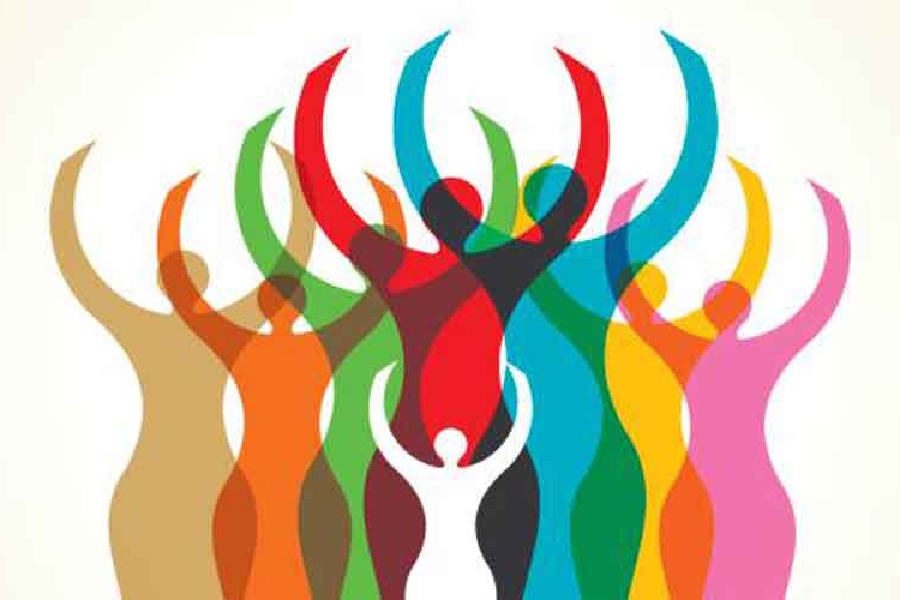
A woman is climbing a mountain in her quest for the peak — equality.
A mural, symbolic of the journey of thousands of women and of the organisation that has supported them in their fight for equality over the last 30 years, presents the daunting task.
The fight takes place in a patriarchal society that, over the years, has undermined the position of women. But she has been able to “climb out of situations” and counter numerous attempts to box her in.
Swayam, which has been working for women’s empowerment and a violence-free society since 1995, inaugurated the mural at its Deodar Street office on Monday, celebrating 30 years of empowering women and highlighting the journey of survivors.
“The image of a woman’s climb is powerful. It is about climbing to equality, climbing out of situations. It is about strength, aspiration, and moving ahead without stopping,” said Amrita Dasgupta, the director of Swayam.
Artist Sumantra Mukherjee has tried to capture a visual that would resonate with women and many passersby. It takes the form of posters against a silhouette. The posters carry the voices of women.
Some of the posters read:
“Main parhna sikh rahi hoon, taki zindagi ko parh saku (I am learning to read and write so I can understand life)” and “Ghorer kaj-e vetan nei. Jekhane vetan, shekhane samman (There is no salary in domestic work. There is respect where there is a salary).”
It’s not a conventionally beautiful piece of art, but the artist wants people to feel disturbed, stop, see, and interpret it.
The wall contains snippets of the work done by Swayam, which includes working with boys since 2016 and supporting 1,000 survivors and their families during the Covid-19 pandemic.
Domestic violence and violence against women are now recognised, said the organisation’s founder, Anuradha Kapoor.
“When we started 30 years ago, domestic violence or violence against women was not spoken about, and it was kept under the carpet. Women, when they came to us, had already suffered for 20 or 30 years before they spoke about the violence against them. But now some women come to us after six months, three months, or even 10 days of abuse and violence,” said Kapoor.
When violence is inflicted on women, especially in marital families, many of them do not stay and put up with it but protest and fight for their rights, said Kapoor.
One among them is a 40-year-old woman who decided to leave an abusive marriage when she was 23. “I was a victim of physical violence. When married, I didn’t realise that I was also a victim of sexual abuse, which I do now,” she told Metro on Monday.
The woman is now financially independent and supports her mother.
“There is a clear understanding that violence against women is a crime and unacceptable, but society doesn’t change as quickly as we want it to,” said Kapoor.
In the fight against patriarchy, men have equal roles to play.
“There is an expectation now that men and boys have to change. We need to work with men and boys because they are often the ones perpetuating abuse, but they are not born like that. They have been gendered, and there has to be a change in their upbringing. We also need to acknowledge that many men are different, too,” said Kapoor.