
A robot in the backpack is now helping wheelchair users with lower limb paralysis to stand, walk and even climb stairs.
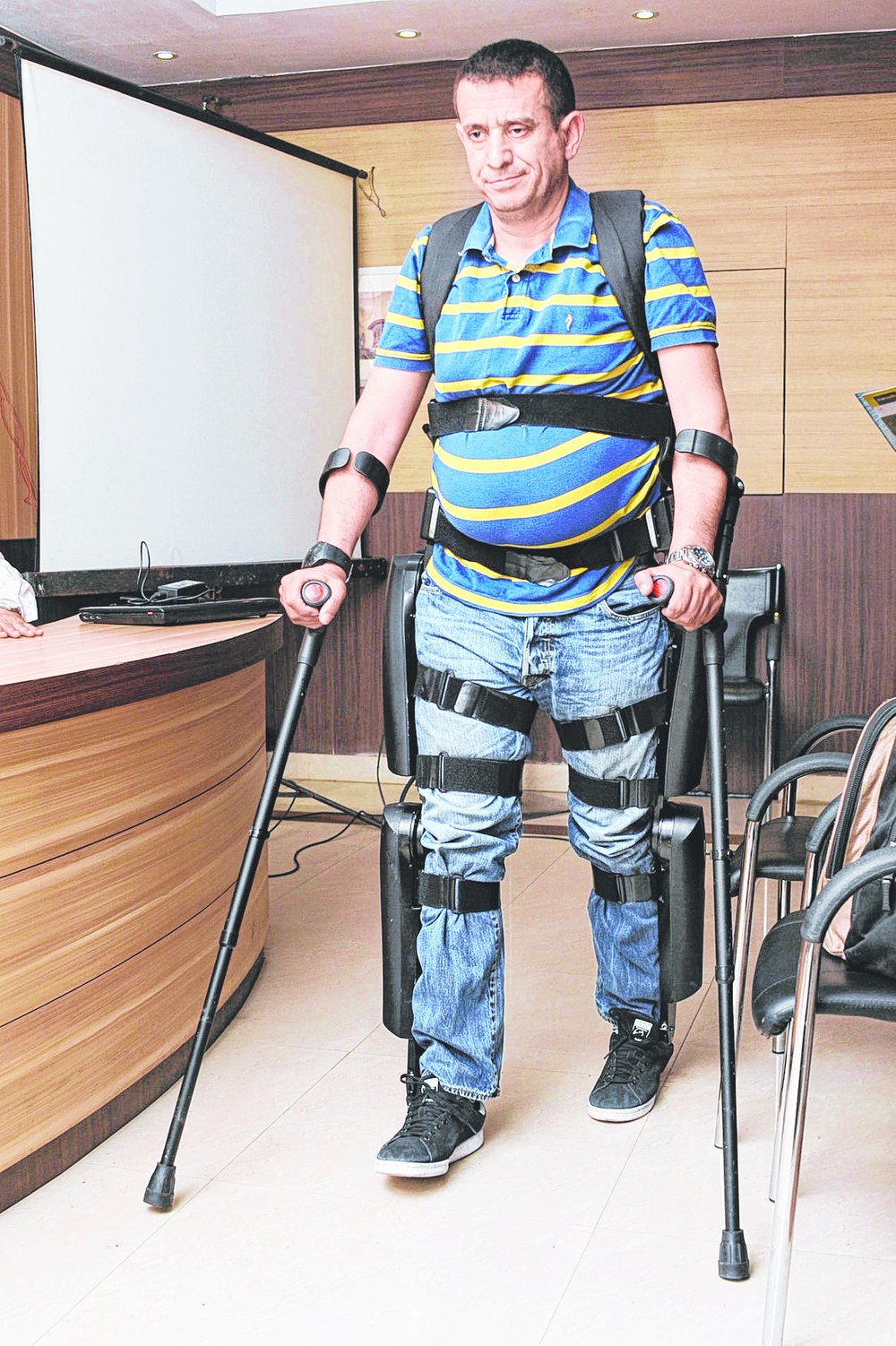
ReWalker consists of pads fitted with motors and sensors strapped on to the patient's legs and connected with wires to a computer and batteries in a backpack.
A remote control is fitted to a wristwatch, with which the patient can change the mode such as stand, sit, walk, ascend or descend.
According to the manufacturers, the watch sends signals to the pads that help the patient perform these basic functions that they may not have been able to do by themselves.
Doctors said about 50 per cent of patients suffering from paraplegia or paralysis of the lower limbs can use the robot effectively.
"Only patients with paraplegia who need support to stand but cannot walk will be helped by ReWalk. Also, their cardiac health has to be sound and they cannot have bed sore, often caused by constant lying in bed or prolonged use of a wheelchair," said Sujoy Sanyal, consultant neorosurgeon with Rabindranath International Institute of Cardiac Sciences, who made a presentation about the equipment in the city on Wednesday.
The battery device allows the wearer to be on the move for four hours at a stretch, enough time for Israeli soldier Radi Kaiuf, paralysed in the legs after taking a bullet in his spine in Lebanon in 1988, to complete the Tel Aviv 10K road race in 2013.
"The bullet had severed one of the bones in my spinal cord. I spent eight months in hospital and spent 19 years after that in a wheelchair. I never thought I would be able to walk again," said Kaiuf, now 46, and in Calcutta to demonstrate how the ReWalk works.
ReWalk, which has been invented by Amit Goffer, an Israeli and a paraplegic himself, costs Rs 50 lakh. The device has an FDA clearance, said the manufacturers, ReWalk Robotics of Israel.
Kaiuf is one of about 180 patients with paraplegia or paralysis of the legs who uses ReWalk, claimed Yishai Potack, sales and business development manager of ReWalk Robotics.
Experts said this could help paraplegic patients in Calcutta more effectively than the conservative physiotherapy.
"This equipment is grouped under robotic limbs and are quite effective. Being computerised, ReWalk can help in smoother walk and almost looks like normal gait," said neurosurgeon L.N. Tripathi.