
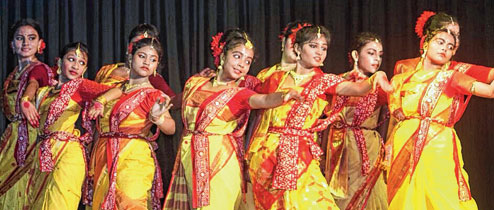

Our school celebrates Rabindra Jayanti every year but this year’s programme was very special to me. That’s because this time I was the head girl of our school and this would be the last Rabindra Jayanti of my school life.
Rehearsals had started as soon as students returned after term break, around April 20, and being a part of the students’ council, I had to ensure they went off smoothly. There would be musical medleys and dance performances, but we had also decided to perform Tagore’s dance drama, Pujarini. This dance drama is not usually a popular choice but we wanted to perform it as we thought its message of peace would be an important one to deliver to the war-torn world today.
About 15 students from Classes VI to X were selected for Pujarini, that was being directed by our co-curricular in-charge teacher, Satarupa Hore. As the rehearsals progressed we realised that our school had some talented actors. Joyojyoti Mallik of Class X, who played the role of Ajatshatru, gave us goosebumps with his voice modulation and Class X’s Aindrilla Acharya, as Srimati, brought tears to our eyes.
I usually take part in the dances and skits but this year, following school tradition, the head boy Krishnangshu Saha and I would be reading the script and taking the audience through the day’s programme.
After the morning section of our school celebrated the occasion, our day section took over. But a few minutes before the show was to start, we were in for a rude shock. Krishnangshu had almost lost his voice! The auditorium was filling up with students but our narrator was croaking.

We were all at a loss till chief prefect Divya Agarwal came up with a solution. “Let Krishnangshu gurgle with warm water for half the show. If the condition of his throat improves, he can take over. Till then let someone else fill in for him.” We agreed and Sourya Bhattacharya was selected to read the script for the first half.
Our principal, Nandini Sen, inaugurated the ceremony by lighting the lamp before a picture of Rabindranath Tagore and spoke on the works of the bard. “Even today his works fascinate the young generation. He gave us new perspectives to see life and meet challenges,” she said.
And then began the show. The opening song was E ki labonye purno pran, sung by Samarpita Banerjee of Class IX as Tulika Basu of Class VIII played the keyboard. Joytonu Kundu of Class VI was slotted next to recite Matribotsol but he looked tense. “Didi, I’m feeling very scared. Will everything be all right?” he asked me before taking stage. I did my best to soothe his nerves and when he started, everyone was astonished by his flawless recitation. After his performance, Joytonu didn’t forget to thank me before disappearing into the crowd.
Next was a dance performance to the song Anondoloke mongolaloke. This was a treat to watch and I could see a broad smile of satisfaction on Puloma (Sen) ma’am’s face. She was in charge of the music and dance departments.
Finally it was time for Pujarini. As the crew took a moment to ready the stage, I took a sneak peak into the greenroom. Prasun Roy, the Class IX student who would be playing Bimbisara, was struggling with his dhoti. “Dhur! Ei shob pore abar hnata jay naki? Paye joriye jachchhe,” he was yelling in frustration at nobody in particular.
Aindrilla, who was to play Srimati, was fretting too. “It’s easier to memorise the dates in history than my lines! One mistake and it’ll all be ruined.” Joyojyoti, who would play Ajatashatru, was seen running to the make-up man: “Kaku, what sort of glue have you used to stick my beard on? This is the third time it’s come off. What if it comes off on stage?”
But music to my ears was Krishnangshu’s voice. After several glasses of salt water gurgling, it had returned somewhat and finally he could uphold the tradition of our school as he took over to read the script for Pujarini and the rest of the show with me.
— Arundhati Biswas,
Class XII, Hariyana Vidya Mandir