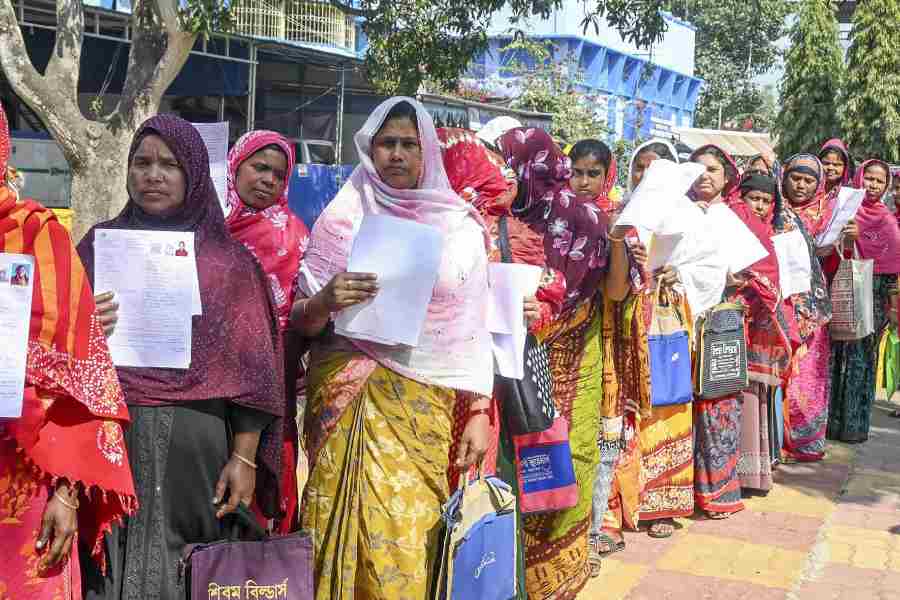
The Election Commission has come out with a set of cases where cross-checking needs to be done to detect “ghost” voters whose names are suspected to figure in the draft electoral roll, which will be published as part of the special intensive revision (SIR) of the voter list.
In an order issued to district election officers, the commission flagged several categories of entries during the SIR that should be scrutinised before the draft electoral rolls are published on December 16.
“I would like to inform you that the Enumeration for the SIR exercise has been extended to 11th December 2025 from 4th December 2025. This provides us and the EROs with one additional week during which we can all put in our efforts to make the Electoral Rolls accurate,” the order issued by chief electoral officer (CEO) Manoj Agarwal reads.
The categories include cases where a person recorded as being 60 years old in 2002 has submitted enumeration forms during the SIR, and the voter who was not enrolled in the 2002 electoral rolls, despite now being aged 50 years or above.
Other red flags include cases where a family member has signed on behalf of an absentee member and booths where progeny mapping touches 50 per cent or more.
“All the instructions are mainly aimed at identifying dead, absentee, and shifted voters whose enumeration forms were allegedly filled up during the process. The suspicion grew after the electoral body found hundreds of booths where all the distributed enumeration forms were returned. This means those booths had no dead, absentee, or shifted voters, which is unusual,” said a senior official.
The instructions came amid allegations from the BJP, CPM and the Congress that the ruling Trinamool Congress was using officials and its machinery to manipulate the enumeration process by keeping the names of ineligible voters in the draft electoral rolls.
Multiple officials said that if any voter aged 60 years or above in 2002 filled out an enumeration form, their current age would now be 83 or above. There is a chance that many of these voters have died, and therefore, the commission wants to recheck the credibility of such entries.
The directive applies to those who are primarily mapped to grandparents or parents enrolled in the 2002 electoral rolls and who are of the age of 50 years or above as per the 2025 roll. Such cases should be verified, if necessary, in the field through sample checks to ascertain why the applicant was not enrolled in the 2002 roll, even though he or she was 25 years of age or more in 2002.
Where a family member has signed on behalf of an absentee voter, BLOs have been asked to verify the authenticity of the applicant.
“There are doubts that family members may have marked a person as a voter in Bengal even though he or she may be a voter in another part of the country simultaneously,” said another official.
The EC has also asked for a thorough scrutiny of polling stations with 0 to 20 uncollectable enumeration forms. District election officers have been directed to check the accuracy of the details entered
by BLOs.
“If the number of uncollectable forms is between 0 and 20, it means the number of dead or shifted voters is either zero or minimal. There could be thousands of such booths across the state. In this context, the scrutiny will play a significant role in determining whether enumeration forms for dead or shifted voters have been fraudulently filled up,” the official said.
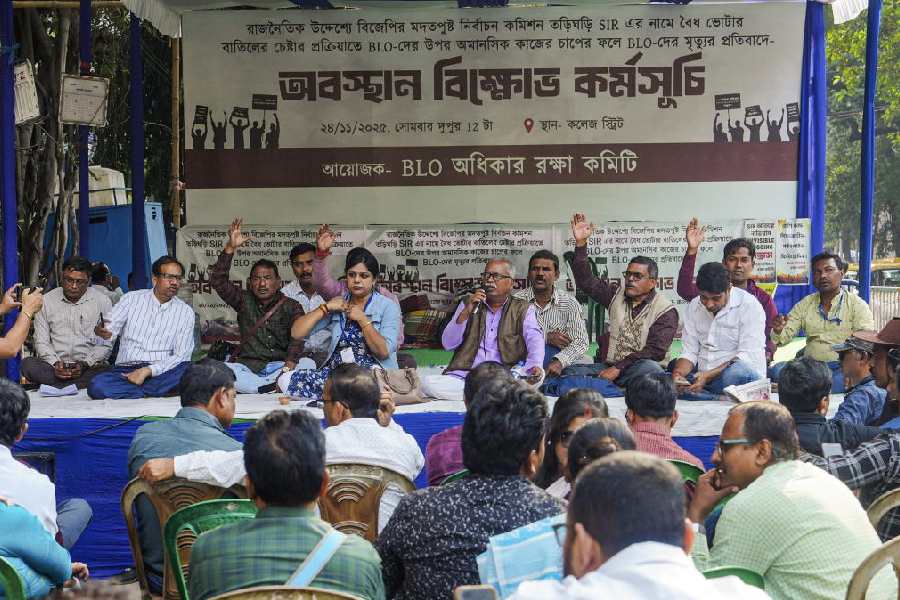
Swapan Mandal, general secretary of Votekarmi O BLO Aikya Mancha, said: “The steps are good, but the EC should ensure that its officials execute those instructions properly. If any BLO is involved in anomalies, he or she would face consequences.”
Since the SIR began, BJP leaders, including the party’s state president Samik Bhattacharya, have claimed that Trinamool has been pressuring BLOs to manipulate the process, leading to the inclusion of the names of dead voters in the enumeration exercise.
On Tuesday, sarcasm from Bhattacharya followed: “Duare Sarkar, Kabore voters” (Government at the doorstep, voters in the grave).
“On polling day, those dead voters will come out of the graves and cast their votes. People should visit Bengal to witness the SIR process here,” said the BJP Rajya Sabha member.
Trinamool leader Kunal Ghosh countered Bhattacharya, saying, “Where are your BLAs? The BJP is nowhere on the ground and is trying to raise the issue of dead voters to cover up its organisational lapses. Samik Bhattacharya talks of government at the doorstep and voters in the grave. I will add another line: the BJP is on Mars.”
Congress leaders said the directives for re-verification of the enumeration process were positive steps, and some reflected their demands.
“Three directives in the guidelines issued by the Election Commission were based on our demands. Though there were many such demands, the EC has responded to some of them,” said Prasenjit Bose, head of the Congress SIR committee in Bengal.