 |
 |
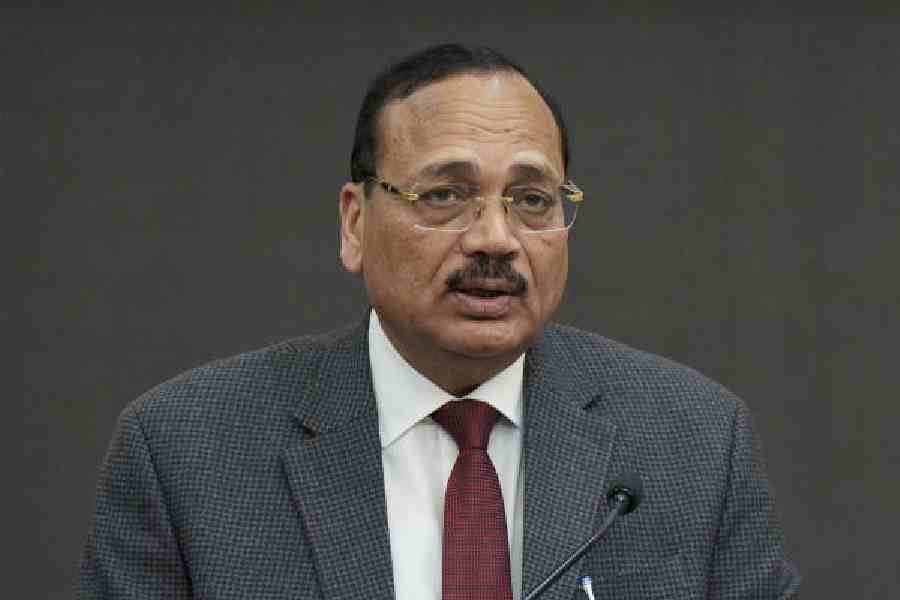
| Trinamul’s Sougata Roy (top) banks on the personal approach at Akra, while the CPM’s Samik Lahiri hits the roads (to Raichak) to cover the far-flung areas of his constituency. Pictures by Pradip Sanyal |
Fazle Azim Molla ambled down to the ground-floor room stuffed with packets of readymade garments after about 10 minutes. In a lungi and white vest, MLA sahab, as he’s known in the area, explained: “Was taking a nap after returning from the party office.”
His incomplete two-storeyed residence, off Garden Reach road, on the southwest outskirts of Calcutta, stood on this hot afternoon surrounded by post-lunch restfulness, except for a bunch of local boys chatting among themselves. “Woh abhi aram kar rahen hain (He’s taking rest),” they had replied when asked about the whereabouts of the Congress leader, who’s won three Assembly elections.
Frail, and looking past 60, Molla, narrated the Congress’ predicament — an outsider would be tempted to interpret it as an excuse for his siesta — “We have just started campaigning for our candidate Daulat Ali. We don’t have the resources to match the CPM or the Trinamul Congress.”
Barely 2 km away on Paharpur Road, sitting CPM candidate from Diamond Harbour Samik Lahiri’s campaign was rolling at full throttle.
Daulat Ali’s lack of resources is unlikely to draw sounds of sympathy from the Lahiri camp in a constituency where minorities make up 35-40 per cent of the population.
Molla, who lost as a Trinamul candidate in the 2001 Assembly polls to the CPM, knows what that means. “We have a strong base among minority voters in Garden Reach and the adjoining areas,” he said.
He also knows a minority name is not a passport to victory, as he realised when he lost to Md Amin in 2001. Being a Trinamul candidate, with the party having earlier associated with the BJP, mattered more. Wiser after the defeat and after Mamata Banerjee renewed her BJP ties, Molla returned to the Congress.
Sougata Roy has traversed the other way — from the Congress to Trinamul, after a courageous fight topped by an embarrassing loss in 1999 to Mamata. He carries the baggage Molla shed.
Still, the numbers of the 2001 Assembly polls weigh up nicely against that disadvantage. Trinamul had won four of Diamond Harbour’s seven Assembly constituencies.
All the lead Trinamul gains in these four is, however, crushed under the mighty 62,000 headstart Lahiri gets at Garden Reach alone. His final margin of victory over Trinamul’s Sardar Amjad Ali in 1999 was 70,000.
“We are confident of leading from Budge Budge, Satgachhia, Falta, Diamond Harbour and Bishnupur West Assembly segments. Now, our aim is to improve our performance in Garden Reach and Maheshtala (which gave the CPM a lead of 16,000 in 1999),” said Roy.
Diamond Harbour may appear to be stuck in the traditional crunching of possible vote numbers, but it is also an arena for national politics — Gujarat and globalisation are engaging issues in this corner of south Bengal, partly industrial and partly rural.
When Roy accuses the CPM for the industrial decline in Budge Budge at a street corner, a young man requests: “Aapni jute mill-gulo kholen daya kore (Please reopen the jute mills).”
As Lahiri blames the National Democratic Alliance, a small trader on Shyam Lal Lane pleads: “Kuch kaam-kaaj ka intejam kijiye sahab, tabhi vote denge (Sir, we will vote for you only if you get us some work).”
The CPM also reminds the people here of the post-Godhra riots. “Gujarat is an issue,” says Lahiri, relaxing in the party office at Garden Reach at the end of the day’s campaigning.
Rivals Trinamul and Congress are accusing the CPM of bringing a communal element into campaigning. Roy has even threatened to go the Election Commission.
Lahiri also goes from door to door, arguing how the readymade garment industry, which gives livelihood to around 70 per cent of the people in the region, faces extinction because of the Centre’s policy.
Md Badruddoza, an ostagar (tailor-cum-owner of a production facility) in Hazi Ratan Lane, explains: “The cheaper imports of garments have taken customers away from us. My business volume has shrunk by over 50 per cent in the past few years and I don’t know how to compete.”
Shrinking is a problem for the CPM, too. After a revision of the rolls, the number of voters at Garden Reach has dropped by around 23,000, a fact that is worrying the party, but it would obviously not admit as much.
“Our vote share in the area has been around 58 to 60 per cent in the last Assembly and parliamentary polls. We expect our share to go up,” says CPM district committee member Kallol Majumdar.
Since 1989, however, the CPM’s vote share in the entire constituency has been declining, except for an against-the-trend spike in 1999.
Assuming that the long-term trend resumes this time, it could slip by 1 or at most 2 per cent. At 47.7 per cent in 1999, even after such a drop it would be above Trinamul’s 39.27, even if Mamata gains what the CPM loses.
Daulat Ali sliced away 12.59 per cent last time. He could eat into both the CPM — minority votes — and Trinamul — anti-CPM votes.
Molla asleep or awake, Trinamul will be the bigger loser.