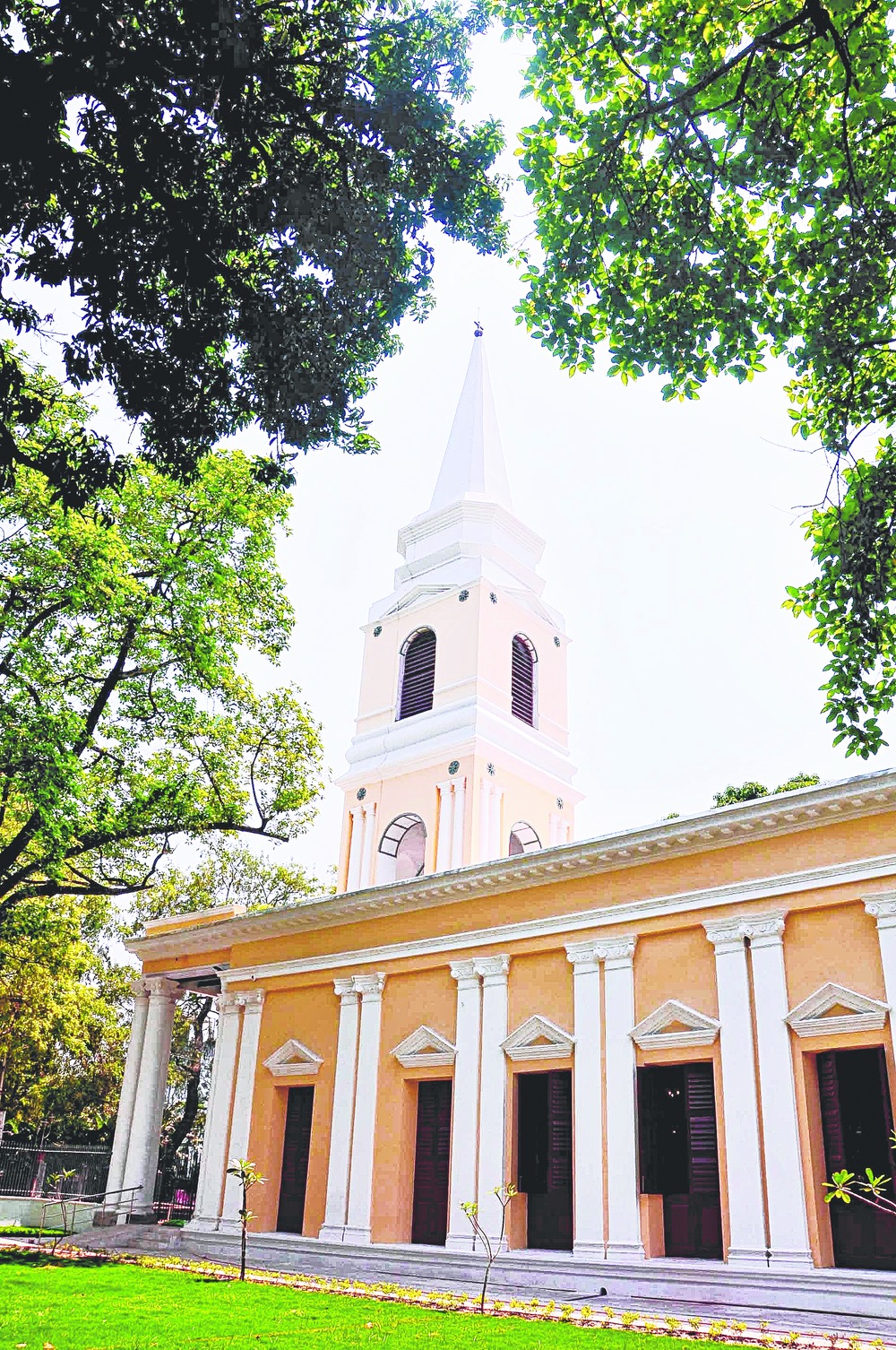
The tall white spire of the Lutheran church across the Hooghly is said to have given Lord Wellesly, then Governor-General of India, a feel of his motherland.
Today, St. Olav's Church, a relic from the Danish settlement in Serampore between 1755-1845, stands restored to its pristine white lime edifice. It is now ready for rededication on April 16 by the Bishop of Calcutta, Rt. Rev. Ashoke Biswas.
St. Olav's Church is one of the several architectural landmarks dotting the suburbia. Close by are Serampore College, Government House and the Catholic Church, all late 18th century-early 19th century structures.

The riverfront of Serampore, then known as Fredricksnagore, is being restored with help from the National Museum of Denmark.
"We are trying to restore the Danish heritage in Serampore under the Serampore Initiative project and St. Olav's Church is the first one to have been restored," said Bente Wolff, project head, Serampore Initiative.
Metro visited the church on Sunday morning for a first-hand feel of the restoration. The open portico of the church with its lofty double columns gives way to blue interiors. The most striking feature in the front is the royal monogram of Christian the VII, who was the King of Denmark when the church was consecrated around 1806.
St. Olav's Church gets its name from Norway's national saint Olav, whose name was shared by Ole or Olav Bie, the Danish governor of Serampore from 1776 to 1805.
Bie began the construction of the church from 1800 for the Protestant citizens of Serampore but died a year ahead of its completion. An epitaph in his honour and other commemorative tablets adorn the church interiors.
The church has a flat roof that had collapsed around 2010 because of a termite attack on the wooden beams. The beams have been rebuilt with steel and wooden rafters.
"It was impossible to get termite-proof Burma teak beams of such dimensions. So, we have replaced it with steel beams," said Wolff. The floor has been redone with sandstone from Rajasthan. The altar though stands intact.
Much of the old furniture, including the pew and the wooden Cross, have been restored and polished for the rededication.
The roof has been relaid with earth tiles and water proofing has been done in the traditional way by compacting lime concrete through weeks of continuous beating.
"This is the most traditional way of weather proofing. In Denmark too, we have started the use of lime as it is a much better material than cement and allows the structures to breathe," said Wolff.
The restoration plan was drawn up by conservation architect Manish Chakraborti, under the guidance of Flemming Aalund from the National Museum of Denmark.
Mascon has executed the project with skilled masons from Murshidabad, who are masters in lime work.