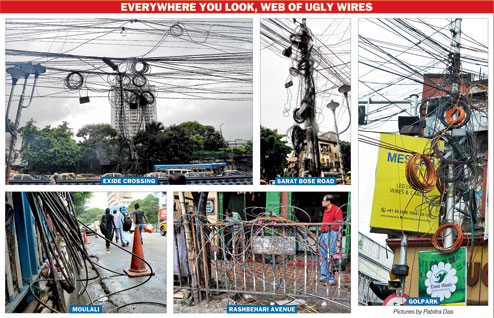

Aug. 30: Calcutta is trapped in a monstrous mess of overhead cabling that compromises public safety and belies all claims to beautification.
From cable television to broadband, power supply to tram operations, each service contributes to the bunch of wires dangling overhead wherever you go. And in a wired city in the wrong sense, the danger is that you often can't tell one line from the other. Early on Monday, three persons were electrocuted when a porter touched a railway power cable during an immersion procession after Ganesh Puja.
Metro highlights how Calcutta has become a web of wires even as New Town and Sector V take the harder but safer underground route for television, broadband, telephone and electricity cabling.
TV and Internet
The city has at least seven multi-system operators (MSO) that transmit cable TV signals through cables running overhead. More than 12 broadband service providers use the same method to reach their customers.
Since MSOs and broadband service providers are allowed to compete with each other across the city, poles in any neighbourhood are likely to have wires of all these private operators bunched under the power or telephone cables. The scene is even messier inside lanes, where wiring by local cable operators criss-crosses the concrete topography.
MSOs like Hathaway, SitiCable, Manthan, DigiCable and GTPL or broadband service providers such as Alliance, PMPL and Siti do not have an underground network because the administration has never forced them to create one.
Electricity
Homes, offices, business establishments and public utilities in wards 1 to 100 of the Calcutta Municipal Corporation get power through underground cables, although overhead lines still exist in parts of Jadavpur, Garden Reach, Kasba and Behala. According to a CESC official, the company has 5,300km of overhead lines, most of that in the districts. The West Bengal State Electricity Distribution Company Limited almost entirely has an overhead network that is more prone to disruptions and also a threat during storms.
Telephone
State-owned BSNL, the country's largest landline service provider, is supposed to do all cabling underground. But practical challenges force it to run overhead cables in several places. "Whenever a road is dug or construction of any kind starts somewhere, telephone cables are the first to snap. This inconveniences our customers, which is why we prefer to keep them overhead in some places," a source said.
Tram and train
There are 25 tram routes in Calcutta and the cars draw power from overhead lines. A senior official of the West Bengal Transport Corporation said that it was possible to have underground or ground-level power lines, but that would require a logistically and financially prohibitive overhaul.
"Ground-level power lines are possible only when there is exclusive space for tram tracks. They have to be like Metro rail tracks that draw power from the third rail," the official explained.
Trains too have overhead power lines that overrun public places such as a rail crossing or along the riverbank, where the Circular Railway operates.
Overhead history
Cable operators said the practice of overhead wiring started in the early Nineties and nobody gave it much thought until the city skyline turned ugly. Around nine months ago, mayor Sovan Chatterjee convened a meeting of cable operators and proposed that all cabling be done underground. "But we haven't heard from the civic body since," said one operator.
Overhead TV cabling saves money for service providers at the installation stage as well as during repairs. Unlike underground cables that require a casing, an overhead line only needs a pole.
New Town strategy
New Town has underground conduits criss-crossing the township. All cables, be it for television, broadband, electricity or telephones, pass through these ducts. Each service provider is given a separate duct between three and five feet wide.
The New Town Telecom Infrastructure Development Company, a subsidiary of Hidco, has created these ducts and service providers need to pay a fee to use them.
The Nabadiganta Industrial Township Authority that administers Sector V has adopted the same strategy despite some resistance from operators.