 |
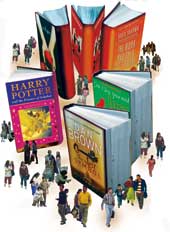
What is the English readership in Calcutta hooked to? Calvino, Eco, Garcia Marquez? Who are they? Derrida, Barthes, Bakhtin? What are they? Chetan Bhagat and Indian writing in other forms rule the city. Metro explores what the “culture capital” of India is really reading, as bookstores try to woo the “non-serious” reader.
Chetan Bhagat and his tribe: Ever since the former investment banker broke into the world of books with Five Point Someone, readers have been divided into two groups — those who love him and those who read him but say they don’t. The city accuses him of bad English, but buys him in enormous numbers. His latest, 2 states — the story of my marriage, has sold 2,000 copies in less than a month from Starmark’s Calcutta stores since it came out in October, when the sale of 5,000 copies in one month nationally is the benchmark of success for English fiction in the Indian market. “I was reading Two States in the Metro and I was approached by five women who wanted to know about the book. I was stunned by the contrast in age and profile of the five,” says 27-year-old Sohini Chatterjee.
Though everyone complains that Bhagat is writing the same book again and again, perhaps that is his strength. He writes about urban youth floating in a flimsy, filmi plot (Hello, a film based on One Night @ the Call Centre featured Salman Khan while the soon-to-be-released Three Idiots starring Aamir Khan and Kareena Kapoor is based on Five Point Someone), in colloquial English and with a finger on the pulse of young, middle-class India. A Chetan Bhagat book costs less than Rs 100. He has spawned a genre.
“Young authors such as Durjoy Datta and Tushar Raheja have the same style of writing. Some think their books are better but they maintain a low profile. They are very popular with the ‘non-serious’ reader, those who would normally read a magazine. These books have created readers out of them. Datta and Raheja sell about 50 to 100 copies per month at each of our stores,” says Gautam Jatia of Starmark.
In a newspaper interview, Raheja had commented: “I have never been a writer. I find it difficult to form flowing sentences. I don’t have a disciplined approach to writing.” But he added that he was a wizard at storytelling and possessed a sense of humour and a crazy, always-up-to-something group of friends. That seems to be skill enough for a writer.
Chick lit: OTT romance such as Mills and Boons may not be passe, but women looking for satisfying romance have another option. Chick lit, which aspires more to literature than the good old MBs and can broadly be described as fiction of, by and for young urban women, written, more often than not, funnily, sassily and with a happy ending, has in the city a captive readership. Much of it is written by Indian writers.
“I started on chick lit with the Shopaholic series and I found it an easy, breezy read. Chick lit is a good stress-buster, it’s like watching a movie and I could identify with the situation even if not with the characters,” says 29-year-old Sweta Agarwal.
But did we say for, of and by urban women? Ahem. Datta and Raheja, mentioned above, are counted among chick lit writers, too. Men have stormed another female bastion.
“Chick lit is something that appeals to the young reader of a ‘non serious’ nature. They are popular among those in the age group of 15-20 and even beyond. Many of them revolve around campus or office romance,” says Sidharth Pansari of Crossword, revising the definition of the genre. Titles that are doing well in this genre are Of Course I Love You..! Till I Find Someone Better by Datta and Manvi Ahuja (Srishti Publishers) and Almost Single, written by Advaita Kala.
“I prefer romance and fantasy. Literary fiction is okay if it is not too serious and the plot is otherwise engaging,” says 24-year-old Mrinalini Banerjee.
Supernatural romance: Move over J.K. Rowling. Stephenie Meyer is here. If Harry Potter and his friends made Hogwarts and Gryffindor House common parlance, today the centre of attention is Bella, her vampire lover Edward Cullen and werewolf friend Jacob. But it is really teen romance in werewolf’s clothing.
“My colleagues and I couldn’t stop reading the Twilight series and were all mooning over Edward,” laughs 28-year-old Priya Mukherjee, a content writer. The book sold 1,500 copies from Starmark’s city stores since its release in the city and did well at Oxford Bookstore and Crossword.
Dan Brown: Is a category by himself. The formula of history, religion and the forbidden, put together by his racy language, continues to sell. The Lost Symbol may not have done well internationally, but in Calcutta it is a chart-topper, selling over a 1,000 copies in one month from Starmark since its release.
Translations of Indian language texts: The size of the English readership is going up. The new readers want to read other Indian language texts. “The readership is growing by at least 10-15 per cent annually. There is a good demand for translations in Calcutta,” says Shashindra Nath Mishra, the chief operating officer of Apeejay Oxford Bookstores.
The demand is not just for English translations of Hindu, Urdu works. Bengalis are increasingly reading their own language in translations. “Satyajit Ray’s Feluda series is an all-time bestseller. The English translation of Sankar’s Chowringhee did extremely well too,” says Pansari. Jatia is contemplating creating a special section on translations at the South City outlet of Starmark.
Non-fiction: So much for fiction. But “non-fiction” as a category is a winner too. “At present non-fiction constitutes only 10 per cent of sales, but the demand is growing. Especially in Calcutta,” feels Pansari. Popular history and political writings are in demand, such as Empires of the Indus, William Dalrymple’s works and Barack Obama’s books.
Within “non-fiction”, self-help books — treated as a category in its own right by bookstores — occupy pride of place, as do cookbooks and health guides. “We sell about 30-40 copies of the writings of Robin Sharma and Dale Carnegie per month per store,” says Jatia.
Stay hungry stay foolish has managed to attract thousands. “They are packaged so well, they seem to scream out at me from the shelf of the bookstore,” says Sweta.
With the race to a size zero frame gathering momentum, weight loss books are very popular. “Rujuta Diwekar’s Don’t lose your mind, lose your weight is still a bestseller,” says Pansari.
Children’s workbooks and activity books: With increased availability in the city now, these books are a hot favourite with young parents wanting the very best for their kids.
Coffee-table books: These are picking up as gifts, especially as corporate gifts and gifts to your senior. “The advantage is that no one really looks at the price of a book. It is considered a sophisticated gift option,” says Pansari.
Readable “serious” Indian writing in English: Don’t lose hope. Serious has a market too, if it’s Indian. Perhaps the fact that so many of the authors are Bengalis or have Bengali characters in their writings helps. They smell of machh-bhat and panch-phoron, mired in the Bangali’s sense of rootlessness in a foreign land that is found in Jhumpa Lahiri’s fiction. Amitav Ghosh’s readability ensures he belongs to this category too.
“These are those who wouldn’t read Chetan Bhagat, but at the same time would want something a little less heavy than literary fiction,” says Jatia.
top five
 |
- Chetan Bhagat: 2 states – the story of my marriagev
- Stephenie Meyer: Twilight series
- Dan Brown (picture above): The Lost Symbol
- Rujuta Diwekar: Don’t lose your mind, lose your weight
- Rashmi Bansal: Stay hungry stay foolish
courtesy Crossword
otherwise, the city is...
 |
- Grooving to: Chiggy Wiggy (Blue) and Tum Mile title track
- Watching: Blue (for want of anything better) and Dadagiri on TV (ditto). Inglourious Basterds is not showing any more
- Eating: Pasta in ketchup
- Talking about: Kishanji and Atindranath Datta
- Dreaming of: A nice cold winter