 |
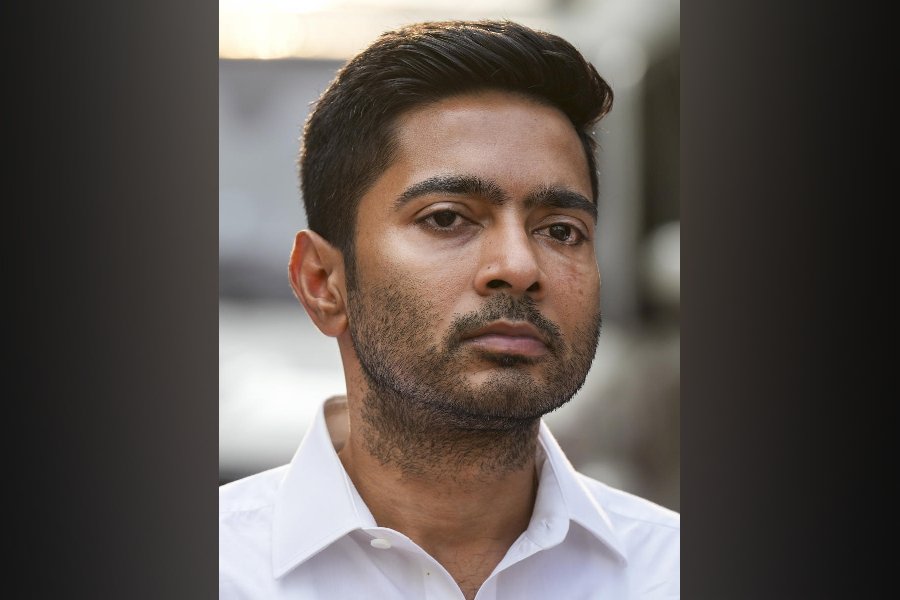
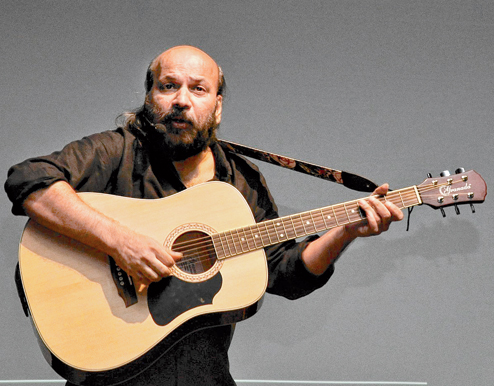
| Debojyoti Mishra at the programme at Max Mueller Bhavan. Picture by Anup Bhattacharya |
It was an evening dedicated to two dedicated men — Vikraman Nayyar, a journalist who travelled far and wide spurred by an urge to know, and Debojyoti Mishra, a composer par excellence who has helped many a filmmaker “create what he has in mind” and yet consciously and unconsciously given each track his own nuance.
The 10th Vikraman Nayyar Memorial Lecture presented by Nandimukh at Max Mueller Bhavan had Debojyoti speaking about his life and work. It wasn’t really a lecture demonstration or a formal masterclass, more an informal chat, a sharing of agony and ecstasy with friends and fellow artists.
The evening began with a snippet from Chitrangada: The Crowning Wish, a film by Rituparno Ghosh, who repeatedly turned to Debojyoti for music. The scene chosen was where Rudra the protagonist (played by Rituparno) is undergoing a gender operation and the voice of the doctor and the mechanical beeps of the operating theatre are woven into the orchestration just as Sanskrit lines written by Rituparno give way to Tagore’s Nutan pran dao, pranosokha to create a unique surreal experience.
“Some things the director has in mind but some are demanded by the film itself. It has its own life and compels us to add new elements. That is what happened here,” shared Debojyoti.
Next came a duduk recital by long-time team member and friend Vachagan Tadevosyan. It was this a 3,000-year-old Armenian instrument that created the soulful sound for the moment when Rudra in his hallucinations meets his counsellor (played by Anjan Dutt).
A brief reference to his work for commercials and Debojyoti was back to his collaboration with Rituparno. Talking about how Rituparno had “his own style of saying things,” Debojyoti shared an anecdote — after listening to a particular piece he had composed for Raincoat, Rituparno had said it seemed as though he was standing in the middle of the road with cars zipping past, the sound filling his head as he tried to see the cars but couldn’t see them. “I realised I had gone a bit overboard with my orchestration and started reducing it.”
More memories of the camaraderie followed — how Rituparno wrote Mathura nagarpati kahe tum gokul jao for Raincoat and read it out to his favourite composer at 5 one morning. “This was a revival but it was adding something new to the traditional Brajabhasha, Maithili traditions and creating a new situation — the longing of Krishna for Gokul.” Debojyoti spoke of how he had deliberately kept a tune as a refrain to Shubha Mudgal’s singing. “The choice of the voice for a composition is essential, rather like casting a role,” he said.
For Bariwali, Rituparno wrote Hoilo modhu mashe biya in the style of Manasa Mangal Kabya after he found it impossible to get songs to fit his films because “they aren’t written for me”. Together, Rituparno and Debojyoti created a music fit to express widow Banalata’s trepidus surrender to hopes and unfulfilled longings, a music that would simultaneously convey her sadness and loneliness.
Talking of his early years, Debojyoti remembered his father and ace violinist Jahnavi Ranjan Mishra who taught him to appreciate the works of Western classical musicians and conductors just as Salil Chowdhury also did later when Debojyoti assisted him for 14 years. Max Mueller, he said, was one place where he got to listen to live music.
The discussion turned towards Debojyoti’s first “real studio work” at age 17 with none less than Satyajit Ray. Playing a “violin part” in a large orchestra for Ghare Bairey, he realised how Ray was making his own conscious constructions for the song Eki labonyo purno prane. Adopting instruments that can give “straight sounds controlling the traditional meends and ghamakas…. I realised for the first time here was a man who perceived Tagore and music the way I do. I didn’t know much about Rabindrasangeet till then, listening to Debobroto Biswas I thought those were his songs”.
Debojyoti is writing a book on Ray’s music and he provided a glimpse into how the auteur worked on the scene where Bimala steps out of the andarmahal. Ray’s musical arrangement of the song Eki labonyo purno prane conveyed the glittering sounds of new-found joy and release with an underlying feeling of foreboding that prepared the audience for things to come. When Debojyoti used the same song in Chokher Bali, he stayed up all night scoring a thumri and then using orchestration to “clean up” the excesses and blending it with the gradually unfolding notes of the Rabindrasangeet to convey the feelings of Binodini who is leaving her physical self to awake to a new dawn full of possibilities.
“How Ray responded to Beethoven’s Fifth Symphony and how members of the Indian People’s Theatre Association did were completely different and significant,” said Debojyoti, who used the composition in his version of Dheu uthchhe kara tutchhe in Meghe Dhaka Tara (2013) to convey “the anger and agony and the undying optimism of Ritwick Ghatak and his times”.
The remarkable Moder kono desh nai, moder kono bhasha nai from the same film was born from personal fear. Some of it came from the feelings of his mother who always referred to Dhaka as her home and more from Debojyoti’s fears as a child when they were forced to shift from house to house as rent rose even in colony para. “We were refugees many times over. I had the image of Africa and a huge crowd, all of them singing.” For this song he also recomposed Abbasuddin’s Nao Chhayra De, giving it an arid sharpness that captures the pain and bewilderment of the age.
The narration ended with two live recitals of songs from Memories in March and Chitrangada by Somchhanda and Madhubanti. Visuals projected by drummer Nilanjan Ghosh and sound controlled by Bijit Prasad enlivened Debojyoti’s narration.