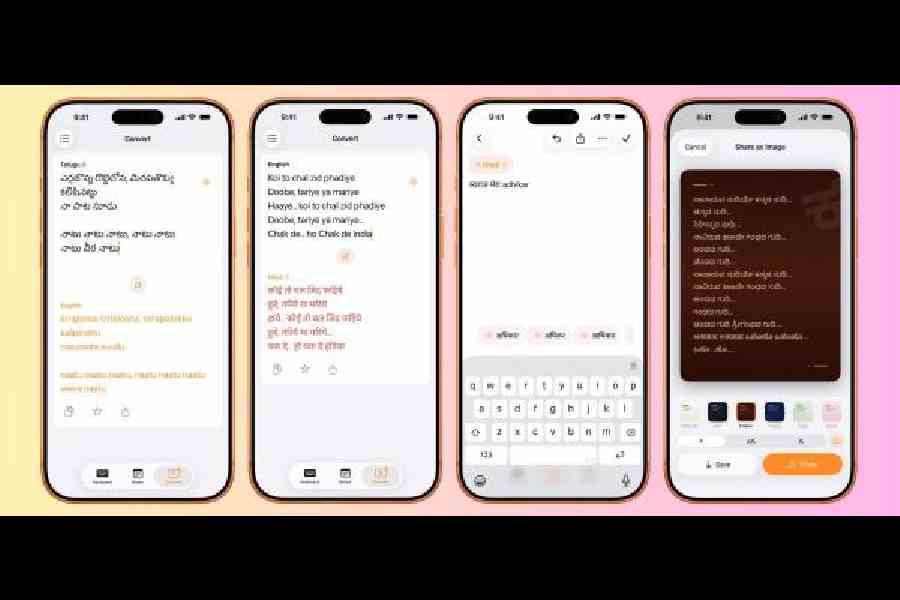
India may have 1.4 billion voices, but typing in many of its languages on an iPhone still feels a bit awkward. For years, users wanting to write in Hindi, Tamil, Bengali, or several other scripts have dealt with clunky keyboards, unreliable transliteration, or apps that gather data without notice. Enter Akshar, an iOS keyboard created by independent developer Krishna Permi, 35, in Bengaluru that offers a new solution. It supports 21 Indian languages, runs entirely on-device, works without an Internet connection, and does not send any keystrokes to a server. This makes it a unique privacy-focused choice for multilingual users. Users type words the way they sound in English and the keyboard suggests them in the chosen script, drawing from an open neural model from IIT Madras (AI4Bharat IndicXlit) packaged for Apple Core ML and run on the Neural Engine.

Krishna Permi, the independent developer from Bengaluru behind the app Akshar
Here’s what he has to say about his app, which we have been using for the last week.
In the next five years, do you think we will stop typing altogether in favour of voice or predictive AI agents, or will the akshar (the written syllable) always remain central to communication?
I think voice and AI agents will keep growing, and they already are the right interface for a lot of tasks — quick commands, search queries, casual messages, accessibility. But typing will not go away.
Three reasons. One, typing offers control. You can edit, refine, and choose your exact words in a way that voice cannot easily match. Writing is still the medium of poetry, formal letters, code, journalism, and anything that needs precision.
Two, typing in your own script is also an act of cultural agency. Voice models today are heavily biased towards English and Hindi at the production-quality end. A Konkani or Bodo, or Meitei speaker will keep wanting to type their own language, because their script is part of their identity, not a tax to pay before they get to communicate.
Three, and this is the bit quietly hidden in the name Akshar: the Sanskrit root means imperishable, indestructible, immortal. It is also the literal word for letter or syllable. The written letter has outlived every interface invented to capture it — reed pen, palm leaf, printing press, typewriter, smartphone keyboard — and I expect it will outlive this generation of voice and agent interfaces too. A Konkani grandparent in Goa typing to a grandchild abroad in 2031 is, I think, a perfectly likely scene. The keyboard is just the medium; the letter is the survivor.
The IndicXlit model appears robust, but no model is perfect. How does Akshar handle out-of-vocabulary words or modern slang that might not have been in the original training data?
Akshar reads what you type one letter at a time, not one whole word at a time. So even a word the model has never seen before — like “yaar” or “fadu” — can still be transliterated by stitching the letters together. There is no “we don’t know this word” dead end. After the model produces several possible Indic spellings, Akshar checks a list of how often each word appears in real-world writing to pick the most natural one. If the slang word isn’t in that list, Akshar simply trusts the model’s own ranking, which is usually still right. For a small set of common words, I knew the model would consistently get wrong, like “chai” wanting to come out as something else, I have a hand-curated correction list per language that overrides the model. And if all of that still produces something off, the user can tap any word in the keyboard suggestions, Notes or Convert screens to see other candidates and pick a better one. That’s the human safety net for the cases the AI can’t handle perfectly.
Transliteration is often context-dependent. Does the model look at the surrounding words in a sentence to predict the most accurate script conversion for a specific word, or is it purely a word-by-word mapping?
It is word-for-word. The IndicXlit model was trained on 26 million word pairs — not full sentences — so it does not look at the words around the word you are typing.
But there are two layers of softer context, both happening on the phone. First, instead of producing one answer, the model produces a ranked list of possibilities. Second, Akshar reweights that list using a per-language record of how often each Indic word appears in real writing. So when a word has multiple plausible spellings, the frequency layer tends to surface the one people actually use in everyday writing, ahead of rarer or stilted variants. It is a weaker form of context than full sentence understanding, but it catches a meaningful share of cases where a plausible-but-wrong word would otherwise win.
You offer 21 languages, including eight that are unique to Akshar on iOS. Why do you think larger tech corporations have overlooked languages like Bodo or Meitei?
First, the business case. A large company picking which languages to support tends to set its bar at tens of millions of speakers before a language gets prioritised. Bodo, Meitei, Konkani, Sindhi, Sinhala, Maithili, Kashmiri, and Assamese all sit below that bar in pure speaker count, even though most of them are constitutionally recognised in India.
Second, the data. Until recently, public data for training transliteration models in these languages was scarce. AI4Bharat changed that with the Aksharantar dataset — 26 million word pairs across 21 languages, the first public dataset to cover seven of those languages and an entire language family. Akshar’s eight-language list is essentially a downstream beneficiary of AI4Bharat opening that data.
Third, momentum. Once a major keyboard does not support a language, the speakers of that language have nowhere to demonstrate demand from, so the gap stays self-reinforcing. The way to break that loop is for someone to ship the support before the demand becomes “obvious” on a spreadsheet, which is the part where indie developers can sometimes outflank larger companies.
Keyboards are a massive privacy risk because they can see everything from passwords to private thoughts. How do you prove to a sceptical user that zero data is leaving the device?
The AI models ship bundled inside the app. Transliteration happens on-device using Apple’s Core ML — no server, no Internet needed. Users can turn on Airplane Mode, and it works the same.
You don’t have to trust me — verify it. Apple’s App Privacy Report (Settings > Privacy & Security) logs every connection. My App Store label says ‘Data Not Collected’, and Apple holds developers to that under their guidelines.
‘Full Access’ permission when setting up keyboard sounds scary, but it’s needed because the keyboard app shares storage with the main app, so it can read your settings (which languages you’ve enabled, sound preferences, autocorrect options). Neither of these involves sending your typing anywhere. It doesn’t mean your keystrokes are seen. Everything is on-device.