Even the 10k posts on fashion designer Prabal Gurung’s Instagram account do not prepare you for his world of hurrah and heartbreak that his memoir Walk Like A Girl plunges you into. First published by Viking in 2025, HarperCollins India has now brought it to Indian subcontinent. Equal parts searing and joyous, the candid narration takes you through Prabal’s prodigious journey from Nepal to the upper echelon of fashion that New York is.
He was born in Singapore and moved to Nepal when he was four. Prabal studied at National Institute of Fashion Technology, Delhi, and worked with the maverick designer Manish Arora in his initial years before enrolling at Parsons School of Design, New York. He left Nepal for good in 1999, that one bold decision changing his life forever.
He dared. He dreamed. He manifested. He believed. That same belief which aided his rise like a phoenix from the ashes, faced with every single adversity. Of which he had many in the course of the last two decades. And, all of which he has navigated with utmost grace and empathy.
Words which come up in our conversation when we meet him at Exide Kolkata Literary Meet, with The Telegraph, on January 25, at the Alipore Museum, prior to his session. I tell him how much the book has moved and emboldened me, and he promptly gives me a giant hug. The same heartfelt ease that’s there in his writing. Lucid language plays with simple and complex emotions that tug at heartstrings.
Comfortably dressed in a grey suit, sneakers and a hot white T-shirt, Prabal mirrors the muses he designs for. Unapologetically cool. His clothes have an effortless sensuality about them. Parts dreamy, parts power, travelling from classic to boho chic, never losing the drama though, and always a whole lot of fun. They are dreamy inasmuch as they celebrate diversity of viewpoints. There is a strange relatability in that eclectic magic, a magnetism that reflects in his rose-tinted glasses that hang on his nose when I meet him.
Life has been anything but a bed of roses for Prabal, though. It’s been a constant evolution, and you see that in his clothes. There’s always a charming surprise. In his celebration of femininity and edginess. Splashed with colours, Prabal’s positivity and joie de vivre come a lot from his mother, Durga Rana. His ‘mami’ is at the centre of his universe and of the book too. Yes, she has just gotten into weight training, Prabal tells me. That’s how cool she is!
The co-vice chair of the Council of Fashion Designers in America, a co-founder of the Shikshya Foundation Nepal, an NGO established in 2011, that works for the “holistic growth of children”, and a co-founder and board member of Gold House, “a cultural ecosystem that empowers Asia Pacific leaders”, Prabal has channelised his success, powering causes close to his heart. His fashion has always represented his beliefs. “Our job as creative persons is to tell stories that resonate with people, hopefully, and make them feel seen,” he says.
His eyes shine from behind his tinted glasses, no matter how tired he is. His warmth lies in his rootedness, his ability to connect with complete strangers and leave them with the belief in the power that lies within them.
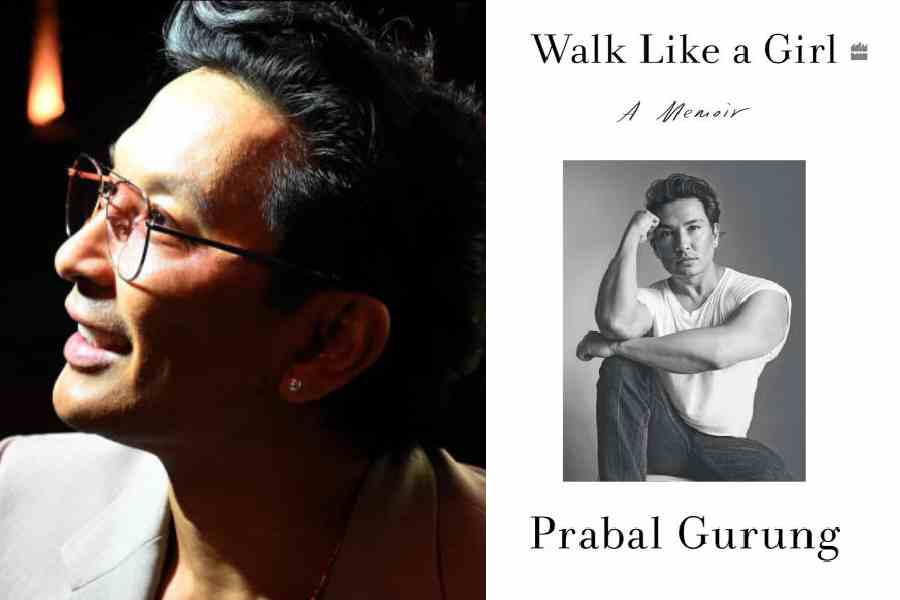
Excerpts from our chat with Prabal.
Walk Like A Girl is overwhelming. What was the starting point of the book for you?
I’d reached a place in my life where, oftentimes, people like me who are in the spotlight because of our work are told to share a story, but share a heroic story. Share a story that’s inspiring. I never thought about it till I got to a place where I said, I want to tell a story that talks about softness, about being vulnerable, being what is considered weak, and having strength in that. Because oftentimes, the narrative that is behind a perceived successful person is the one of like this brute force or something like against all odds, but oftentimes, those are also equated with something loud. And I wanted to do something that was quiet, something very personal, so that people felt that there are various ways of becoming who you are, and also, success just doesn’t mean one thing.
The title came to me when I was very, very, very young because people used to say that to me, ‘Oh, you walk like a girl’. And I didn’t understand at that time that it was a bad thing, to be completely honest. But when I realised it was something that was used to diminish me, I was like, one day... I didn’t know if I was going to write a book, I just said, I want to write something about it. And I got to a place where I was like, let me just share a story because I don’t want people to feel like they have to put on an armour constantly. It’s okay to falter. It’s okay to fall. It’s okay to pick yourself up, and it’s okay to share it.
It’s both heartbreaking and glorious. Where did you get the courage to be so brutally honest?
Perhaps, when you don’t fit the norm, you know, you’re oftentimes told to be quiet or diminish or go away quietly. Disappear. I didn’t want to, because to those people that I respected and loved, my mother and my siblings, I was very visible. And their love gave me the strength. If I’m visible to them, I can be visible to myself. And it gave me the courage to be myself, and being myself often meant it really annoyed people, or people didn’t like me. And there was a lot of bullying. All that stuff came my way, but I was like, I just don’t know how else to be.
In that lack of acceptance and in unbelonging in the majority while growing up gave me the freedom. And all of a sudden, I didn’t know what getting a validation meant because I never got one. So, I no longer needed it. So I was free, you know. And I will say, if I didn’t have the mother I have and siblings I have, I wouldn’t be able to do it. So, when I look back at my life now, even though it was painful growing up with all those boys constantly bullying me, I’m grateful to them.
You hear a lot of horror stories about people who are bullied, like, often there are tragic cases. I am grateful that I chose a life of joy, unapologetically myself. And it was not in defiance. It was the only way I knew how to be. And in my being myself was the defiance and the resistance.
How much time did you take to write this book?
It took me seven years to write this book. When you’re writing, you’re like, you write your story, and you’re like, ‘Is it worthy?’. Then you start thinking. Then I was like, okay, what am I trying to tell? Oftentimes, you get to a place where there are people who are involved in it, and they’ll tell you, maybe it should be this way.... ‘I hope it’s inspiring’. And then you’re like, what is their version of inspiration versus what is mine? I wanted to give myself grace and time, as well as the wisdom that comes with time. And so, it took me that long.
Did you cry while writing the book?
Living the life, I cried. And while writing the book, I had to hold back tears. And there were moments, yeah, there were extremely difficult moments when I had to revisit those. My sister is a voracious reader and an amazing writer herself. And she kept saying two things — she was like I want it to be unpretentious, and I want it to have grace. That’s all I care about in your book. And as I was writing, the writing part was still easy. Recording the audiobook, I’ve never done anything that difficult in my entire life.
Was it cathartic for you?
It was cathartic, but it was having to relive those (moments of trauma). And while you’re recording it, you can see it as if it had just happened to you seconds ago. It’s the hardest thing. So yeah, I cried. And I don’t allow myself to not feel things, because the way I feel things has allowed me to be who I am. And so it wasn’t easy. It took me a while. I ended a relationship while I was deep in writing. And then my father passed away.
I’m here today. I’m grateful that I’m able to sit down and have this conversation with you. It is still hard. You know, I don’t know if it’ll ever get easy talking about the book, talking about the experience, because…
You’ve laid yourself bare…
While I was writing, I was like, I hope it’s good. I hope people really like it. But then you get to a place where you’re finishing, and you’re just like, you know, it’s out there in the world now. By grace of the Lord, the universe, whoever is responsible, that it resonates with people. And not because they can see me, honestly. I hope they can see themselves. I hope it gives them the courage… I hope they can share stories. Imagine when everyone around you, besides your family, says to you, ‘Oh, it’s a big mistake, you’re becoming a fashion designer. Oh, it’s a big mistake, you’re going to do this.’ And you’re like, you know, I’m a human being. So there are times like, am I? And I was just like, what the heck, man, let’s just give it a shot. I’m unafraid to fail.
That’s been your biggest success mantra, you think?
Perhaps. You can’t take anything with you. And my mom always says this. I talk to my mother every morning, you know, and she lives in Kathmandu, and I’m in New York, and sometimes she’ll come to New York. And she says, at the end of the day, Prabal, you can’t take all this stuff with you. All you can do is how you make people feel. That’s all it is.
If you can live your life with utmost honesty and joy, that is inspiring enough. She’s the best person. I love my mother. She’s like a beast and started weight training. And I said, how is it? And she’s like, ‘I’ll know in three months. I can’t tell right now’. She’s very tough, you know (laughs).
Who did you give the first copy to?
My sister, because not only is she protective, but she’s also extremely honest, and she is an incredible writer. She reads a lot, and she’s extremely thoughtful. I always say my brother and my sister are my best friends, you know. And so when she read it, she just said, ‘I’m proud of you’. A lot of those things that happened to me, I hadn’t told them because I didn’t want to cause them pain. But I was finally at a place where I was like, you know what, I can do this. After that, my brother and then my nephew and my niece, who are brutally honest too.
Any of the boys who bullied you, did they get back or write back?
No, no, they haven’t. When I was in Kathmandu, I ran into a bunch of them. I didn’t use real names just because I needed to give them that much grace. I look at them as victims of patriarchy. I understand them. I understand the circumstances. I don’t forgive them for what they’ve done to me or to others. But what I can do is, I can understand that. And I have that much empathy. And you know, if you look at the world we’re living in now, it hasn’t changed that much. We still celebrate brute force. The masculinity that almost feels like a caricature, you know, we celebrate those. So all I can say is, I release you, good for you, on your own. I hope it doesn’t get passed on to your children. That’s all it is.
Your label turns 20 soon. The journey has been like a film. Do you just pinch yourself to kind of tell yourself that all this actually happened?
You know, I don’t till now. I am constantly moving forward. Again, my mother. She says, karm karo, fal ki chinta mat karo, from the Bhagavad Gita. But when I come here (the Literary Meet), I’m like, this is surreal. I’ve looked up to so many of these writers, and I read their books, and I love it, and to be amongst them....
So, in terms of fashion in 20 years, I’m glad I just followed my instinct, and that’s why solitude is important. That’s why sometimes being alone is important. That’s why not fitting in is important. Unbelonging is an incredibly powerful thing because it allows you to discover yourself. That’s what I believe.
We have to talk about Diljit Dosanjh’s look from Met Gala 2025 that broke the Internet...
The conversation started with my brother, who lives in Mumbai. He’s a film director there. We always talk about Deepika (Padukone) and Alia (Bhatt) (at Met Gala). And he was like, have you thought about Diljit? And I’ve always loved Diljit as an actor and musician. He performed at Coachella. What really struck me was how unapologetic he was. So, I reached out to Diljit and invited him. You know, I obviously got an approval from the Vogue team and everyone.
And when I reached out to Diljit and he said yes, we had this conversation… I always give them freedom to tell me what they want to wear. When he said what he wanted to look like, which is heritage, we worked on the look together. It was so moving for me because here was someone who spoke like me, understood the power of being unapologetically yourself and using his platform. So it was the easiest conversation. The first time he came to my showroom, I said ‘Sat Sri Akal ji’, and he was like, ‘Oh my God’,… I said ‘Mainu Punjabi gal karni aati hai thodi bahut…’
So, it was easy, you know, and when we went to the Met Gala together, people didn’t know who he was, but the minute he showed up there, there was a collective gasp, and the cameras went like... and I looked at him, and I just knew it. It was a moment. And everyone came up to him. There are people who knew his music and everything.
My job as a creative person who’s had access to a rarefied space like the Met Gala, is to create space for someone, another person who’s unapologetically himself and to be able to do that, and like step back and let him shine. That’s my job. I don’t need to shine. I need them to have a moment. That was really incredible. And I would say that was one of the moments when I felt like I did good.
The fact that you’re saying this, that the spotlight can be on someone else, you have to be incredibly secure in yourself as a person to actually say that. How have you arrived at that? It’s not easy.
It’s not. I’m very secure about the story I want to tell through my work, through words, through fashion. Does it always land? Maybe not. But I’m okay. I’m okay to make mistakes. I’m okay to learn. And that gives me the strength, you know, to be able to just be like, let’s just do it.
I know what it feels like to be the only one at the table. When you’re given access to this rarefied seat at the table, and when you’re the only brown person there, or when you’re the only person of colour there, I know what it feels like.
Now to see a table that’s more open to this, that I’ve been able to create that, whether through Alia or Deepika or, you know, Diljit, it’s been such a joy for me. I hope that now they open more doors. Our job as creative people, like fashion designers, writers, musicians, everyone, is to tell stories that resonate with people, hopefully, and make them feel seen, giving them the power to tell the story. That’s all it is. That’s our job. That’s the only thing you’re supposed to do — to make people feel seen.
What would be some of your other favourite moments from work that you’ve done?
I would say when I dressed Michelle Obama, the first lady. It was representing the continent (Asia), Nepal, and also India, because I lived there for 15 years and went to school there, you know. And it had such a huge impact on my career. So that was really monumental. When Oprah Winfrey wore something for the cover, you know, that was amazing. Dressing Kamala Harris, the first female vice-president of America.
My dream is to take Arundhati Roy to the Met Gala. That would be the dream, the ultimate dream.
Dressing Madonna remains a dream…. Have you met her?
Yeah, it remains a dream. Yes, at the Met Gala. She embodies unapologetic fearlessness, you know.
Do you veer towards these kinds of women?
I veer towards women who are unapologetic. People who are willing to be themselves. It’s not easy fighting patriarchy. When I see women who are able to do that day in and day out, I’m just like, wow, it’s inspiring. So, I’m always like, if I can somehow help them in a small way, whether through dressing or just being there, you know, supporting, that’s a job well done.
Your clothes are a celebration of your South Asian heritage. But it’s also got structure and fluidity. Is that how you see women, powerful yet with grace and elegance?
I always say, I live in the dichotomies of opposites. I love that. I love complexities. It’s the layered, complex, nuanced ideas that oftentimes feminine-leaning people or women have come with. It is very heart-led. Oftentimes, even in our mainstream films and everything, the actors just have a few things to do. Fight, protect, save, and grunt. Actresses have so many nuances, you know, with their ada, and I love that. That’s how humans are.
How much has America changed in the last 20 years?
I would say, I think we all consume news. So, we know how America has changed. You know, it has changed in ways that we didn’t fathom. But it’s also changed in the way that has given new voices like Zohran Mamdani... and like the revolution that’s happening on the streets, you know. And that’s really incredibly inspiring.
And it’s also allowed creatives to tell stories in various forms, various ways. Not always in a pedantic kind of an obvious way. There are a lot of nuances.
Progress is never linear. It is always back and forth. And so, we are in this place where I think the world and all of us, America, need to be reflecting on what our next decade or so is going to look like. It’s really going to define how we are. What remains hopeful for me is the freedom of speech, even though it is at times challenged right now. There is still something that in America we hold in such value.
Are you scared, sceptical or resigned to what is happening around us?
No, no, never resigned. I always lead with hope and radical hope because that’s the biggest resistance. The majority right now wants us to be cynical and hard. I refuse to give in to it. I am cautiously optimistic. Because there is a consciousness in people who have perhaps been, let’s say, kind of complacent, to wake up and feel, have this conversation. The conversations are intense. It’s a moment of reckoning for all of us.
How has your label evolved?
I would say it has evolved into storytelling in a very nuanced way. I have given in to creativity and used creativity as a power of showing visibility to different kinds of people, different stories. People of different walks of life who are celebrated on the runway, who don’t often get the spotlight... giving access to other voices. It’s also time for us to sit back and not sit back complacently, allow space for others also. It’s extremely important.
Why have you not done a show in India?
Honestly, I’ve been dying to do it. I want to. It has to be with the right partners, the right thing. I come to India, and I hear from other designers also, because I was perhaps one of the very few people who have been able to break through in the West... I want to share this story about how in our unapologetically accepting ourselves lies our power. I want to bring that story, and I would love to do it. That’s been a dream, honestly.
Who are your friends in the fraternity from India?
In the industry, I don’t talk to them regularly, but I do know Manish Malhotra, Tarun Tahiliani, Suneet Varma. I used to know Gudda (Rohit Bal).
A lot of my friends are from the film fraternity also. I keep in touch with all of them. I always say to everyone, not everyone has to be political or anything. We just have to do our job in the most meaningful way.
Whose collections do you really like or look forward to coming out of India?
I would say Tarun is one of them. The reason I say Tarun is because of his ability to reinvent himself and yet remain true. I really love his work. I’ve always loved his work.
Have you been to Calcutta before?
This is the first time. I was telling my friends, the minute I arrived... the energy is so gentle. Anywhere it’s a creative hub, when there’s a respect for art, there lies a soul. And I feel that in the city.
What are you taking back?
Oh my God. If I could, I would take all the fish dishes!