Football is becoming increasingly robotic and vertical. Position No. 10 is a rarity; the modern game is now overloaded with money, systems and commercial noise.
Clubs are now multinational brands. Players become data assets before legends. Coaches speak in tactical dialects as if it’s a corporate presentation. Forget Pele, Diego Maradona or Lionel Messi, football is missing a Juan Roman Riquelme or a Carlos Valderamma. The languid style, a nutmeg, and a defence-splitting pass which can change the course of the game in a second.
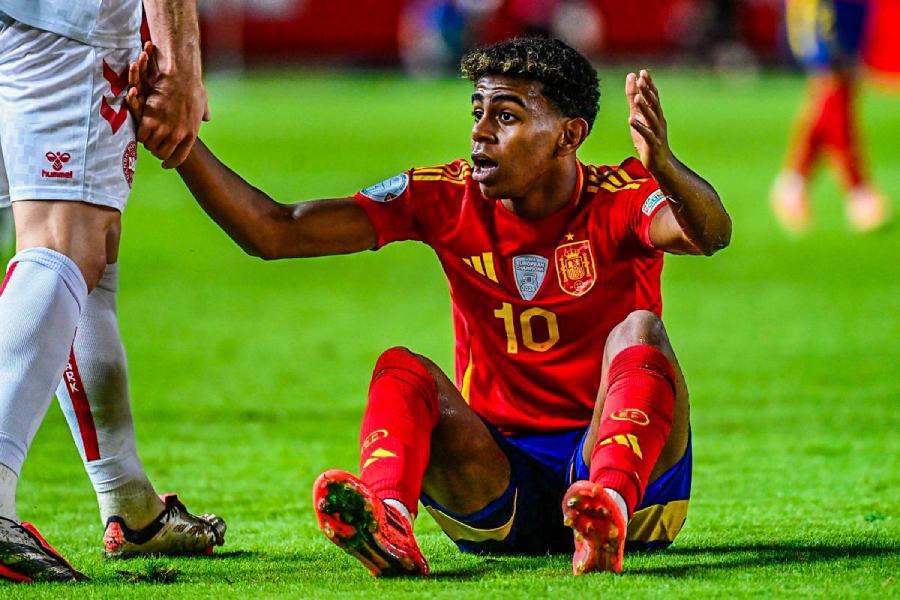
In this scenario, a Lamine Yamal comes as a whiff of fresh air. Yamal has a unique, game-breaking ability to consistently beat defenders by himself, regardless of how many opponents are in front of him.
As Uruguay’s Argentine coach Marcelo Bielsa points out. “If you have a player like the Barca winger (Yamal), who you give the ball to and it doesn’t matter if there are two or 10 players in front of him, he dribbles past them anyway... That type of player solves the offensive game. He breaks the analysis and makes his team better because he removes opponents on his own, without anyone’s help.”
That’s the beauty of football. When you think the game has become a prisoner of its own device, football brings forth a rare talent like the Spaniard, who at 18 is already a European Championship winner and two-time La Liga champion with his club, Barcelona.
As the World Cup starts in North America on Thursday, Yamal is expected to give us memories. Memories that will be afresh even after 50 years. Like Pele’s volley in the 1958 World Cup final against Sweden, Maradona’s goal of the century against England in 1986, Zidane’s headbutt that felled Marco Materazzi and earned the former a red card, Messi’s strike against Mexico in Qatar that revived Argentina’s World Cup campaign, or Roger Milla’s dance after every goal he scored for Cameroon in the 1990 World Cup.
Life now gives the impression that everything is engineered. Algorithms predict our tastes before we form them. Streaming services complete our moods. Social media turns spontaneity into performance. But it’s not the same when the World Cup arrives.
It still offers unscripted collective emotion. So here you cry with Maradona after the 1990 World Cup final setback, you feel for a distraught Italy wizard Roberto Baggio when he volleys over the penalty against Brazil in the 1994 edition, or gasp in disbelief when you find Ronaldo’s name missing from the Brazil team list in the 1998 Cup final against France.
These emotions are the same irrespective of which part of the world you are in. Calcutta, Calicut or Casablanca, it does not matter. For a nine-year-old football fan, the first impression of the tournament was Marco Tardelli’s celebration after scoring Italy’s second goal against West Germany in the 1982 World Cup final. Known as “L’urlo di Tardelli” (The Tardelli Scream), it is one of the most iconic moments in sports history.
Ditto for former Mohun Bagan coach Sanjoy Sen, then in his early 20s. “If my memory serves me right, the first taste of the World Cup was watching Paulo Rossi (Italian striker) on television in 1982,” Sen, now in his mid-60s, tells The Telegraph. “Then 1986 happened, and we were floored by the genius of Maradona,” he adds.
So here you are, two from different decades, united by memories. In 1986, children were so enamoured by former England striker Gary Lineker’s crepe bandage on his left hand, that every kid was flaunting one during those late afternoon kickabouts in the neighbourhoods. Lineker had flashed his trademark grin when this reporter narrated to him how he was idolised in Calcutta during an informal interaction in Rio de Janeiro, 28 years later.
Emotions can sometimes be deceptive. For example, even 30 minutes after Argentina ended their 36-year wait for a Cup triumph in Qatar, their fans still could not believe that. One supporter was so shaken and stirred by Kylian Mbappe’s hat-trick, that he could not stop from asking this reporter if the match was actually over.
You could not stop laughing, but that Argentine fan was not alone in having the same feeling. There were innumerable spectators across the globe who thought Mbappe would prolong Argentina’s wait for the third star on their shirt.
Remember Messi’s creased forehead when Randal Kolo Muani had only Emiliano Martinez to beat, and the Argentine goalkeeper made the save of his life? And how beaming the magician’s face was when he kissed the World Cup on the podium. It gave a high. To think he was feeling just the opposite as he walked past the trophy with tears welling up at the Maracana in 2014.
Messi in Qatar was not merely a footballer winning a trophy. He became the resolution to a global narrative people had emotionally invested in for nearly two decades. The story mattered because people carried fragments of their own lives through his career: Childhood, aging, failure, persistence, and redemption.
From Dhaka to Calcutta to Kochi to Bengaluru, Messi with the World Cup (the only trophy that was missing from his cabinet) is the frame everyone yearned for. That’s why, probably even the journalists were seen crying on that memorable December 18, 2022, night. Sen does not see anything outlandish in that. “After all, it’s a passion. Football is all about emotions, excitement, fightbacks, nervousness, silly mistakes, great comebacks, missed chances and brilliant saves. You can keep on adding.”
Yamal can evoke an emotion akin to that. A Muslim — he holds both Moroccan and Equatorial Guinean heritage — who turns up for Spain, where sports federations and the government are trying their best to weed out racism, Yamal himself was booed by Real Madrid fans during the Clasico in October 2025.
A soon-to-be 19-year-old (his birthday is on July 13 and he will be in the US if Spain stay in the tournament that far) rallied for Mohamad Salah when the Egyptian was a victim of vitriolic racist and Islamophobic chants during an international friendly in Barcelona (RCDE Stadium, not Camp Nou).
“I understand that not all fans are like that, but to those who chant these things: using a religion as a taunt on the field makes you ignorant and racist,” he had written on Instagram.
He arrives in North America for his maiden World Cup with a burden of expectations, something similar to what Maradona endured in his first in 1982. Every move scrutinised, every action discussed threadbare.
There are concerns after he missed the final stretch of the season with Barcelona because of a hamstring injury, but Spain is bullish on Yamal regaining fitness. This adds to the pressure.
“I am waiting for a talent like Yamal to emerge,” coach Sen says.
Well, he is not the only one. The entire world wants that. To tell the tale of a new hero and a new story.