
Looking at the crepuscular paintings of Abanindranath Tagore, many of them painted between the 1920s and 1930s, now on show in the portrait gallery of the Victoria Memorial Hall, one realizes why it is so damnedly difficult to reproduce them in print. Even in his famous paintings of the Arabian Nights, the jewel colours seem to glow under a patina, like gems worn by a veiled lady. Although Abanindranath was clearly employing the style of Mughal and Rajasthani miniatures, or even Japanese wash, as the case may have been, his colours do not shimmer. Even the white peacock is far from white. Instead, they exude the muted luminosity of a landscape seen by moonlight.
It is indeed a great privilege to view 123 rarely-seen works by the master at this exhibition being organized in collaboration with the Rabindra Bharati Society. The exhibits were chosen by Baroda-based scholar Ratan Parimoo, and cover the major periods of his career as an artist. But the works are so detailed, the minutiae are barely visible because of reflections on the glass fronts.
The very first picture sets the tone for the exhibition. In this charming brush drawing, he portrays himself as a grandfather resting on an easy chair, smoking a cheroot. Next to him on a table is a portrait he painted of his little grand daughter along with a note on gifting it to the child. This is the playful mood we can observe in many his major suite of works like the ones based on the Arabian Nights, where not only does he take liberties with the stories but also with their locale and milieu. Although like the ancient Sindabad in his painting he travelled little (the ship behind him is a toy), his mind was fancy-free. Echoing his uncle's verse, 'kothao amar hariye jabar nei mana, mone mone', he could go adrift anywhere - in his mind.
The pictures are arranged chronologically (most dates are mentioned in the captions, some of which are flawed) and this gives us a fair idea of Abanindranath's evolution as an artist. After the initial attempts at sketching, we find the stylized Krishna Leela of 1895, with its etiolated Edwardian era fashion plates in Mughal miniature fancy dress, and the accompanying Bengali verse in Persianized script. Although he did not receive any formal training, as in many upper class homes, he did receive lessons in Western realistic art from Italian artist O. Ghilardi, and later from an English artist, C.L. Palmer. But the same man who 'wrote pictures' had famously joined hands with Ernest Binfield Havell, principal of the Government School of Art, Calcutta, who developed a mode of art and art education based on Indian rather than Western models. In his celebrated painting, The Passing of Shah Jahan, he clearly had a Mughal miniature in mind, although the medium is oil.
Abanindranath's nationalist sympathies could not have been more apparent than in his resplendent Bharat Mata. He participated in the scholarly discourses of his coevals, A.K. Coomaraswamy and Sister Nivedita, on reviving the glories of ancient Indian art, and sought to rescue contemporary Indian art from its rigid conventions. His exposure to the Japanese wash technique spurred his endeavour, and hence his forays into the world of myths and legends which he looked at from a very personal perspective. Abanindranath may have been one of the artists who spearheaded the Bengal School movement, and his Bharat Mata may have been regarded as one of it cornerstones, but this protean genius could not be confined to any clear-cut definition. Moreover, as an artist he had an eclectic style, and he did not mind helping himself to trends from the West and playing around with them, often giving them a naughty twist.
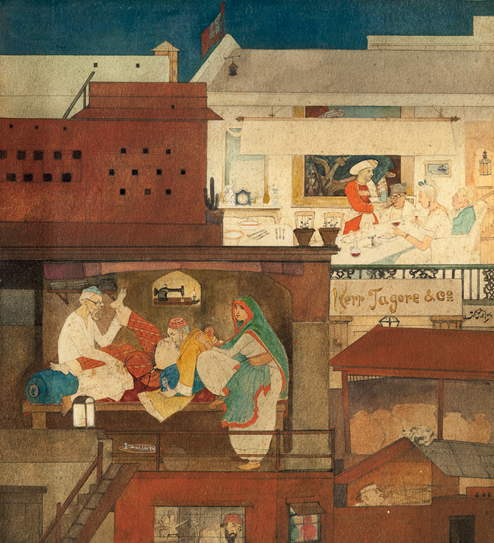
His rotund Rati and Falstaffian Kamadeva are more like characters from opéra bouffe and would hardly inspire lust. He let himself go when he worked on the Arabian Nights and the amazing masks. He sanitized the former, but he was certainly enjoying himself when he located these exotic characters in Chitpur and his familiar milieu. He looked at each scene from so many perspectives, all included within a single frame. Beneath Nuruddin's colourful wedding procession is a dark kitchen and a bare-bodied Muslim servant, and windows with lunettes - sights we can still see in Chitpur. The three sisters smuggle in a box of forbidden goodies. And although the tailor, his wife and the hunchback are the focus of his painting, the signboard of Kerr Tagore & Co is a reference to Dwarkanath Tagore's failed enterprise (picture).