
It is difficult to write a convincing account of the oeuvre of Paresh Maity without being reductive. As an artist, Maity effortlessly oscillates between watercolours and oils, the realist and the abstract idioms, landscapes and non-representational figures. CIMA Gallery, along with the Birla Academy of Art & Culture, has organized a retrospective of the artist's works, entitled Sounds of Silence. The exhibition is open till January 16 and shows a range of installations, paintings and sculptures by the master, spanning over three decades of his immensely successful career. The retrospective features 32 oils, 13 watercolours, three mixed media works, 15 ink drawings and seven installations and gives a glimpse into the evolution of an artist whose style and theme have undergone radical transformation.
Over the years, Maity has moved from landscapes delineated in the realist idiom, to more abstract works that incorporate themes, figures and images culled from his childhood days spent in the idyllic surroundings of Tamluk. And even though he has mastered the sophisticated styles of modern European art, many of his works continue to incorporate vignettes from the daily life of rural Bengal. Thus the Turner- and Constable-inspired watercolours of his early years have given way to more abstract compositions in oil, in which figures and objects are broken down and reassembled haphazardly on the surface of the canvas. Human and animal forms with exaggerated features, geometric shapes and sharp contours can be found in some of his installations as well. In spite of such Cubist propensities, indigenous themes abound in several of his paintings. Thus, in works such as Formation of Life (2013), Life is a Music (2014) and Sound of Music (2015), we find the non-figurative abstraction of jatra or the itinerant folk theatre and the Bauls, the mystic minstrels of rural Bengal. In warm hues of red, yellow and blue, they capture the unceasing itinerancy of life interjected with love, music, intimacy and celebration. In Life is a Music, figures of men, women, birds, flutes and drums happily merge into one another on a massive, round canvas mirroring the coming of all things, animate and inanimate, into a full circle.
If the circularity of existence is the theme of his jatra series, his landscapes are a visual ode to nature and its conflicting principles: order and chaos, calmness and turbulence, colour and starkness. In his early works such as Winter Light (1987) we see muted tones of grey, white and brown. The effort in such works is to depict the natural surroundings faithfully. Those would give way to an array of colours: scarlet reds, vibrant blues and luminous yellows in most of his latter creations. Morning Passion (2008), for instance, portrays the flaming red hues of the twilight hours, while Mountain Melody (2008) foregrounds pitch-dark mountains against the misty sky done up in a range of blues.
Compare these to the stark and minimalist ink drawings of Venice and Benaras. The ghats of the temple town along with resting boats and filigreed towers and the expansive waterfront of Venice with its floating gondolas are delineated in the bare simplicity of black and white in works such as City of Ultimate Peace (2008) and in Waterfront and Venice, both done in the year 2001. Yet in some of his recent explorations of European towns and Benaras, he once again returns to warm shades of maroon, blue and yellow. The dalliance with the abstract, however, continues in works such as Medieval Town (2015) and Reflection of Passion (2015), as he convincingly portrays the quaint red-brick roofs of European towns and the ornate towers of Benaras in classic Cubist features: sharply outlined images, heavy use of geometric shapes and erratic placements of objects across the planes of the canvases.
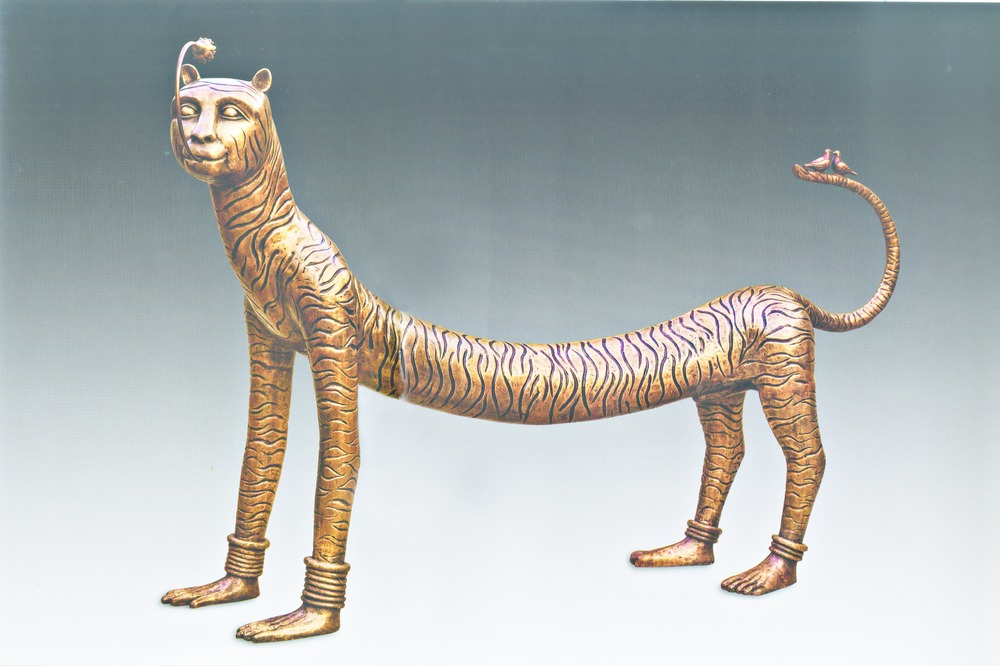
His intimacy with nature, people and animals comes to fruition in the giant installations and sculptures. One particular sculpture in bronze, Fantasy (2014), caught my attention. A giant, tiger-like figure stands at the entrance to the CIMA Gallery. Its tail is pointed upwards, as if it is ready to pounce. However, its ferocity is offset by a strange, beatific smile and a pair of lovebirds perched on its tail. The limbs of the animal resemble those of a woman, complete with thick bangles. A lotus-like flower sprouts from its mouth symbolizing fecundity and abundance. This strange amalgamation of human and animal forms, once again, is a commentary on the state of nature, where all life forms depend on one another, where the precariousness of nature co-exists in perfect harmony with its nurturing abilities.
This show happens to be the 74th solo exhibition of Maity. From traditional watercolours of landscapes to giant installations that transform protean objects of daily life - such as bells and motorcycle spares - into objects of beauty, Maity has been continuously evolving in terms of the use of artistic media, styles and techniques. But unlike some of his themes, where life seems to come full circle, this maverick of an artist refuses to remain faithful to any particular medium of art. Like the itinerant folk theatre groups or the Bauls of rural Bengal, he, too, seems to be incessantly moving in search of the unique and the unconventional.