I was recently reading a remarkable Bengali book, Bangalir Mon (The Bengali Mind), by the senior civil servant, Alapan Bandyopadhyay, which offers an incisive and original account of how the social, political, and economic transformations of the past two centuries have shaped the Bengali psyche. It’s not a long book, but it is magisterial in sweep and rich in counterintuitive insights — particularly on the Bengali bhadralok whose long, slow ‘crisis’ Bandyopadhyay dissects dispassionately. As West Bengal prepares to vote, it seems worth revisiting some of his observations and situating them within the stakes of the present moment.
As I write, the familiar theatre of accusation and counter-accusation goes on with ritual intensity. Yet, one can’t escape the thought that beneath the noise lies a quieter, more consequential, drama — one that concerns not the immediate fate of the All India Trinamool Congress or that of the Bharatiya Janata Party but the historical trajectory of the bhadralok, a status group that once imagined itself as Bengal’s natural custodian.
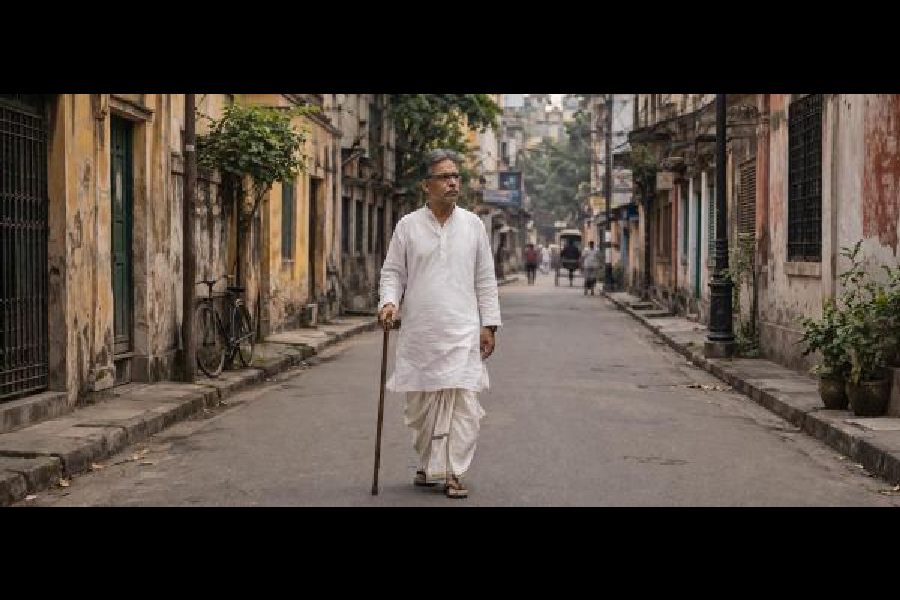
For over a century, this primarily upper-caste, educated, urban, disproportionately Hindu group had occupied a peculiar position in Bengal’s political and cultural life. More than a ‘class’, it was an ethos forged in the crucible of colonial modernity and the so-called ‘Bengal Renaissance’. The bhadralok mediated between empire and society, between tradition and reform, between nationalism and cosmopolitanism. Their authority derived not from numbers but from cultural capital — education, language, and a self-assigned role as interpreters of the public good.
Today, as that authority stands eroded, this election presents them with a paradox. They are courted rhetorically by both sides. The ruling party invokes Bengali identity and cultural pride, often framed as resistance to a homogenising, ‘outsider’ nationalism. The Opposition appeals to anxieties around putative demographic change, minority ‘appeasement’, and a perceived erosion of Hindu interests. Both, in different ways, seek to activate the bhadralok’s historical anxieties about loss, displacement, and cultural dilution.
Yet, in electoral arithmetic, they scarcely matter. The transformation of West Bengal’s political landscape over the past five decades has steadily displaced them from the centre of power. The Left Front’s long tenure, beginning in 1977, initiated what might be called the democratisation of political agency. Land reforms and rural mobilisation shifted the locus of politics from the urban elite to the peasantry and the subaltern classes. This was not merely a change in policy but in political culture. The bhadralok’s claim to moral-intellectual leadership was quietly undercut by the assertion of those who had historically been its objects rather than its agents.
The rise of populist welfare regimes, direct benefit transfers, and identity-based mobilisation in the post-Left period has further entrenched a politics where numerical strength and immediate material interests outweigh abstract ideological discourse. The idiom of politics has moved from the bhadralok’s cultivated rhetoric to a more visceral, performative style often dismissed as ‘low-brow’. But that very dismissal betrays the residual elitism of the bhadralok gaze.
One might ask whether mass democracy, grounded in universal adult franchise, was always structurally at odds with the dominance of the bhadralok whose ‘golden era’ predated even the rudiments of representative government. With rising voter turnouts and the deepening of democracy, the terms of legitimacy have shifted decisively. The bhadralok’s historical discomfort with mass politics is not new. As Joya Chatterji showed in her seminal Bengal Divided: Hindu Communalism and Partition, 1932-1947, sections of the Hindu elite in late colonial Bengal, uneasy with the prospect of majoritarian rule in a religiously diverse province, flirted with the ideas of communal representation and even separatism. The debates preceding Partition were marked by precisely this anxiety: that numerical democracy might displace cultural hegemony.
Partition reshaped the bhadralok psyche profoundly, with the trauma of displacement — especially among Hindu refugees from East Bengal — producing a complex amalgam of victimhood and resilience. It reinforced a sense of historical grievance, even as it deepened attachment to a secular, linguistic identity that could transcend religious divides. This ambivalence between a cultural Hindu self-understanding and a professed secularism has remained central to the bhadralok political imagination.
The Left Front years provided a temporary resolution. By subsuming class over community, and by privileging ideological coherence over identity politics, the Left allowed the bhadralok to retain a sense of relevance. They may have ceded electoral dominance, but they continued to shape discourse through academia, media, and cultural institutions. It was, in effect, a tacit compact — now dissolved — the masses would rule electorally, but the bhadralok would interpret the meaning of that rule.
In contemporary West Bengal, political legitimacy is increasingly forged outside the traditional spaces of bhadralok influence. Grassroots mobilisation, welfare networks, and identity-based solidarities have created new centres of power. The rise of subaltern voices — lower castes, Adivasis, Muslims — has not only altered electoral outcomes but also transformed the very language of politics. The bhadralok, accustomed to setting the terms of debate, now find themselves reacting to narratives they do not control. The present election epitomises this bhadralok dilemma, which is not simply about choosing between two parties but about confronting their own historical displacement.
One response is to retreat into identity. The appeal of a broader Hindu consolidation, as articulated by the BJP, resonates with sections of the bhadralok precisely because it taps into long-standing anxieties about demographic change and cultural erosion, reframes them within a national narrative of ‘civilisational’ resurgence, and thus offers an escape from the uncertainties of subaltern democracy. And yet, from the reformist impulses of the 19th century to the secular-nationalist ethos of the 20th, the bhadralok engagement with religion has often been critical, even sceptical. To embrace a homogenised, assertive Hindu identity would require a rupture with that intellectual inheritance and a renunciation of the cosmopolitanism that once defined them.
The alternative is to reaffirm a pluralist-linguistic-cultural identity, as the ruling party attempts. By foregrounding Bengali culture and resisting perceived external impositions, this strategy appeals to bhadralok sensibilities of regional pride. But here too, the ground is unstable. Cultural assertion, when coupled with patronage-driven politics, can appear hollow. It also does little to address the bhadralok’s structural marginalisation within the state’s political economy.
Is there, then, a third possibility? Can the bhadralok reimagine their role, not as arbiters or custodians but as participants in a more genuinely democratic polity? This would require relinquishing nostalgia for lost dominance and engaging with subaltern aspirations on their own terms. It’s, admittedly, a tough ask, but it would at least entail seeing the rise of Dalit, tribal, and minority voices not as a distortion of democracy but as its fulfilment. This might allow them to regain relevance as interlocutors rather than overlords, and as contributors to a plural public sphere rather than its gatekeepers.
Whether this is politically feasible is another matter. Electoral mobilisation thrives on polarisation, not nuanced introspection, and, so, the bhadralok voice risks either marginalisation or co-option into narratives that ultimately diminish it. Yet the symbolic weight of their choice remains significant. Even if their numbers are inconsequential, their alignment can signal a new direction for Bengal’s intellectual climate.
As the poll bells toll, then, the question is stark. Will Bengal’s once-formidable bhadralok endorse a politics of exclusion, rooted in fear and resentment? Or will they resist it, even at the cost of further marginalisation? The answer may well determine whether this moment marks their final eclipse or the beginning of a modest, redefined presence. If this election is indeed a cusp, it’s less about the victory of one party over another than about the end of an illusion — that cultural capital can indefinitely be a substitute for democratic legitimacy. The bhadralok must decide whether to cling to that illusion or to confront the altered realities of power in contemporary Bengal and embrace an inclusivist view of it.
And in that choice lies their future, or their quiet dissolution, like the lingering smile of the proverbial Cheshire Cat.
Jayanta Sengupta is Director, Alipore Museum; jsengupt@gmail.com