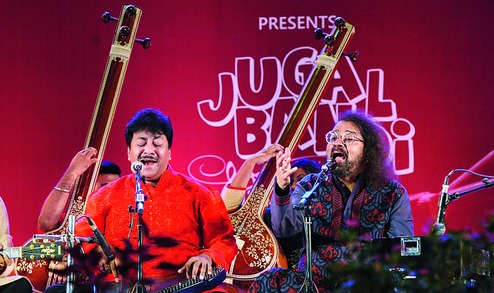

The presence of two distinguished musical personalities like Rashid Khan and Hariharan on the same stage at the Calcutta Club - an initiative by The Telegraph - added greatly to the city's pre-winter musical ambience. The programme was a wonderful union of two different styles, with a subtle differentiation of mood. It began with Rashid Khan's pure classical rendition. He rendered Raga Behaag with his spontaneous ease and went on with both the vilambit and drut kheyals. Initially he seemed more comfortable with the vistaars and taans in the lower and middle octaves, and the audience enjoyed his well-known mannerism of touching the keynotes after the completion of a full cycle. The compactness within a varied structure made the beauty of the raga more profound. The warmth of his voice, especially in the drut kheyal, set the mood for the programme.
This was followed by the solo presentation of Hariharan. Despite his fame for different kinds of playback singing in Bollywood as well as the numerous musical projects he has done with famous composers and artists, Hariharan has always been comfortable with the genre of geet and ghazals. The smoothness and lucidity of his voice, carrying all the intricacies of pure classical music, always made his renditions unique. This evening was not an exception. He presented some of the most popular ghazals, such as " Patta patta buta buta" and "Kash aisa koyi manzar hota", and sang with his own approach. His popular rendition, " Shahar dar shahar", with a shadow of the Raga Nat Bhairav, was arresting. Although he created a soulful mood with the starting of "Kesariya Balam", the continuation of this well-known Rajasthani folk song could have been better - the extra nuances could have been avoided.
In the second phase of the programme, both the artists graced the stage and chose the Raga Puriya Dhanashree to perform together. This was a spontaneous zone for Rashid; Hariharan, too, gave his best in creating a serious atmosphere of Indian classical music. From the beginning of the aochaar they tried to bring out the quintessence of this melodious evening raga, and both the artists gave enough space and time to each other to allow the performance to bloom. Rashid went into the depth of the raga to create a charm with sparkling vistaars and taans in the three octaves, while Hariharan made a sincere effort to coordinate with his originality, especially in the middle and upper octaves. Rashid was more melliflous, on account of his core expertise in this genre, but Hariharan, too, portrayed a different side of the raga. They presented the common compositions in vilambit and drut kheyal, and both the compositions were filled with an altogether different musical resonance.
After Puriya Dhanashree, the artists sang the famous thumri, "Yaad piya ki aye", and the melody soared because of the generosity of Rashid's powerful voice and Hariharan's innovation. The programme concluded with some popular songs by both artists for films, especially Hariharan. On the tabla, Shubhankar Banerjee showed his skill and comfort level with any musical genre, from pure classical to Bollywood fusion. His special care for both the artists made the performance captivating.