
|
|

 |
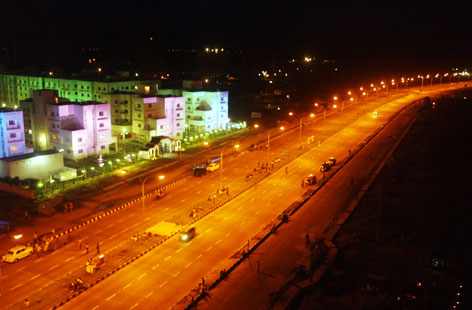
| Caught in a bind: A housing complex at New Town, Rajarhat (above); Hatkata Dilip after his arrest |
With his thatch of hair and a hint of a moustache, Tridib Mitra ? in a gaudy T-shirt and patched jeans ? looks every inch a teenager; the proverbial unkempt boy next door. Except that, in Baguihati?s Railpukur, on the eastern fringe of Calcutta, the 19-year-old inspires awe everywhere he goes.
Knots of men, chattering on the roadsides, cut their voices down to a whisper when he swaggers by. Shopkeepers leap to their feet, fold their hands and smile ingratiatingly when he strides in. Girls, if they happen to come in his way, race past him, looking down at their feet to avoid catching his eyes.
?Nobody wants to rub him the wrong way. Everybody is scared of him,? a local shopkeeper, who asks not to be named, says.
But to the police, Tridib is just a small-time thug not worth bothering about. He indulges in extortion and other petty crimes, they acknowledge. But his history sheet does not include murder or robbery charges, which explains why he doesn?t command much police attention.
Tridib is, clearly, not in the same league as Bulton or Hatkata Dilip, the arrested gangster who has jolted the CPM-led government by naming a powerful minister among his backers.
But make no mistake, local residents warn. It may not be long before he catches up with them. For, like most gangsters operating on the eastern and northern edges of the West Bengal capital, he looks mainly to real estate for sustenance. He knows land is where the money is.
As Calcutta stretches deep into its eastern and northern flanks, ponds disappear, apartments sprout and criminals mushroom. Rapid urbanisation, mostly haphazard and unregulated, breeds crime, with the likes of Tridib stalking many neighbourhoods in Dum Dum, Lake Town or Rajarhat, the areas witnessing a construction boom.
?There?s lots of easy money in real estate and that?s what attracts criminals to it,? Keya Dasgupta of the Centre for Studies in Social Sciences says.
Tridib, for example, started out as a petty extortionist after dropping out of school, raising protection money from shopkeepers and vegetable vendors at local markets. But before long, he had sniffed out the cache of lucre hidden in real estate.
As land prices soared along VIP Road connecting Calcutta to its lone airport, Tridib jumped at the opportunity. In a short time, he earned the reputation of being the most notorious dada or goon in Railpukur.
With the administration looking the other way, real estate dealers are on a construction binge, aided and abetted by criminals. ?Promoters are filling the ponds with impunity with the help of anti-socials, and building highrises,? says Tanmoy Mondal, the Rajarhat MLA. ?Very few dare raise their voices against this for fear of reprisal.?
As wetlands shrink fast across east and north Calcutta, hideous highrises scar the landscape. Between 1980 and 2000, the city is believed to have lost some 1,500 hectares of wetlands to real estate. In several instances, Dasgupta says bheris ? large ponds used to farm fish ? were converted first into paddy fields and then into housing estates in the eastern fringe areas. No wonder the current census shows a rapid leap in population on the city?s eastern, northern and southern flanks compared to the city proper.
The social and environmental impacts have already begun to tell on the city. ?Land sharks are taking over the crucial wetlands,? Subrata Sinha, retired deputy director general of Geological Survey of India, says. ?Both flooding and crime are on the rise,? he says.
With ponds rapidly becoming plots for housing estates, a new band of criminals has sprung up over the past decade or so across what?s now North 24 Parganas district. Among the most notorious are Dilip Banerjee or Hatkata Dilip (thus called because of an amputated hand) and Tapas Das or Bulton. Large swathes of Dum Dum, Lake Town, Patipukur, Rajarhat and even Barasat have been under their control, though turf war has often broken out among rival gangs.
There is a pattern to the crime. A district police officer says that a promoter has to pay Rs 50,000 to Rs 5 lakh to a hood ? depending on how dangerous he is ? before he can start work on an apartment building.
The rates go up substantially if a promoter wants to convert a pond or build a highrise building on a disputed plot.
?It?s easy money and its attraction is immense,? the officer says. ?If a promoter demurs, the hoods just raid his building sites and lob a few bombs at the construction workers as a ?warning?. It often works and the promoter pays up,? the officer adds.
With promoters and gangs working with impunity, land prices are shooting up ? and attracting more hoodlums. A real estate agent says the prices of land have ballooned in fringe areas.
Plots along VIP Road in Baguihati that fetched Rs 1 lakh per cottah 10 years ago now sell for Rs 10 lakh. Prices of apartments have gone up manifold. ?You would get a flat for Rs 350 to 500 per square foot a decade ago, but now it would cost you Rs 1,000 to 1,200 per square foot,? he says.
The police point out that the area is also strategically located, which enables criminals on the run to escape into neighbouring districts or even Bangladesh. Dilip, for instance, had slipped into Bangladesh when he was chased by the police in June. A ?most-wanted? gang leader, he was caught last week from the house of a footballer in faraway Hooghly district after a three-month-long chase.
As the Dilip case underlines, gangsters often have a nexus with politicians, spurred on by the fact that there are several CPM factions at work in the politically volatile North 24 Parganas, with disparate groups at each other throats.
The immense political clout that the gangsters enjoy was highlighted when Humayan Kabir, the police officer who had busted Dilip, was sent packing within days of the arrest that had been ordered by chief minister Buddhadeb Bhattacharjee himself.
The chief minister had been incensed when Dilip and his gang members gunned down three local residents, objecting to what they said was a vulgar dance by a girl at a musical programme in Salt Lake in June.
But even Bhattacharjee was not prepared for the drama that was to follow. There was little that the CPM leadership could say when the arrested gangster threatened to expose party leaders he had allegedly helped in the last Lok Sabha election in Dum Dum, a seat the party wrested from the BJP.
Although state sports and transport minister Subhas Chakraborty has denied the charge, a brother of Sasthi Duley, an East Bengal footballer arrested for harbouring Dilip, said publicly that the gangster was sheltered at the behest of the minister.
Police sources say that Dilip, wanted for several murder and extortion cases, had amassed a fortune over the past five years or so, with money extorted from a string of promoters. His reach and influence spread so much in the last couple of years that promoters in distant Garia, Sonarpur and Barasat also paid for ?protection?.
BJP leader Tapan Sikdar blames his Lok Sabha defeat in Dum Dum on the likes of Dilip, who, he claims, were ?engaged? by the CPM. ?The CPM had these criminals released before the election so that they could intimidate the voters and tilt the balance in their favour.?
Sikdar accuses the ruling party of unleashing a ?Promoter Raj? on people. ?The only industry thriving in Bengal is real estate and CPM leaders are trying to control it through criminals,? he says.
The CPM dismisses the charges as a ?pack of lies?. CPM state secretary Anil Biswas stands by Chakraborty, saying that the transport minister is ?innocent? and the charges levelled against him are ?motivated?. And Amitava Nandi, the party MP from Dum Dum, argues that the CPM?s victory in Dum Dum had little to do with criminal elements.
He points out that the party lost the seat in 1999 by almost 1.45 lakh votes. But this time, it won by nearly one lakh votes. ?Do you think we polled 2.45 lakh more votes compared to 1999 because of a few criminals?? Nandi asks. ?It?s absurd.?
The CPM MP, however, acknowledges that there is a ?promoter-criminal? nexus. ?We are trying hard to break it. Promoters have a role to play in urban development. But it cannot be like this.?
At times, even ruling party leaders have fallen prey to this nexus. In August, Dum Dum municipality chairman Sailen Das, a 73-year-old CPM leader, was shot dead in front of his house. The killing was linked to a dispute over the filling of a large pond in the area to build the hostel of a private engineering college.
Sharma, a prime accused in the murder case, died in a mysterious fall in the Dum Dum central jail within a few days of his arrest. ?He possibly knew too much,? Sikdar says.
Rajarhat municipality chairman Tapas Chatterjee acknowledges that ponds are being filled ?illegally? to build apartment buildings. ?We are making all efforts to stop this with the help of the fisheries department. I have asked all councillors not to indulge in this,? he says.
But Tridib and his gang carry on. For them, it?s business as usual. He is still a petty criminal, but don?t write him off.
Not just yet.