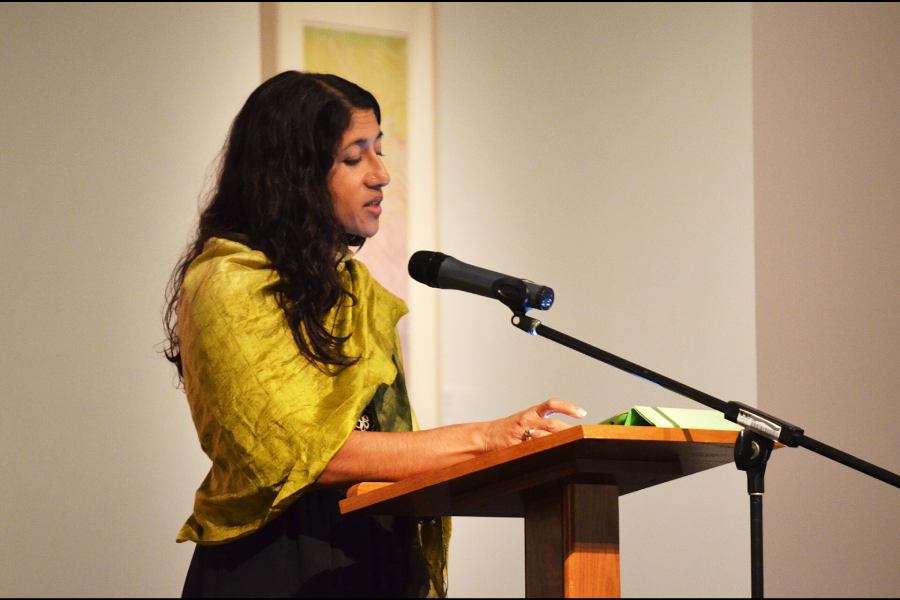

Yogendra Yadav was speaking at a school - Sishya - in Chennai recently. The audience comprised the young and the once-young.
The first group, outnumbering the second, clapped long, loud and, as phalanxes of students are wont to, rhythmically. Unlike adults who wait nervously for someone else to start an applause and then join in, the young start and keep clapping and watch who gives up first. The older group applauded less collectively but equally enthusiastically, for what the still-young, bearded academic-cum-politician was saying on "Rethinking Revolution" was unusual.
He started by invoking the great and widely-used slogan bequeathed to us by Bhagat Singh and Batukeshwar Dutt: Inquilab Zindabad! He had heard it, he said, only the other day in Pune, being shouted not ritualistically or routinely but as it used to be, in its heyday, with feeling: Inquilab, Inquilab, Inquilab- o-Inquilab, Zindabad, Zindabad, Zindabad-o- Zindabad. What a difference that 'o' can make!
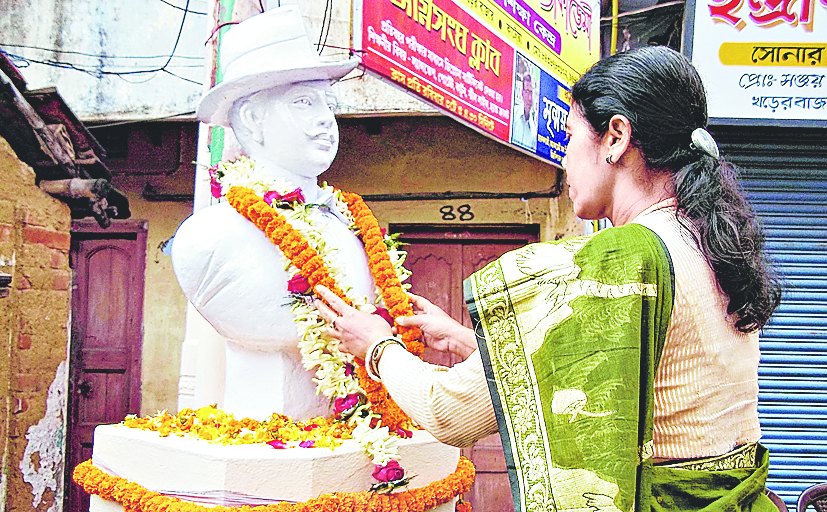
Inquilab Zindabad or Revolution Long Live was what those two young heroes shouted as they hurled two bombs into the Central Assembly in New Delhi, from the public gallery, on April 8, 1929 when the Assembly was in session. Beyond the assembly, the entire nation was roused from stupor. Bhagat Singh famously said he did what he did that day "to make the deaf hear". Revolution was, suddenly, in the air that was being breathed in by the lungs of the Empire. The duo was apprehended on the spot, Bhagat Singh being held captive until he was hanged two years later, at age 23, for his earlier shooting of the deputy superintendent of police of Lahore, John P. Saunders, to avenge the death of Lala Lajpat Rai.
It emerged that the extremely well-read and well-informed Bhagat Singh had been influenced by the example of a French anarchist, Auguste Vaillant (1861-1894), who had hurled a small bomb inside the French Chamber of Deputies in Paris on December 9, 1893 and was guillotined, at age 32, two months later. As he walked to the scaffold Vaillant too shouted a slogan which, translated from the French, reads: "Death to the Bourgeoisie! Long live Anarchy!"
To return to Yogendra Yadav's invoking of Inquilab Zindabad!
What, he asked, did that slogan invoke in him? Nostalgia, he said. Nostalgia for something wonderful that is now past, that belongs to history, is done and finished with. But inquilab, or revolution, Yadav went on, is not meant to be about things past. By its very meaning, it is about shaping the future. There is need for revolutionary change, not a violent or spasmodic change which is full of theatrical din, but a foundationally corrective change that slowly but surely alters the status quo.
Gandhi, Ambedkar, Periyar, Ram Manohar Lohia and Jayaprakash Narayan, he said, were revolutionaries in the latter, real sense.
The academic-activist's observations led me to ponder the world of revolutionary slogans we have known in India, grown up with. All of them today invoke, as the speaker said, nostalgia. Bhagat Singh's Inquilab Zindabad! is, with Netaji's Jai Hind! pre-eminent among them. It recalls those two immortals, their times. It resonates with their sacrifice, their aspirations. The south did not use Inquilab all that much though Jai Hind worked as well south of the Vindhyas as it did in the north.
Gandhi's 1942 slogans, Karo ya Maro and Quit India, were one-time slogans, and though very strong, subsided with the end of that particular campaign. In Tamil parts of the Madras Presidency, Dravidian politics threw up many memorable slogans, of which the one that is translated as Dravidanad for Dravidians is the most celebrated. That call is of course now antiquity.
Post-independence, Nehru's Hindustani slogan, Aaram Haram Hai (Sloth Is Sin), was an important message but, by that very fact, was destined an early death. His successor's Jai Jawan Jai Kisan had a good welcome but a short innings and his daughter's Garibi Hatao was quickly seen as realpolitik and did not permeate the national imagination, though it did bring poverty alleviation into policy planning.
Inquilab! and Jai Hind! have become formulaic.
So, are there any slogans at all that 'work' today? None, for the country as a whole. Not one. And that is not because we have had no word-spinners. It is because we have been short, woefully short, of ideas that 'hit' India as a whole. The closest we have got to a national slogan is in Jayaprakash Narayan's Sampoorna Kranti Ab Nara Hai, Bhavi Itihas Hamara Hai (Total Revolution is our slogan now, future history is our very own now). But while it summed up his goal and his faith, it was too long to be on everyone's lips and in any case it was beyond the south's linguistic scope.
Aruna Roy's pioneering right to information movement in Rajasthan has seen some gripping slogans voicing popular aspirations, of which Paisa Hamara, Hisab Hamara has struck a chord. Medha Patkar's Narmada Bachao Andolan and Anna Hazare's anti-corruption movement have done likewise. They are the closest any political movement has come to a mega-idea captured in a crisp slogan. But by and large, the Republic of India has been a graveyard rather than a nursery of ideational slogans of all- India salience.
But there is a sub-genre of slogans that can be overlooked. A large number of people, both underground and 'above', known in officialese as Left Wing Extremists or LWEs, have their slogans, intensely worded, crisp and, for their adherents, powerfully inspirational. And we should know too that the Hindu Right and the Islamic Right are bursting with slogans, mostly drawn from the Hindu pantheon, which excite, spur hatred of 'the other'. Vande Mataram is embraced by the Hindu Right not because of its legendary re-telling of India's physical environment but because the Hindu Right believes it irritates Muslim sentiment.
A marked rise has taken place in the use of high-voltage religiose slogans and salutations. Jai Sri Krishna with its 'return' in Radhe! Radhe! as a greeting-cum-slogan is being heard more, much more, now than it was in Gandhi's and Nehru's India. And, at the other 'end', Khuda Hafiz is being quite noticeably replaced by Allah Hafiz to say good-bye or 'go well'. Cosmopolitan Hindus, Sikhs, Parsis and Christians used Khuda Hafiz not so long ago almost as naturally as Urdu-speaking Muslims. But they cannot be expected to and will not say Allah Hafiz. Is this atavistic recoil being engineered and encouraged systematically, by rabid clerics on both sides? Is there a mutually self-protecting reversion taking place from secularism and social integration?
So we have two sets of 'working' slogans and sentiments in India, one of the extreme Left and the other of the extreme Right, competing for India's future. The vast centre-space occupied once by Inquilab Zinadabad! and only now in certain contexts by Jai Hind! It is bereft of a 'working' slogan, indeed, of a central 'working' idea. Little wonder it is being entered by sectarian bigotry pandering to the basest sentiments, prejudices and biases. All of which are status quoist at best, and provocatively revivalist at worst.
This brings me back to revolution, to Inquilab and to Bhagat Singh and to the seeming demise of revolutionary ardour among the generality of Indians. Is this something to be regretted or not ?
To my mind most definitely yes. I say this because the tyranny of money on the one hand and the tyranny of bigotry on the other are distorting the India that our Constitution speaks of and seeks to protect. I believe Jai Hind as a slogan and an idea needs to be retrieved, not for being belted out mindlessly at rallies but absorbed in our thinking as a password to our identity as a secular, socialist republic where democracy is not majoritarian, nor nationalism jingoistic.