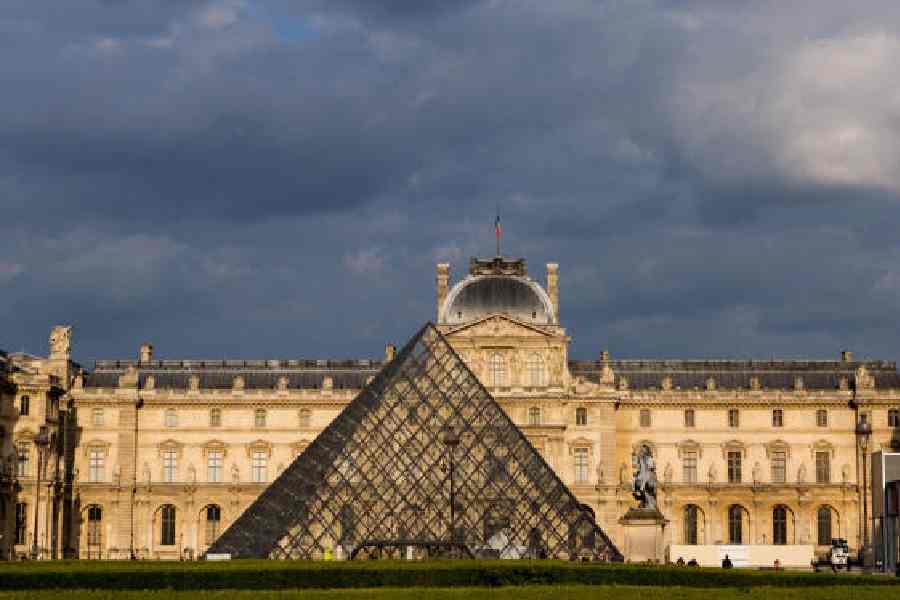
When four daring souls slid up a ladder into the Louvre Museum’s gilded Galerie d’Apollon in late-October and sped away on motor scooters with approximately $100 million worth of historic jewellery, they touched many chords. Many were thrilled by the vibes of a glitzy, sensationalised, blockbuster heist movie, some of which — like The Thomas Crown Affair where Pierce Brosnan plays a suave billionaire orchestrating a raid on the Met, no less, in New York — have popularised the idea that there is something classy about art crime. The French took it as an affront on their much-vaunted national culture and identity, and much soul-searching followed on the perceived loopholes in the security system in the world’s most-visited museum. Several arrests have been made and the search for the elusive jewels retains its intensity. However, by reviving the old question of the ethical tenability of the colonial plunder hiding in the underbelly of many ‘great’ museums of the modern West, the Louvre incident has transcended the boundaries of crime reporting and entered the fraught terrain of politics, ethics, and history.
I was amused by the discussion in France quickly zeroing in on a distinction between ‘art theft’ — projected as a crime against culture and collective heritage — and ‘commodity theft’. For this differentiation undergirds the foundational idea of museums like the Louvre or the British Museum — that art embodies universal human achievement, transcending national or ethnic boundaries. Ironically, though, many of the ‘universal’ museums of Europe are stocked with objects extracted from colonised lands through outright loot. The heist thus, expectedly, rekindles a debate about the longer history of how many of the Louvre’s — and indeed Europe’s — most prized artefacts arrived there in the first place, gearing the conversation toward
imperialism, colonial plunder, and the unfinished business of restitution.
The dissonance between universalist rhetoric and imperial practice is unmissable in the life of the modern museum. The Louvre itself, though a symbol of national pride and Enlightenment humanism, holds objects that are inseparable from France’s imperial ventures — from Napoleon’s campaigns in Egypt and Italy to later colonial occupations in Africa and Asia. The 18th and 19th centuries represented the great age of collecting, an era when museums expanded in tandem with empires, with the Rosetta Stone, the Elgin Marbles, the Benin Bronzes, and countless other artefacts becoming part of an imperial archive through which Europe narrated the story of human civilisation as its own. The display of colonial artefacts in metropolitan museums served to naturalise imperial dominance, framing colonised peoples as contributors to an ancient past now ‘rescued’ and interpreted by Europe. Needless to say, it is this context that makes the modern discourse of ‘art theft’ deeply ambivalent, and the moral outrage directed at it appears hollow and sanctimonious when compared to the indifference that long surrounded imperial plunder.
The recent debates on decolonisation have, therefore, rekindled an old question: who has the right to interpret and narrate the histories embodied in these objects? It’s not the first time that France finds itself at the centre of this debate. In 2017, the French President, Emmanuel Macron, declared in a speech in Ouagadougou, Burkina Faso, that “African heritage cannot remain a prisoner of European museums” — a counterintuitive move just a year after a strong French refusal to return any of the Benin Bronzes. In 2018, at Macron’s behest, a Senegalese economist and postcolonial theorist, Felwine Sarr, and a French art historian, Bénédicte Savoy, co-authored a report, The Restitution of African Cultural Heritage: Toward a New Relational Ethics, which recommended the permanent return of artefacts taken without consent during the colonial period. Some 30-odd restitutions did follow, including a few royal treasures to Benin in 2021. Yet, this gesture has continued to be derailed by persisting bureaucratic hesitations, legal obstacles, and curatorial anxieties, revealing how deeply entangled the question of art ownership remains with the legacies of Empire.
A remarkable figure who has successfully given this question global visibility in recent years is a Congolese-born, pan-Africanist, Mwazulu Diyabanza, who has staged dramatic protests in European museums. During 2020-21, Diyabanza entered institutions such as the Musée du Quai Branly in Paris and the erstwhile Afrika Museum in The Netherlands, attempting to pick up and take away African artefacts in full view of visitors. These acts, filmed by his accompanying associates and circulated online, were deliberately and carefully staged to resemble both political theatre and direct action. Diyabanza declared that he was not stealing but reclaiming what was stolen, framing his actions as a moral intervention against the enduring effects of colonial looting. In all cases, he was arrested within the museum building and released with relatively minor fines, but in one case he faced litigation and a brief incarceration, in none other than Paris, in a high-profile case where his lawyer said — memorably — that it was not his client but the history of European imperialism that was on trial. Diyabanza was again released with an admonition, but not before his protests had forced museums to reckon with an uncomfortable visibility of their silent complicity in narratives of conquest and domination.
The perpetrators of the recent Louvre heist — bereft of the moral high ground claimed by Diyabanza’s ceremonial and performative attempts at reclamation or restitution — stand on the wrong side of history, having been slapped with the more easily criminalisable charge of ‘commodity theft’. It also helps that they belong largely to the Parisian underclass — almost analogous to the sans-culottes of Revolutionary France — where the glamourised semantics of ‘art theft’ and ‘restitution’ don’t penetrate. However, it’s hard to miss the irony that the prime suspect is a native of Algeria from where, during French colonial rule from 1830 to 1962, the authorities expropriated religious endowments and seized manuscripts, artworks, and artefacts that populate French museums even today. To give just two examples, the sabres belonging to Emir Abdelkader, the emblematic, 19th-century leader of the Algerian resistance to the French conquest, lie confined inside the Château de l’Empéri in Salon-de-Provence, southern France, while many priceless Islamic manuscripts seized from his library are preserved in the Château de Chantilly. And the skulls of 24 Algerian freedom fighters decapitated in 1849 for resisting French colonial forces were taken to France as war trophies and stored in the Museum of Man in Paris till 2020 when they were repatriated to Algeria after a decade of intense lobbying by Algerian politicians and historians, and, finally, given a burial near Algiers.
But the past can hardly be buried, and I cite these examples to emphasise the point that the very idea of the museum as a neutral custodian of humanity’s treasures is complicated beyond measure. If the modern museum was born out of the Enlightenment and Empire, then its decolonisation demands more than token repatriations. It requires a drastic rethinking of how collections are narrated, how provenance is disclosed, and how partnerships with source communities are structured. The spectacular nine minutes of an October morning in Paris and its aftermath remind us again that museums are intensely contested spaces where histories of violence and possession converge. Much more than the semantic binary of ‘art theft’ and ‘commodity theft’, it messes up the fragile boundary between admiration and appropriation, conservation and control. As the accused face trial, it pays to remember that — viewed through the lens of Empire — the greatest art thefts in history were ‘legal’, sanctioned by conquest and celebrated as civilisational achievements.
Jayanta Sengupta is Director, Alipore Museum; jsengupt@gmail.com