|
|
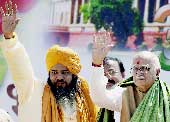
| In Sync: L.K. Advani (right) and Syed Zainul Abedin Ali Khan of the Khwaja Moinuddin Chishti shrine of Ajmer, at the start of the Bharat Uday Yatra in Kanyakumari (AFP) |

It was the most unexpected shade of saffron. As the Bharatiya Janata Party (BJP) rally at Kanyakumari for the start of L.K. Advani’s Bharat Uday Yatra drew to a close, in the shadow of the Vivekananda statue, party general secretary Mukhtar Abbas Naqvi brought to the stage a prize guest, the head priest of the Khwaja Moinuddin Chishti at Ajmer. The man wore a saffron safa (headgear) and a saffron choga, but it was saffron of an altogether different hue from the Sangh parivar’s wardrobe.
Diwan Syed Zainul Abedin Ali Khan, the 32nd successor to Khwaja Moinuddin, founder of the 9th-century Sufi shrine, is too elevated a prelate to lend his presence to political jamborees, least of all to the vote-catching drive of a party known for its strong views about Muslims. The shrine enjoys a stature unequalled in the subcontinent, paying a visit to it being de rigeur for every visiting dignitary from Muslim nations. Its rituals are formidable.
While all are welcome to the shrine, the Diwan would receive at the central gate only the heads of nations, heads of governments and the chief justices of apex courts. The Diwan broke the rule only once, in 1979, when he received Indira Gandhi, who was then out of power. But, in deference to form, he set up an arch a few feet away from the central gate to receive her, and told her, in the presence of a gathering, that he’d welcome her through the main gate “very soon”. Indira indeed regained prime ministership after a few months.
Such being the Ajmer priest’s reported political inclination, the audience of the faithful at Kanyakumari was spellbound as it saw the tall and bearded cleric putting a shawl on Advani’s shoulders. The reclusive Diwan did not speak. But his media secretary Deepak Sharma later explained, “The Diwan Ali Khan sahib wants to narrow the large gap between the country’s largest party and the largest minority community. It may otherwise lead to the community being totally isolated.”
In these pre-election weeks, the BJP is bending over backwards to narrow the gap on its own. In the rabbit warrens of the BJP headquarters on the capital’s Ashoka Road, the small cubicle of the Minorities Morcha, with its door usually padlocked, is now teeming with inmates wearing fezzes. They’re armed with pictures of the party’s Muslim leaders at Kanyakumari — Naqvi, the lone BJP member of the last Lok Sabha, Syed Shahnawaz Khan, and recent catch Arif Mohammad Khan.
Also on call are copies of Prime Minister Atal Bihari Vajpayee’s speech at the Morcha’s rally at the Talkatora Stadium last month, in which he urged the Muslims to accept the BJP, and scores of computer print-outs that try to show that the NDA government had been more equitable to the Muslims than the previous Congress regimes in education and health care. “If only we as a community shed our inhibition about the BJP,” says Tanvir Haidar Usmani, national vice-president of the Morcha, “we’ll get a new deal”. And, everybody in the room praises Vajpayee in a choked voice calling him “another Nehru”.
But the real architect of the policy of engaging Muslims is Advani, the man generally regarded as Nehru’s antithesis in the BJP pantheon. Advani’s nimble touch is evident in many of the party’s recent breakthroughs on the Muslim front — be it getting the Ajmer Diwan on stage at Kanyakumari, getting Arif Mohammad Khan into the party, or drawing Rajya Sabha deputy chairperson Najma Heptullah almost into a saffron embrace.
The behind-the-scene appeal of the deputy Prime Minister have caused some stirrings among Muslim intellectuals and within some of its sects. The faculty of the Aligarh Muslim University has for the first time got a section, however small, lending a ear to the BJP. Javed Habib of the Babri Masjid Action Committee, an academic of the Jamia Millia Islamia University, may soon join the party. And, thanks to Advani’s initiatives, the BJP’s new sympathisers include Kalwe Sadiq, prominent Shia leader of Lucknow. Sadiq is the man who led the movement against Uttar Pradesh chief minister Mulayam Singh Yadav’s decision to close down schools on Friday for prayer.
And Advani’s emissaries are in constant touch with the religious fundamentalists belonging to the two most powerful seminaries at Deoband and Bareilly, notable among his pointsmen being Kari Mazhari, an Islamic scholar and chairman of the Minorities Finance Corporation.
It seems that the party’s lauh purush woke up to its growing disconnect with the Muslims after the Gujarat riots of 2002. On larger issues like Kashmir, he brought in his trusted bureaucrat ..Vora as interlocutor with the Hurriyat, a move which brought immediate dividends.
However, much more needed to be done in the party itself as its gates seemed shut to an entire community. Of the party’s 182 Lok Sabha members, only Shahnawaz is Muslim. But the party had fielded only four Muslim candidates in 1999. In the entire country, there is a single BJP Muslim member in the state assemblies, Yunus Khan, now a member of the Rajasthan council of ministers. At the party headquarters as well as the state units, the Minorities Morchas were a rubber stamp and the Muslim office-bearers of the party units were no more than showpieces.
Advani had to tread cautiously. The Morcha was begun by Arif Baig, a Lohia socialist from Bhopal who’d joined the Bharatiya Jan Sangh in 1973 and had defeated the late S.D. Sharma in the 1977 election to become a minister in the Morarji Desai cabinet at the Centre. Baig left the BJP in 1996 after complaining to Advani bitterly about not a single ticket being given to Muslims in that year’s election. He joined the Congress and was rotting. However, Uma Bharti, after becoming the chief minister of Madhya Pradesh, and reportedly on being prodded by Advani, met Baig at his Bhopal residence and dispatched him to Delhi for an audience with Advani. Baig returned to the party the same week.
While the party may nominate him from the Chandni Chowk constituency in Delhi — incumbent member Vijay Goel being shifted to Sadar — his main assignment now is to help the leaders cobble together a new strategy for Muslims. Baig calls it a strategy for “partnership without appeasement”. Both Baig and Naqvi expect the number of the party’s Muslim candidates to go up this time to 10 or 12, “with at least three or four winnable candidates,” as Naqvi hastens to add.
Everyone in the Sangh parivar knows it is much simpler to put up a few more Muslim candidates or resort to some similar tokenism than to win back the community’s trust. However smart Advani’s overtures may be, they have merely scratched the surface of the Muslim society in north India.
Leaders of the Urdu Press, like Nai Duniya and Quom-e-Awaz, are vituperative about the BJP and even a new entrant like the Urdu edition of Rashtriya Sahara is keeping up the anti-saffron tirade.
The more articulate among the Muslim intelligentsia, like Syed Shahabuddin, a former member of the Indian Foreign Service and member of the All India Muslim Personal Law Board, have hardened their position since the Gujarat riots. “Why doesn’t Mr Vajpayee make a credible gesture before the election by dismissing the government of Narendra Modi?” he asks wryly.
In UP, the ever-boiling cauldron of communal hostilities, there is no sign as yet of lessening of hostilities, not to speak of Muslims actually deciding to vote for the BJP. As a member of the All India Muslim Personal Law Board says, on condition of anonymity, “Our community is not very clear if the BJP will not resort to violence if its India Shining campaign fails to take off.”
While the Muslim mood is non-committal at best, some of BJP’s leading strategists are at pains to explain the great distance to which the party has already shifted from its earlier stand on minorities. “In this election, our issues are purely economic and political. Religion doesn’t figure at all,” says Pramod Mahajan, party general secretary and chief campaigner in UP. The fine print is, the party hadn’t kicked off the religious platform once since its earlier avatar Jan Sangh fought the first election in 1952 (the post-Emergency election in 1977 and the next one in 1979 were exceptions as the party had then merged in the Janata Party).
Even Advani began his yatra with an admission that Gujarat had been a blot on his party. On the Ram Mandir issue, otherwise an everlasting electoral milch cow, the NDA government is pushing for a negotiated settlement, not confrontation. What is startling is the tacit support the party is getting from its cradle, the Rashtriya Swayamsevak Sangh (RSS), in piping down on communal issues. K.S. Sudarshan, the RSS chief, has remained silent for some time now on issues on which he’d earlier have been on a short fuse. Like talks with Pakistan, the cricket diplomacy, initiatives with the Hurriyat and the freeze on the temple question. On the other hand, a new generation of RSS men is moving into the BJP, and if these people still carry the ideological baggage of Golwalkar and Hedgewar, it’s weight is at least kept to the minimum.
Seshadri Chari, whom the BJP has borrowed from RSS, is in touch with Islamic authors. “The RSS has now taken it upon itself to explore the Muslim psyche,” he says. RSS is also open to the party’s idea of admitting ‘secular Muslims’ in its fold — like Arif Mohammad, who’d revolted against Rajiv Gandhi and quit his cabinet on the Shah Bano case, and Najma Heptullah, whose admiration for Vajpayee distanced her from Congress president Sonia Gandhi. Nor will RSS object if Arif Mohammad is given a safe seat in Gujarat and Heptullah is brought into the Rajya Sabha from a seat still kept vacant as President’s nominee.
There is of course a discordant voice from the Vishwa Hindu Parishad leader Praveen Togadia who lambasted Advani for calling the Gujarat riot a blot (it’s cultural nationalism, according to him), but everyone knows the Sangh parivar doesn’t risk speaking in one voice. The mood today is decidedly to move away from religious strife.
While it is hardly likely to result in Muslim votes pouring into BJP’s ballot boxes, it is the Muslim mindset that may be undergoing a slow but perceptible change. Journalist and Rajya Sabha member Chandan Mitra says that the Muslims feel “an aggressive championing of their cause has not helped them and has even worsened their bargaining position”. In the BJP, many hope that Muslims may not be averse to a leader like Mulayam Singh Yadav cutting a tacit deal with their party. So, even if the Muslim is not giving the BJP a warm hug today, even a formal nod is welcome. Let the hug be reserved for those who may hold the lotus afloat in the next Lok Sabha.