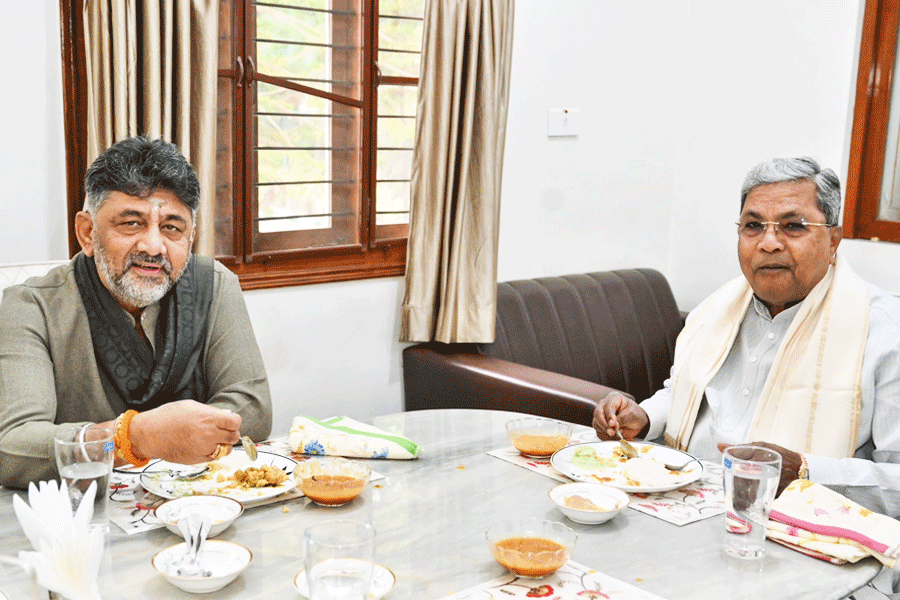
On Tuesday, the chief minister of Karnataka, Siddaramaiah, stated that he and D.K. Shivakumar, his deputy who appears to have his eyes set firmly on the chief ministerial chair, apparently run the government like “brothers”. Cynics would scoff at this assertion. It has taken two breakfast meetings between the two rivals, one each at the chief minister’s and the deputy chief minister’s place, to bury — for the time being — the hatchet between the proverbial brothers up in arms after Mr Shivakumar made some noise, yet again, about his claim on the kursi. Whether brotherhood will prevail remains to be seen but the question of interest concerns Mr Shivakumar’s timing to up the ante in his favour. The whispers in the Congress are that the high command — Rahul Gandhi — has Mr Siddaramaiah’s back; the latter’s backward class politics and relatively clean public image weigh in his favour with Mr Gandhi. The chief minister also commands the support of a higher number of legislators. Yet, Mr Shivakumar threw his hat in the ring. Is this because the Congress’s chances, or so says the grapevine, of returning to power in Karnataka appear to be slim? Mr Shivakumar may have thus wanted the coveted chair in case it slips away.
All this, of course, belongs to the realm of speculation. But what cannot be denied is that this latest round of sibling rivalry between Mr Siddaramaiah and Mr Shivakumar reveals the Congress’s Achilles heel: inner feuding which, in turn, is fed by personal ambition. What is surprising is that these fault lines that are the result of competitiveness continue to deepen even as the Congress’s electoral footprint diminishes across the country. There can be no doubt about the fact that such crass displays of discord among Congress leaders — Rajasthan had witnessed such drama too — make for poor optics at a time when public opinion is shaped by perception. It is also suggestive of the fact that in the Congress, the moorings of leaders to ideology or, indeed, even to the party’s welfare have slackened considerably on account of discord within its leadership. What has compounded the problem is the weakness of the high command whose hold on state leaders remains vulnerable as the Congress diminishes as a political force. The Congress’s revival — survival — depends on extinguishing its home fires.