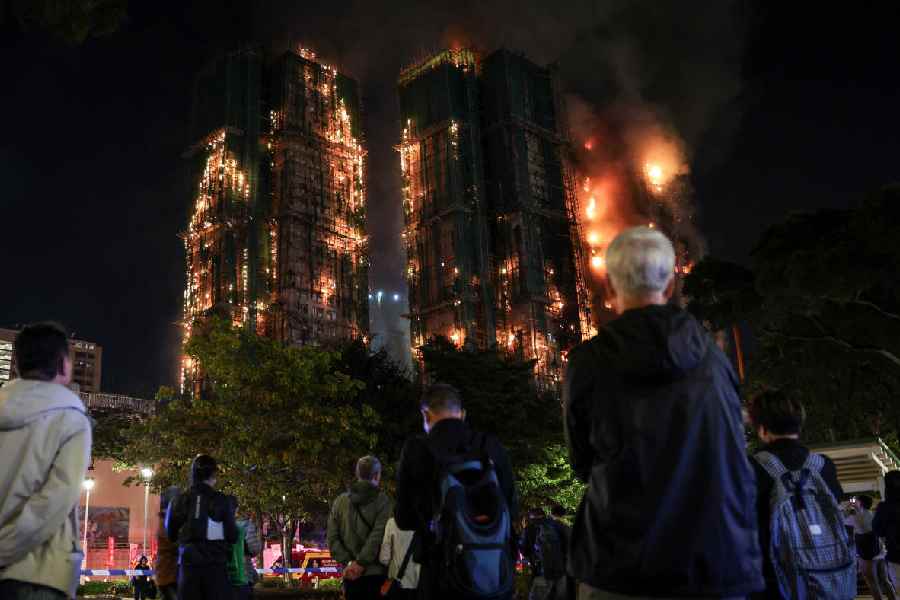
The Hong Kong fire has killed the Hong Kong dream. Hong Kong was what many Chinese wished their metropolises would be: international centres that are both modern and open; where rules are followed; where one can be sure one is not getting fake goods and adulterated milk; where opinions can be freely voiced.
The fire has shattered that image. The Chinese internet is full of analyses on the reasons for the fire, leading to dire utterances that Hong Kong is now old and in decline, no longer “the benchmark for Asia in our hearts”, as one writer put it.
There is disappointment that Hong Kong lagged behind the mainland in terms of safety standards in construction. China banned bamboo scaffolding and nylon netting almost four years ago, whereas its use continued in Hong Kong despite bamboo scaffolding being the cause of a fire just last month and of 22 fatal mishaps from 2018 to 2024. The only reason for this is the clout enjoyed by the bamboo manufacturers association and the bamboo workers union, say the Chinese.
But the fire has also sparked admiration for the “normal public space” that exists in Hong Kong. The fire was seen online as it raged; across the mainland, the Chinese saw the terrible scenes but also the prompt arrests of officials and heard the discussions by Hong Kong’s residents. Some compared these scenes with how disasters back home had been covered — some of these comparisons, too, have been taken down. A fire in a Shanghai high rise in 2010 that claimed at least 42 lives had been blamed on a welder’s mistake. He was the first to be arrested, followed by a crackdown on unlicensed welders. Later, it emerged that every level of renovation work had been sub-contracted, making it difficult to fix responsibility. But such “malicious” critiques were censored.
In contrast, in Hong Kong, although survivors mentioned having seen construction workers smoking, the first to be arrested were three top officials of the firm renovating the complex. The Chinese also noticed the way Hong Kong’s citizens have been speculating about the causes and how the media there reported that way back in September 2024, residents complained about flammable materials being used but were ignored by officials.
On the mainland, such discussion is shut out both in the media and on the internet, in the name of “rescue and relief first”. A day after the Hong Kong fire broke out, Kunming witnessed a train disaster killing 11 persons; it was linked to an alleged failure in high-speed railway line testing. But the focus of the media was on the “safety and stability of trains”; even public mourning on the internet was not allowed.
The fire has alarmed the Chinese. The Hong Kong complex that caught fire was built in the 1980s. These were the first high rises to be built as part of public housing. Space is notoriously short in Hong Kong, forcing the government to cram as many people as possible in limited space. Those who bought these apartments are now old; their age was one cause for the high death toll.
In China there is no shortage of space. Yet, a high rise boom took place after 2000. What will the Chinese who bought homes in these glamourous skyscrapers do when the buildings age? Will they be able to afford repairs? In Hong Kong, the fire has sparked a discussion on whether high rises are desirable; in China, such questions would be taken down, say netizens. But the “mainlandization” of Hong Kong has already started: a youth who demanded rehabilitation of the victims and an independent inquiry has been arrested.