
FARTHEST FIELD: AN INDIAN STORY OF THE SECOND WORLD WAR By Raghu Karnad, William Collins, £18.99
Who were they, these three solemn young men in silver frames on the walls of his grandmother's house in Madras? As a boy, Raghu Karnad never thought to ask, and his grandmother Nurgesh, always known as Nugs, never thought to talk about her husband Ganny, her mischievous brother Bobby, or her brother-in-law, the daredevil Manek. Yet by anybody's standards, they were war heroes. Ganny died of bronchitis treating refugees on the North-West Frontier, Bobby died in the horrific aftermath of the Battle of Kohima, Manek died in Burma too, flying rescue missions low over the jungle. His younger brother, also a pilot, died there too a year later.
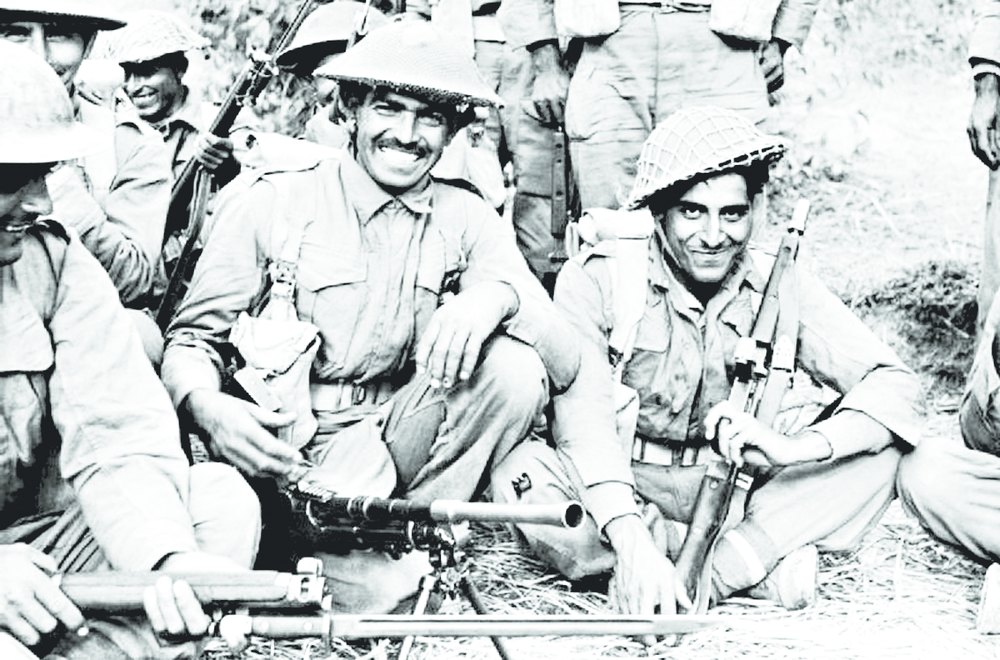
Anywhere else, their exploits and their tragic end would have been sung in the ears of their children and grandchildren. The trouble was, they were fighting in the wrong war. The Viceroy of India, Lord Linlithgow, had raised the largest volunteer army to take part in the Second World War and Indian troops fought with signal bravery everywhere from Tobruk to Imphal (colonial troops were between them awarded 39 VCs). By 1945, Sir Claude Auchinleck, the much loved C-in-C of the Indian Army, was writing to the Viceroy that some high commanders had "actually asked that British units should be replaced by Indian". The reconquest of Burma, in the most hellish jungle warfare ever, was the Japanese land army's most conclusive defeat. It was the achievement above all of the Indian Army - the largest component of what became famously known (or not known) as the forgotten army in a forgotten war.
British minds remained on Dunkirk, El Alamein and D-Day. But for the Indians the war came increasingly to be seen as a war among imperial powers and irrelevant and if not actually injurious to India's future. The worst confirmation of this came in the terrible famine in Bengal, which was partly caused by the deliberate burning of the rice crop to deny supplies to the advancing Japanese. After India became independent in 1947, it was rather the tiny Indian National Army which had fought alongside the Japanese against the British who were remembered as heroes. Nugs's old schoolfriend from Queen Mary's College, Lakshmi Swaminathan, was marooned in Singapore when war broke out and she joined the INA to become a legend commanding the Rani Lakshmibai Women's Brigade, called after her namesake who had defended her city of Jhansi against the British in the Great Mutiny of 1857.
In a dashing mixture of fact and imagination, Karnad recreates the whole extraordinary saga: the easygoing world of the Parsee merchants on the Malabar coast, disturbed only by the scandal and then the ostracism of Nugs when she married Ganny who was a Tamil Hindu, then the reluctant call-up and the engulfing of India - never itself a battlefield but crowded with refugees from all over the world - and the final terrible days at Kohima which saved India and swung the whole war in the East. Farthest Field tells a grim and epic tale, but it is also full of charm and playfulness, for Raghu Karnad is as alive to the incongruities of war as to its horrors. He gives equal value too to the respect and even affection as well as to the resentments and inequalities between the British and the Indians in what everyone could see were the last days of the Raj, as soon as the Japanese had sunk the Prince of Wales and the Repulse and effortlessly captured Singapore. The book is an audacious achievement for a first book, and one more welcome sign that the years of oblivion are coming to an end.
The Indians are of course not alone in neglecting to remember those parts of their history which do not fit the national myth. For decades after independence, the new Irish nation treated the hundreds of thousands of Irishmen who had fought for the King-Emperor in two world wars with an equally embarrassed neglect. When the Irish Ambassador laid a wreath at the Cenotaph on Remembrance Day last November, it was for the first time in nearly 70 years. As for the British, it was not until 2002 that the Queen inaugurated those inconspicuous memorial gates at the top of Constitution Hill to honour the soldiers from every part of the old Indian Empire who twice came freely to Britain's aid. Ancient history takes a long time to die - and even longer to bring back to life.